Fish Preparation: Non-Fried Choices, Cooking, and Food Safety
Every major fish study asks a question most fish advice ignores: how was it cooked? The cardiovascular associations were documented for nonfried seafood — baked, broiled, steamed, grilled — while fried fish repeatedly shows up null or on the wrong side of the data. This page covers why the preparation split exists, what common cooking methods actually change, and the FDA's safe-handling rules for buying, storing, thawing, and cooking fish at home.
What the evidence supports
- The favorable cardiovascular associations were observed for nonfried seafood; fried fish was not associated with lower sudden-cardiac-death risk in the cohorts the AHA advisory reviewed.
- In the Cardiovascular Health Study, fried fish intake of 1+ serving a week associated with higher heart-failure risk (RR 1.35) while baked/broiled fish ran the other direction.
- The FDA's safe-handling rules — 145°F internal temperature, 40°F storage within 2 days, refrigerated thawing — are established food-safety practice.
What remains uncertain
- Cohorts cannot fully separate fried fish from what it travels with — breading, refined-carb sides, the restaurant meal as a whole — or from who eats it.
- Whether home-pan-fried fish in olive oil behaves like commercially deep-fried fish is genuinely unknown; no trial compares them.
- Nutrient losses from specific home cooking methods vary by study and cut; rough directions are clear, magnitudes are not.
Evidence last reviewed: October 6, 2026. Conclusions may change as new research is published.
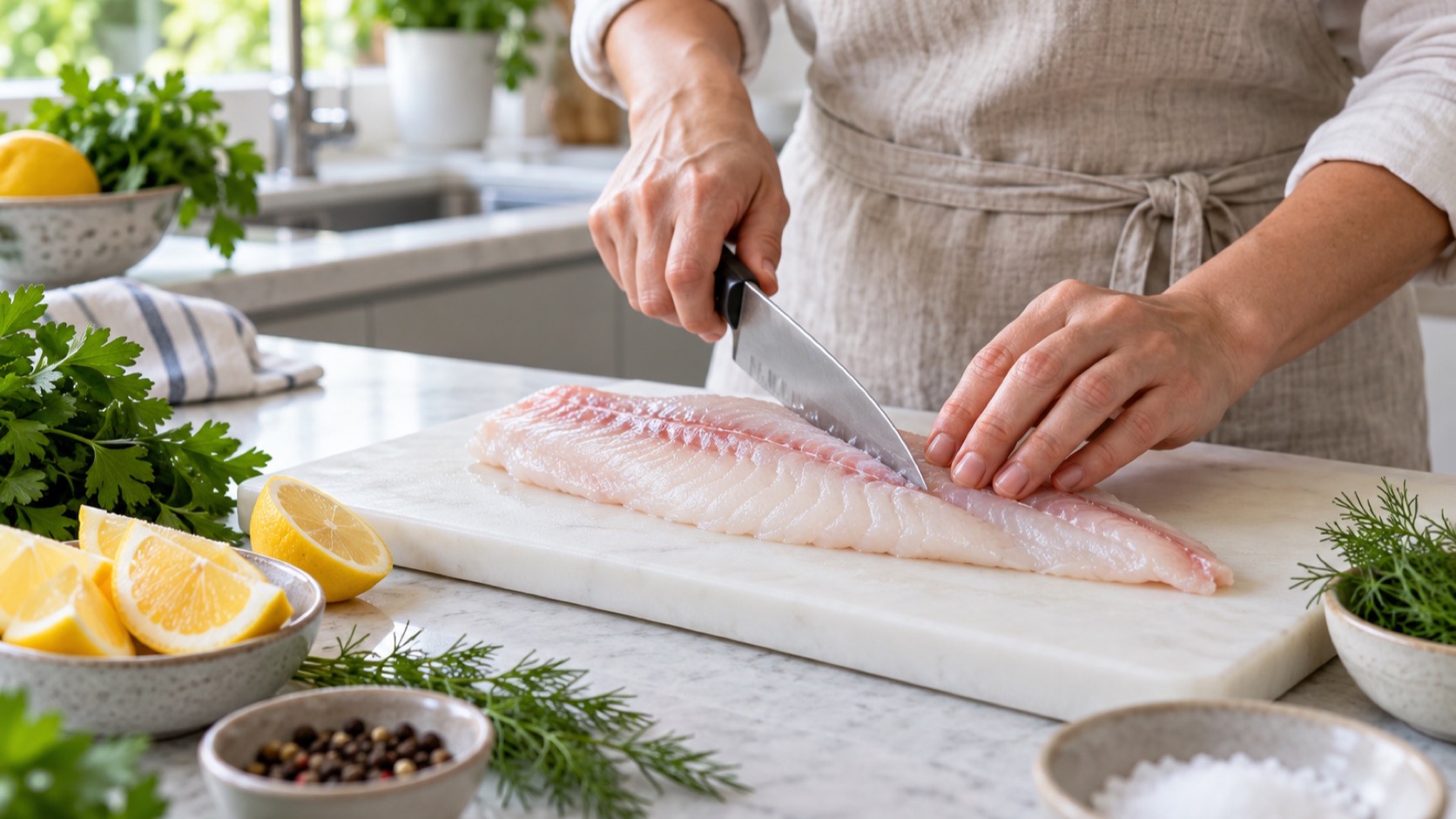
Why the Frying Split Keeps Showing Up
When researchers split fish intake by preparation, the same pattern recurs across cohorts: baked or broiled fish associates with lower risk, fried fish with none — or with higher risk. In the Cardiovascular Health Study of older adults, tuna or other broiled and baked fish associated with lower ischemic stroke risk, while fried fish or fish sandwiches associated with higher risk. In the same cohort and in the Women's Health Initiative, fried fish 1+ times a week associated with roughly 35–48% higher heart-failure risk across intake categories.
The AHA advisory offered a mechanistic reading, with appropriate caution: the fried fish in these US cohorts was typically commercially breaded and deep-fried — historically in partially hydrogenated oils carrying trans fat — and was usually lean white fish, low in omega-3s to begin with. Whether type of fish or method of preparation accounted for the difference, the studies could not determine. Either way, "fried fish" in the data is not just fish plus heat; it is fish plus a delivery system.
Cooking Methods, Compared
For the home cook, the practical differences between methods are smaller than the fried-versus-nonfried research gap suggests. Roughly:
| Method | What changes | Notes | Verdict |
|---|---|---|---|
| 🔥 Baking / broiling | Minimal added fat; the form most studied in cohorts | Oven at 400°F+ until 145°F internal; forgiving and low-attention | Default |
| ♨️ Steaming / poaching | No added fat; gentle; some water-soluble nutrients lost to liquid | Use the poaching liquid in the dish and nothing is wasted | Default |
| 🍢 Grilling | No added fat beyond what you brush on | Fish cooks fast; high heat needs attention to avoid drying | Default |
| 🍳 Pan-searing | Small amount of added fat; keeps omega-3s largely intact | Light browning in a modest amount of oil is not the cohort exposure | Fine at home |
| 🍟 Commercial deep-frying | Breading, high-calorie density, frying-oil quality varies; typically lean fish | This is the preparation the unfavorable associations track | Rarely |
The honest caveat from the evidence box applies to the table too: no trial randomized people to pan-seared versus deep-fried fish. The verdicts rank preparations by how well they resemble what the favorable cohorts actually ate — and by what they add to, or subtract from, the plate.
Practical Home Cooking Rules
- 🌡️ 145°F is the target: the FDA says most seafood is done at an internal temperature of 145°F. No thermometer? The fallback signs: flesh turns clear and separates easily with a fork; shrimp and scallops turn firm and opaque; clam and mussel shells open (discard any that don't).
- 🍋 Fat is a flavor tool, not a hazard: a teaspoon of olive oil, herbs, and lemon is fully consistent with the studied preparations. The problem preparation is breading plus deep oil, not fat per se.
- 🐟 Lean fish need protection, oily fish don't: cod and tilapia dry out fast — poach, steam, or bake with moisture. Salmon, mackerel, and sardines tolerate high heat and are hard to ruin.
- 🥫 Canned is a prepared meal: sardines and canned salmon need nothing but draining (or not) and a plate — the nutrients page covers what the can preserves.
- 🧊 Frozen fillets are the weekday realistic option: cook from thawed or per package directions; freezing is nutritionally cheap and removes the freshness gamble.
Buying and Storing: The FDA Rules
The FDA's consumer guidance on selecting and serving seafood is specific enough to shop with. At the counter: fish should smell fresh and mild — not fishy, sour, or ammonia-like — with clear, shiny eyes on whole fish, firm flesh that springs back when pressed, and no discoloration or drying around the edges of fillets. Color alone is not an indicator of freshness. For frozen packages: pass on anything open, torn, crushed, frost-crystallized, or bendable — frost suggests thaw-and-refreeze cycles.
- 🧊 The 2-day rule: refrigerate at 40°F or below within 2 days of buying if you'll use it that fast; otherwise wrap tightly and freeze.
- 💧 Thaw overnight in the refrigerator — or, for speed, sealed bag in cold water, or microwave defrost only if cooking immediately after.
- 🧼 Separate raw from ready-to-eat: 20-second handwash after handling raw fish; wash boards and utensils between raw and cooked prep.
- ⏱️ The 2-hour serving rule: cooked seafood out no more than 2 hours — 1 hour above 90°F.
- 👃 When in doubt, throw it out: sour, rancid, or ammonia odors in raw or cooked seafood mean do not eat it — and they get stronger, not weaker, with cooking.
🍣 What about raw fish?
The FDA is direct: cooking seafood thoroughly is the way to minimize foodborne-illness risk, and if you choose raw fish anyway, one rule of thumb is to eat fish that was previously frozen, since freezing kills parasites — but not all harmful germs. The at-risk groups are named specifically: pregnant women, young children, older adults, and immunocompromised people should avoid raw or undercooked fish and shellfish (including sashimi-style sushi and ceviche) and refrigerated smoked seafood unless it is cooked into a dish. The life-stages page covers the pregnancy side.
Questions, Answered Briefly
- 🍳 Is pan-frying at home "fried fish"? Probably not what the cohorts measured — they largely tracked commercially breaded, deep-fried fish. A modestly oiled pan is much closer to the studied preparations than to a fryer.
- 🔥 Does cooking destroy omega-3s? Some loss occurs with high heat and long times, but ordinary baking, broiling, and poaching retain most of the EPA and DHA. Extreme charring is the case for more caution.
- 🐟 Fish sticks? Breaded, frozen, usually pollock — low mercury, decent protein, but the preparation is the commercial-fried pattern the data disfavor. Occasional is fine; they are not the studied "fish intake."
- 🦠 Ceviche — cooked or raw? Raw by food-safety standards: citrus denatures proteins but does not heat them. At-risk groups should skip it.
- 🧀 What about smoked fish? Refrigerated smoked seafood is a "keep refrigerated, cook before eating" product in FDA guidance — fine as an ingredient in a cooked dish, but listed among the foods at-risk groups should avoid straight from the package. Shelf-stable canned smoked fish is different and acceptable.
- 🌡️ Do I really need a food thermometer? It is the surest check — 145°F internal — but the fork test (flesh opaque and flaking easily) is the FDA's own fallback. For thick cuts and whole fish, a thermometer removes the guesswork.
- 🍱 Meal-prep angle? Cooked fish keeps 3–4 days refrigerated per FDA serving-time guidance; portion-and-freeze works well. If a seafood routine needs the two weekly servings to be realistic, canned sardines and frozen fillets do most of the work.
The Bottom Line
- Preparation is part of the exposure — the favorable associations belong to nonfried seafood; commercial deep-fried fish tracked null-to-worse in cohorts.
- Home methods are mostly equivalent — bake, broil, steam, grill, or lightly pan-sear to 145°F internal; all resemble the studied form.
- The FDA rules are short and sufficient — fresh-smelling fish, 40°F within 2 days, overnight fridge thaw, separate raw from ready-to-eat, discard on any ammonia odor.
- Raw fish is a calculated risk, not for everyone — previously frozen helps with parasites; the named at-risk groups should skip raw entirely.
Related Topics
- U.S. FDA, "Selecting and Serving Fresh and Frozen Seafood Safely" — fda.gov
- Rimm EB et al., "Seafood Long-Chain n-3 Polyunsaturated Fatty Acids and Cardiovascular Disease: A Science Advisory From the American Heart Association," Circulation (2018) — ahajournals.org
- Mozaffarian D et al., "Fish intake, omega-3 fatty acids, and risk of heart failure in older adults," Circulation (2005, Cardiovascular Health Study)
- Belin RM et al., "Fish intake and risk of incident heart failure in women," Circulation: Heart Failure (2011, Women's Health Initiative)
- U.S. FDA / EPA, "Advice About Eating Fish" (revised October 2021) — fda.gov