Fish Across Life Stages: Pregnancy, Breastfeeding, and Children
No seafood question carries more anxiety than the pregnancy one — and no question has a clearer official answer. In advice revised in October 2021, the FDA and EPA told people who are or could become pregnant, breastfeeding parents, and caregivers of young children to eat more fish, not less: 2 to 3 weekly servings from a "Best Choices" list, while avoiding seven high-mercury species. This page walks through that guidance as written, explains the nutrient-versus-contaminant logic behind it, and translates the serving sizes into something you can actually put on a plate.
What the evidence supports
- Fish intake during pregnancy is officially recommended: the FDA/EPA advice cites moderate scientific evidence that fish supports a baby's cognitive development.
- People who are pregnant or breastfeeding are advised to eat 2–3 weekly 4-oz servings from lower-mercury "Best Choices" species — or 1 serving from the "Good Choices" list.
- Children are advised to eat 2 weekly servings from "Best Choices," with serving size scaling by age — about 1 oz at ages 1–3 up to 4 oz at age 11.
What remains uncertain
- The cognitive-development evidence is rated "moderate," not strong — it comes largely from observational cohorts where fish eaters differ in many other ways.
- Exactly how much DHA intake optimizes infant outcomes remains an open research question; the guidance sets a floor, not a ceiling of benefit.
- Local contaminant profiles vary, and national advice cannot cover every waterbody — locally caught fish needs a local advisory check.
Evidence last reviewed: October 6, 2026. Conclusions may change as new research is published.
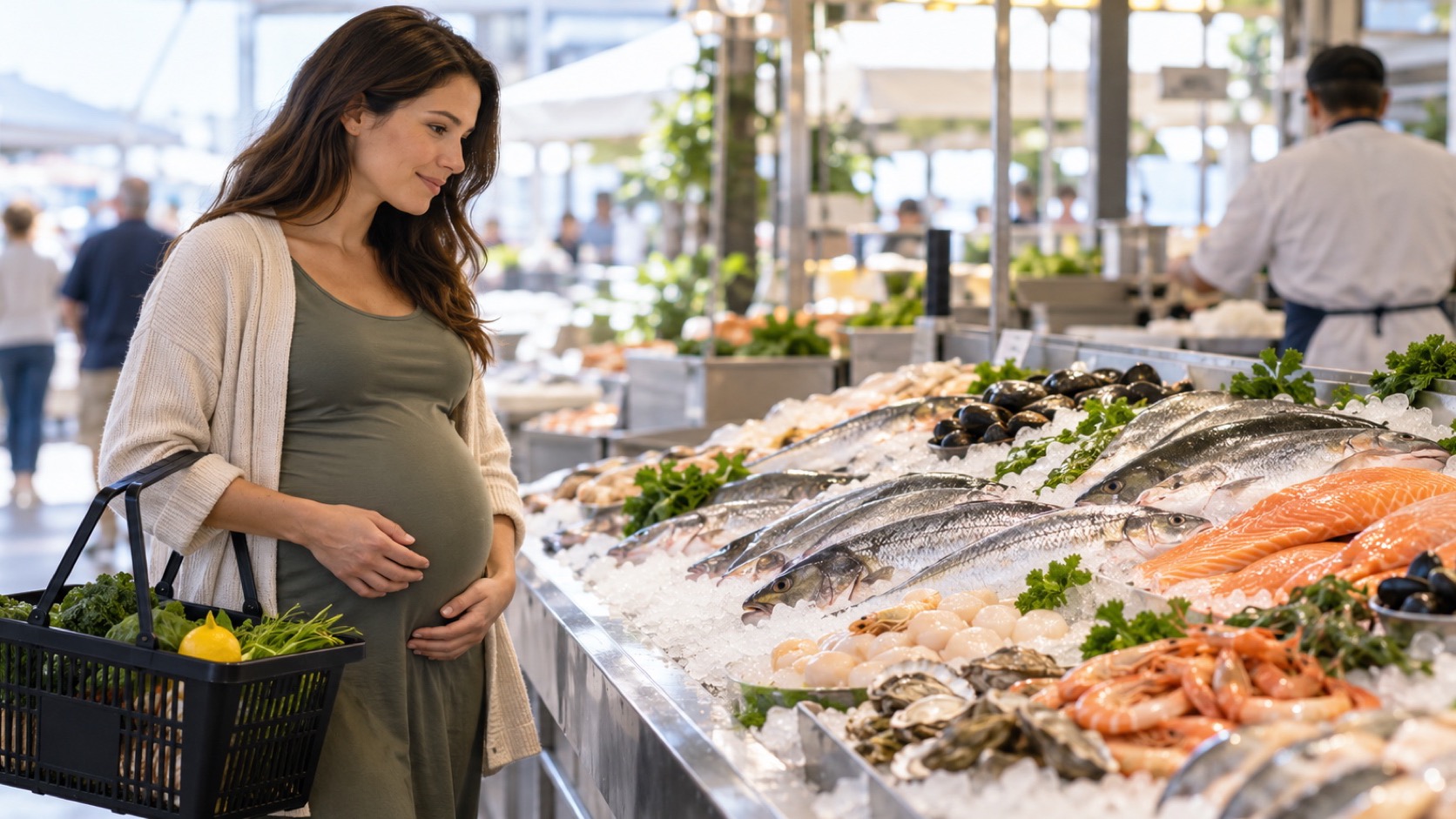
Why Guidance Says More Fish, Not Less
The FDA/EPA advice, revised in October 2021, starts from a nutrient case, not a fear case. Fish supply nutrients that matter acutely during pregnancy and early childhood: DHA and EPA omega-3 fats, iron, iodine — flagged as important during pregnancy — and choline, which the advice notes supports development of the baby's spinal cord. Fish also provide iron and zinc for children's immune systems, plus protein, vitamin B12, vitamin D, and selenium. That list is why the question was never "whether" but "which fish, how much."
On the benefit side, the agencies write that fish intake during pregnancy is recommended because moderate scientific evidence shows it can help a baby's cognitive development. On the risk side sits methylmercury, which can harm a developing brain and nervous system, and concentrates in large, long-lived fish. The entire guidance is the resolution of those two facts into one chart.
The Numbers, As Written
| Life stage | Serving size | Weekly amount | Category |
|---|---|---|---|
| 🤰 Pregnant or breastfeeding | 4 oz (roughly one palm-sized portion) | 2–3 servings/week | Best Choices |
| 🤰 Pregnant or breastfeeding | 4 oz | 1 serving/week | Good Choices |
| 👶 Child, ages 1–3 | ~1 oz | 2 servings/week | Best Choices |
| 🧒 Child, ages 4–7 | ~2 oz | 2 servings/week | Best Choices |
| 🧒 Child, ages 8–10 | ~3 oz | 2 servings/week | Best Choices |
| 🧑 Child, age 11 | ~4 oz | 2 servings/week | Best Choices |
| 🚫 Everyone in these groups | — | 0 | Avoid |
Two reading notes. First, the palm-of-your-hand guide in the advice is about the adult hand for adult servings; a toddler's serving is smaller. Second, the "1 serving from Good Choices" option is an either/or swap for that week, not an addition on top of the Best Choices servings.
The Avoid List and the Lists Beneath It
The seven species to avoid in these life stages are named directly in the advice: king mackerel, marlin, orange roughy, shark, swordfish, tilefish from the Gulf of Mexico, and bigeye tuna. The common thread is biology — mercury accumulates up the food web, so large, long-lived predators carry the most. Beneath the avoid list sit two big categories:
- ✅ Best Choices (lowest mercury): dozens of species including salmon, sardines, anchovies, herring, trout, pollock, tilapia, cod, flounder, haddock, catfish, canned light tuna (including skipjack), shrimp, crab, scallops, oysters, and clams.
- ⚠️ Good Choices (moderate mercury): eat 1 serving a week at most in pregnancy — albacore (white) tuna, yellowfin tuna, halibut, grouper, snapper, Chilean sea bass, mahi mahi, and others.
- 🐟 The tuna nuance: canned light tuna is a Best Choice while albacore and bigeye tuna sit one list down and on the avoid list respectively — "tuna" is three different guidance answers depending on the type.
What About Fish Caught by Family or Friends?
The advice handles locally caught fish with a one-line rule: check for fish and shellfish advisories for that waterbody, and if there is no advisory, eat only one serving that week and no other fish that week. Some locally caught species — the advice names larger carp, catfish, trout, and perch as examples — are more likely to carry advisories due to mercury or other contaminants. The local-catch page walks through how to find your state's advisory in detail.
⚖️ Skipping fish in pregnancy is not the safe default
The agencies wrote this advice partly because avoidance had become common — and the nutrient costs of avoidance (DHA, iodine, choline, iron during a window when they matter developmentally) are what the guidance weighs against mercury. The low-anxiety algorithm is short: pick from Best Choices, serve the age-appropriate amount 2–3 times a week, skip the seven named species, and check advisories for anything caught locally. And because pregnancy nutrition questions interact with your own health history, bring the plan to your prenatal clinician rather than treating this page — or any page — as individualized advice.
Breastfeeding, Formula, and the First Years
The same 8-to-12-ounce weekly target applies while breastfeeding, because DHA passes into breast milk and the advisory's nutrient logic continues. Beyond that, the guidance is thinner and more caution is warranted: the advice covers people who "might become or are pregnant," breastfeeding mothers, and young children, but it does not make species-specific recommendations for infants beyond childhood serving guidance that begins at age 1. When a child transitions to table food, the age-scaled serving table above is the operative part of the advice. For what these nutrients actually do in the body — composition only, no outcome claims — see the nutrients page.
Servings on an Actual Plate
The guidance is written in ounces and categories; dinner is written in pans and cans. A 4-oz adult serving is measured before cooking and is about the size and thickness of an adult palm — one standard salmon portion, or a typical can of tuna drained. Children's portions are age-specific, so don't apply the adult hand-size estimate to a child. That makes "2 to 3 servings a week" surprisingly achievable without ever cooking a whole fish:
- 🐟 Two fillet dinners: a Tuesday salmon bake and a Saturday trout or cod dish covers the week in two meals, both from the Best Choices list.
- 🥫 The canned shortcut: canned light tuna, canned salmon, and sardines are Best Choices — a lunch salad or toast topping counts toward the weekly total with zero cooking.
- 🧒 For a 2-year-old: the serving is about an ounce — two small fish cakes, a few flakes mixed into pasta, or a mini tuna sandwich. The target is exposure and habit, not volume.
- 🦐 Shellfish count: shrimp, crab, scallops, clams, and oysters are all on the Best Choices list — "fish" in the advice means fish and shellfish together.
- 📅 Spacing beats stacking: spreading servings across the week, rather than three in one day, matches how the intake-risk modeling behind the advice treats exposure.
Questions, Answered Briefly
- 🍣 Can I eat sushi while pregnant? Cooked sushi from Best Choices species fits the guidance; raw fish is a different risk category — the FDA's at-risk-group guidance says pregnant women should avoid raw or undercooked fish and shellfish. Details on the safety page.
- 🐟 I ate swordfish before I knew I was pregnant — now what? The guidance is prospective, not a trigger for alarm; mercury risk relates to ongoing accumulation. Shift to Best Choices going forward and raise it with your clinician if worried.
- 🥫 Is canned tuna okay? Canned light tuna (including skipjack) is a Best Choice; canned albacore is a Good Choice, meaning 1 serving a week in pregnancy. Two different answers inside one product aisle.
- 👧 What about kids who won't eat fish? The guidance recommends fish; it does not claim a child fails without it. Nutrients exist in other foods (iodine in iodized salt, DHA in some eggs), and feeding dynamics — no force, keep offering — matter more than any single food.
- 💊 Are omega-3 capsules a substitute during pregnancy? Supplement decisions in pregnancy belong with your prenatal clinician — this page covers food guidance and makes no food-versus-capsule claim. The supplement page covers products.
The Bottom Line
- Official advice is "eat more fish," not "avoid fish" — 2 to 3 weekly 4-oz servings from Best Choices for pregnancy and breastfeeding, chosen for nutrients the developing brain and nervous system use.
- Seven species sit off the menu in these life stages — king mackerel, marlin, orange roughy, shark, swordfish, Gulf tilefish, and bigeye tuna, all high-mercury predators.
- Children's servings scale with age — about 1 oz at 1–3 years to 4 oz at 11, twice a week from Best Choices.
- Locally caught fish has its own rule — check the waterbody's advisory, and with no advisory, one serving that week and no other fish.
Related Topics
- U.S. Food and Drug Administration / Environmental Protection Agency, "Advice About Eating Fish" (revised October 2021) — fda.gov
- U.S. FDA, "Mercury Levels in Commercial Fish and Shellfish (1990–2012)" — fda.gov
- U.S. FDA, "Selecting and Serving Fresh and Frozen Seafood Safely" — fda.gov
- Dietary Guidelines for Americans — dietaryguidelines.gov
- National Institutes of Health, Office of Dietary Supplements, "Omega-3 Fatty Acids — Health Professional Fact Sheet" — ods.od.nih.gov