Fiber supplements vs food matrix
A fiber powder is fiber minus everything else a plant is. Sometimes that subtraction is the point — psyllium's LDL effect is real and doseable — and sometimes it is the problem, because the mortality benefits live in the whole pattern. This page scores the shelf honestly and marks the exceptions where a powder earns its keep.
What the evidence supports
- Psyllium lowers LDL (~7% at ~10 g/day) and improves regularity and IBS symptoms in randomized trials (Am J Clin Nutr, 2000; Am J Gastroenterol, 2014).
- Oat β-glucan at 3 g/day lowers LDL by ~0.25 mmol/L (Am J Clin Nutr, 2014); viscous fibers as a class lower HbA1c by roughly 0.6 percentage points (Diabetes Care, 2019).
- Inulin-type fibers reliably raise Bifidobacteria counts — a real prebiotic effect with modest lipid and glucose benefits (Eur J Clin Nutr, 2017).
What remains uncertain
- Whether any supplement reproduces the mortality associations of whole-food fiber is unproven — the cohort curves were built on food.
- Long-term outcome data for inulin, wheat dextrin, and methylcellulose are thin; most trials are weeks to months.
- Individual responses vary widely, especially for fermentable powders, which trade prebiotic effects against gas.
Evidence last reviewed: August 15, 2026. Conclusions may change as new research is published.
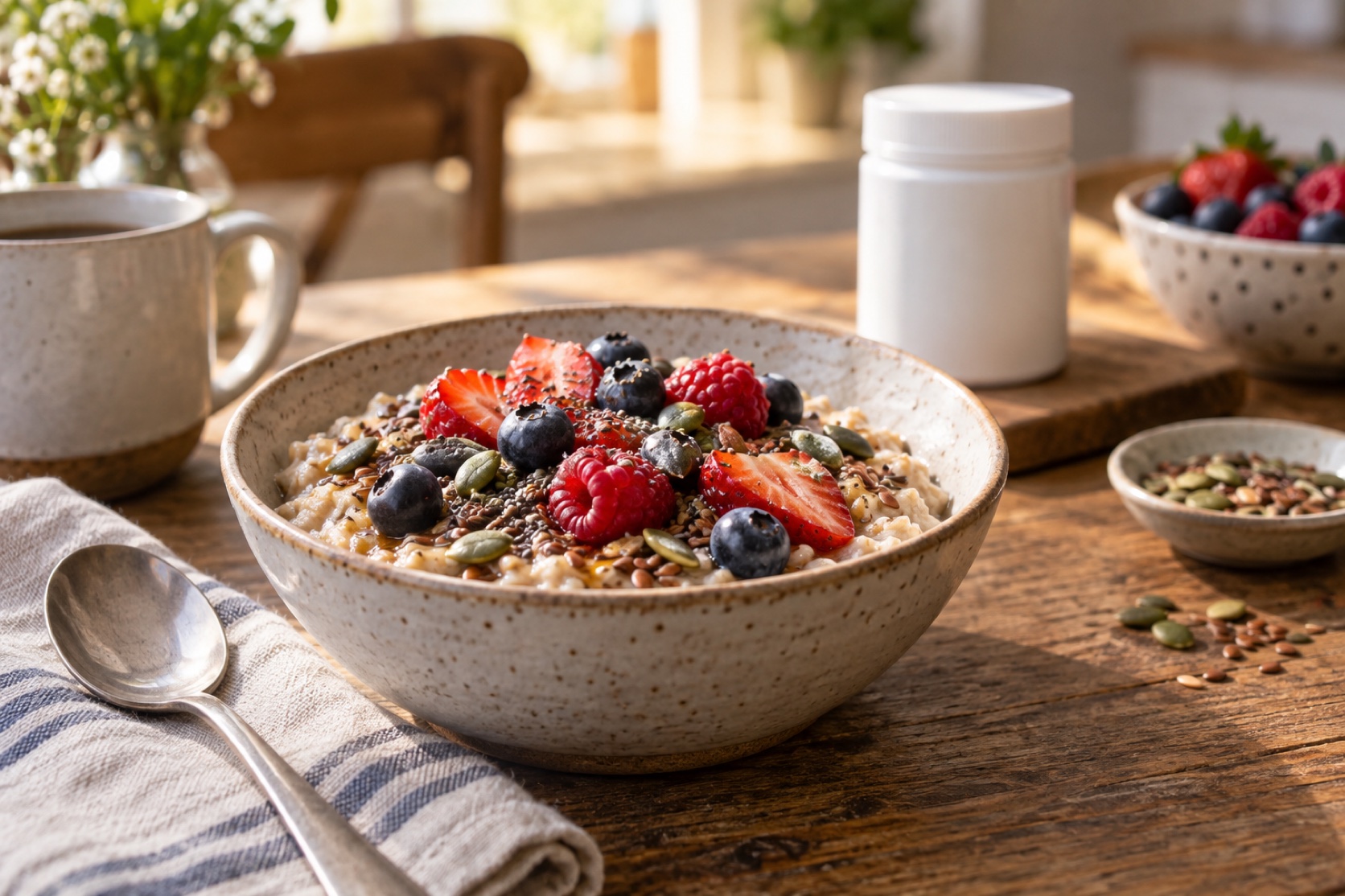
The Matrix: What the Powder Can't Carry
A cup of beans is not a fiber capsule with extras; it is a structure. The plant delivers fiber physically entangled with polyphenols, magnesium, potassium, and slow carbohydrate, wrapped in cell walls you must chew — which is itself part of the satiety signal. The polyphenols and minerals in plants have their own evidence base; the chewing and bulk shape appetite (Obesity Reviews, 2011); and the fiber types arrive mixed, which the fermentation page explains is how the butyrate economy works best. A powder delivers one isolated fiber at a dose chosen by a manufacturer. That is why the honest position is not "supplements are useless" but "supplements are narrow": each one is good at what its physics does and silent on everything else. The epidemiology points the same way: whole-grain intake itself tracks with lower mortality even in analyses that adjust for fiber (Circulation, 2016), which is what you'd expect if the matrix is doing work beyond the grams.
Product picks are generic categories, not brands. We may earn a commission on Amazon or iHerb purchases at no cost to you — this never changes our evidence conclusions. Full disclosure
Psyllium fiber supplement
May help increase soluble-fiber intake when food-first approaches fall short.
⚠️ Can cause gas, bloating, or constipation if fluids are inadequate; can affect absorption of some medicines, so separate timing and ask a pharmacist when unsure.
Check price on Amazon →The Supplement Shelf, Honestly Scored
Six common products, scored on the outcomes they actually have trial support for. "Strong" here means replicated randomized evidence on that specific effect — not that the powder is a longevity product.
| Supplement | What it is | What trials support | Verdict |
|---|---|---|---|
| 💊 Psyllium husk | Viscous gel-forming fiber | LDL ↓ ~7% at ~10g; regularity; IBS symptoms | Good |
| 🌾 Oat β-glucan | Viscous fiber from oats/barley | LDL ↓ ~0.25 mmol/L at 3g; modest glucose effects | Good |
| 🧅 Inulin / FOS | Fermentable prebiotic | Bifidobacteria ↑; modest lipids and glucose; gas at doses | Moderate |
| 🌽 Wheat dextrin | Partly fermentable, low-gas | Regularity; small SCFA increases; well tolerated | Moderate |
| 🍠 Glucomannan | Highly viscous konjac fiber | LDL and glycemic markers; aspiration risk if taken dry | Moderate |
| 🧊 Methylcellulose | Non-fermentable bulk | Regularity only; no fermentation, no metabolic effects | Limited |
💊 Powders are doses; food is a pattern
The mortality curve in the Lancet page was built on food, and the swap experiment on the parent page changed biology in two weeks with plants, not powders. Use a supplement the way you'd use a specific tool: to fix a specific gap — LDL, regularity, an IBS bridge — at a dose from a trial. Earn the other 80% of your fiber from food.
When a Supplement Earns Its Place
The honest exceptions, where a powder is the right tool:
- 🫀 LDL that food swaps haven't fixed. Psyllium's ~7% LDL reduction is additive to diet and meaningful when cholesterol is the specific problem — a legitimate reason to use it daily at trial doses (~7–10 g).
- 🚽 Constipation unresponsive to food fiber. Psyllium is first-line for chronic constipation; wheat dextrin and methylcellulose are gentler, lower-gas options with less metabolic reach.
- 🌀 IBS, carefully. Soluble fiber (psyllium) improved IBS symptoms in a primary-care trial while bran made some participants worse (BMJ, 2009) — but doses should start small and climb, per the ramp-up page.
- 🧳 Travel, illness, and institutional meals. A sachet of psyllium beats nothing on a week where plants are scarce — gap-filling, not substitution.
- 🍬 A warning about gummies and bars. "Fiber-fortified" snacks are usually inulin in a candy matrix, at doses below anything studied. They are snacks with marketing, not supplements with evidence.
⚠️ Clinician territory: glucomannan taken dry has caused esophageal obstruction — always in water, and avoid it entirely with swallowing difficulties. Psyllium needs fluid and is contraindicated in some bowel conditions; viscous fibers can slow absorption of medications, so separate doses by a couple of hours. If you take medication, have diabetes on glucose-lowering drugs, or have any history of bowel obstruction or stricture, discuss fiber supplements with a clinician rather than self-dosing. Nothing on this page prescribes.
What the Trials Actually Show
The supplement evidence is real but bounded. A 2019 meta-analysis of viscous fibers in diabetes found HbA1c lower by roughly 0.6 percentage points and fasting glucose and insulin resistance improved across 28 trials (Diabetes Care, 2019) — genuinely useful adjunct numbers. A meta-analysis of inulin-type fructans found modest LDL, triglyceride, and glucose improvements (European Journal of Clinical Nutrition, 2017) — directionally right, small in size. Psyllium's glycemic benefit scales with how poor baseline control is (American Journal of Clinical Nutrition, 2015). Set against the whole-food data: the Lancet series' mortality findings tracked food intake, and in the 2021 Stanford trial comparing a high-fiber diet with fermented foods, the fiber arm changed enzyme capacity while the fermented arm changed diversity and inflammatory markers (Cell, 2021) — two different tools, neither a substitute for the other. The consistent conclusion across all of it: supplements move markers; food moves outcomes, and the two are not interchangeable. Part of that gap is structural rather than damning: supplement trials run weeks to months and measure markers, while the food evidence accumulates over decades of exposure. The two designs answer different questions, and an honest reading refuses to let either substitute for the other.
The Sensible Middle Path
The decision rule that respects both sides of the evidence:
- 🥗 Food first for the mortality-associated benefits — the dose-response, the SCFAs, the satiety, the matrix. Supplements cannot buy these; there is no equivalent swap.
- 🎯 Powder second, for a named gap — LDL, regularity, an IBS bridge — at a dose that appeared in a trial, taken consistently, and reassessed.
- 🧮 Count food fiber toward your target, not powders. A psyllium serving is a tool, not a serving of vegetables; your 25–30 g should come from plants.
- 🛑 If a powder causes gas, pain, or bloating that persists, stop it — supplements are optional by definition, and the food route remains open.
Questions, Answered Briefly
- 🍬 Do fiber gummies count? Barely. Gummies deliver a few grams of usually-inulin at confectionery doses, and their clinical backing is minimal. Treat them as candy with a fig leaf.
- 🥤 Can I drink my way to 25g with powders? You can hit the number, but you'd be drinking the number without the pattern — and the evidence that matters tracks the pattern. Powders top up a plant-based day; they don't replace one.
- 🫁 Will inulin make me bloat? Possibly — it is rapidly fermented, which is its mechanism and its side effect. Start at 2–3 g/day and climb slowly if you try it; the ramp rules apply to powders too.
- 🩺 Which one would a clinician reach for first? Psyllium — the trial support is the deepest across LDL, regularity, and IBS, and its non-fermented structure makes it the most predictable. The scorecard above reflects that consensus.
- 💸 Are fiber powders worth the money? Psyllium is cheap, single-ingredient, and evidence-backed for its specific jobs; most novelty "fiber blends" and gummies are expensive packaging around unstudied doses. If you supplement, buy the boring single powder from the scorecard, not the lifestyle brand.
The Bottom Line
- Supplements are narrow by design: each delivers one fiber's physics — psyllium's gel, inulin's fermentation — and none carries the plant matrix.
- Where powders are genuinely good: psyllium for LDL (~7% at ~10g), regularity, and IBS; oat β-glucan for cholesterol.
- Where they are not: no powder has evidence of reproducing the mortality associations of whole-food fiber — those were built on food.
- The working rule: food for the pattern, powder for the gap — count only plant fiber toward your 25–30 g, and dose supplements like medicines, with water and respect for the cautions.
Related Topics
- Anderson et al., "Cholesterol-lowering effects of psyllium intake adjunctive to diet therapy in men and women with hypercholesterolemia: meta-analysis of 8 controlled trials," American Journal of Clinical Nutrition (2000)
- Whitehead et al., "Cholesterol-lowering effects of oat β-glucan: a meta-analysis of randomized controlled trials," American Journal of Clinical Nutrition (2014)
- Jovanovski et al., "Should viscous fiber supplements be considered in diabetes control? Results from a systematic review and meta-analysis of randomized controlled trials," Diabetes Care (2019)
- Liu et al., "Effect of inulin-type fructans on blood lipid profile and glucose level: a systematic review and meta-analysis of randomized controlled trials," European Journal of Clinical Nutrition (2017)
- Gibb et al., "Psyllium fiber improves glycemic control proportional to loss of glycemic control: a meta-analysis of data in euglycemic subjects, patients at risk of type 2 diabetes mellitus, and patients being treated for type 2 diabetes mellitus," American Journal of Clinical Nutrition (2015)
- Moayyedi et al., "The effect of fiber supplementation on irritable bowel syndrome: a systematic review and meta-analysis," American Journal of Gastroenterology (2014)
- Bijkerk et al., "Soluble or insoluble fibre in irritable bowel syndrome in primary care? Randomised placebo controlled trial," BMJ (2009)
- Wastyk et al., "Gut-microbiota-targeted diets modulate human immune status," Cell (2021)
- Wanders et al., "Effects of dietary fibre on subjective appetite, energy intake and body weight: a systematic review of randomized controlled trials," Obesity Reviews (2011)