Soluble vs insoluble vs resistant starch
"Eat more fiber" hides a three-way division of labor: some fiber gels in water, some just adds bulk, and some gets quietly fermented into signals your whole body reads. This page maps the families to their actual jobs — and explains why the classic two-bucket taxonomy is overdue for an update.
What the evidence supports
- Viscous soluble fibers (oat β-glucan, psyllium) lower LDL cholesterol in randomized trials — ~0.25 mmol/L for 3 g/day of oat β-glucan (Am J Clin Nutr, 2014).
- Insoluble fibers reliably increase stool bulk and speed transit — a mechanical, well-demonstrated effect (J Acad Nutr Diet, 2017).
- Resistant starch reaches the colon largely intact and raises butyrate production and, in several trials, insulin sensitivity (Am J Clin Nutr, 2005; Diabetic Medicine, 2010).
What remains uncertain
- The disease-prevention evidence for insoluble fiber is weaker than for viscous soluble fiber — bran trials for colon-polyp recurrence were null (NEJM, 2000).
- Resistant starch's metabolic benefits are inconsistent across trials and doses; a large Lynch-syndrome trial found no colorectal-cancer effect (Cancer Prev Res, 2022).
- The soluble/insoluble labels themselves are crude — fermentability and viscosity predict behavior better than the old buckets.
Evidence last reviewed: August 15, 2026. Conclusions may change as new research is published.
Why the Two-Bucket Model Breaks
The soluble/insoluble split dates to the 1970s and was built around a lab assay: does the fiber dissolve in hot water? The problem, as fiber chemists point out, is that the assay predicts behavior poorly (Journal of the Academy of Nutrition and Dietetics, 2017). Psyllium is soluble but barely fermented. Inulin dissolves readily yet produces no gel. Wheat bran is insoluble yet partly fermentable. What actually predicts a fiber's effects are two physical properties: viscosity (does it form a gel that slows digestion?) and fermentability (does it become bacterial fuel in the colon?). The useful modern map has three families: the gel formers, the bulk formers, and the starch that escapes digestion entirely. That third family — resistant starch — is the one the old two-bucket model simply missed. The labels have not caught up, either: two products can both read "soluble fiber" on a package and behave nothing alike in your gut, because food labeling still sorts fiber by the old water-bath assay rather than by what the fiber does.
Product picks are generic categories, not brands. We may earn a commission on Amazon or iHerb purchases at no cost to you — this never changes our evidence conclusions. Full disclosure
Canned beans and lentils
A lower-friction way to use legumes where an article gives a concrete food-first practice.
⚠️ Increase gradually if gas is troublesome; people with IBS or a prescribed diet may need individualized guidance.
Check price on Amazon →Soluble: The Gel Formers
Viscous soluble fibers — oat β-glucan, barley β-glucan, psyllium husk, pectin from apples and citrus — thicken the contents of the gut like weak jelly. That viscosity is the mechanism: it slows stomach emptying and sugar absorption (blunting glucose spikes), and it traps bile acids so the liver must pull cholesterol from the blood to make more. The trial numbers are among the cleanest in nutrition: 3 g/day of oat β-glucan lowered LDL by about 0.25 mmol/L in a meta-analysis of 28 trials (American Journal of Clinical Nutrition, 2014), and 10 g/day of psyllium lowered LDL by roughly 7% in an earlier meta-analysis (Am J Clin Nutr, 2000) — numbers substantial enough that the FDA has authorized health claims linking both to reduced coronary heart disease risk.
Insoluble: The Transit Workers
Insoluble fiber — cellulose, much of wheat bran, and the lignified parts of vegetable skins — does its work mechanically. It resists fermentation, holds water in its matrix, and adds the bulky lattice that keeps stool soft and transit moving. This is why bran cereals "work" for regularity, and it is also where the honest caveats sit: insoluble fiber's cholesterol effects are nil, and its disease-prevention evidence is thinner than the gel formers' — a large wheat-bran trial showed no reduction in colon adenoma recurrence (New England Journal of Medicine, 2000). None of that makes insoluble fiber unimportant; it makes it narrow. It is the family you eat for the colon's plumbing, not for its cardiology.
Resistant Starch: The Plot Twist
Resistant starch (RS) is starch that survives the small intestine — either physically trapped in intact grains (RS1), ungelatinized as in green bananas and raw potato starch (RS2), retrograded when cooked starches cool, as in potato salad or sushi rice (RS3), or chemically modified (RS4). It reaches the colon largely intact, where it ferments — often preferentially into butyrate, the SCFA with the strongest signaling resume (see the fermentation page). Trial results are genuinely mixed, and that honesty matters: 30 g/day of RS improved insulin sensitivity in metabolic syndrome (Diabetic Medicine, 2010) and in overweight men (Journal of Nutrition, 2012), yet a large 10-year follow-up of the CAPP2 trial in Lynch-syndrome carriers found 30 g/day of RS did not reduce colorectal cancer — though non-colorectal cancers, mostly upper gastrointestinal, fell (Cancer Prevention Research, 2022). The honest summary: RS is a promising, mechanistically interesting fiber with a butyrate bias and an unfinished evidence file.
🧪 The labels are a map, not the territory
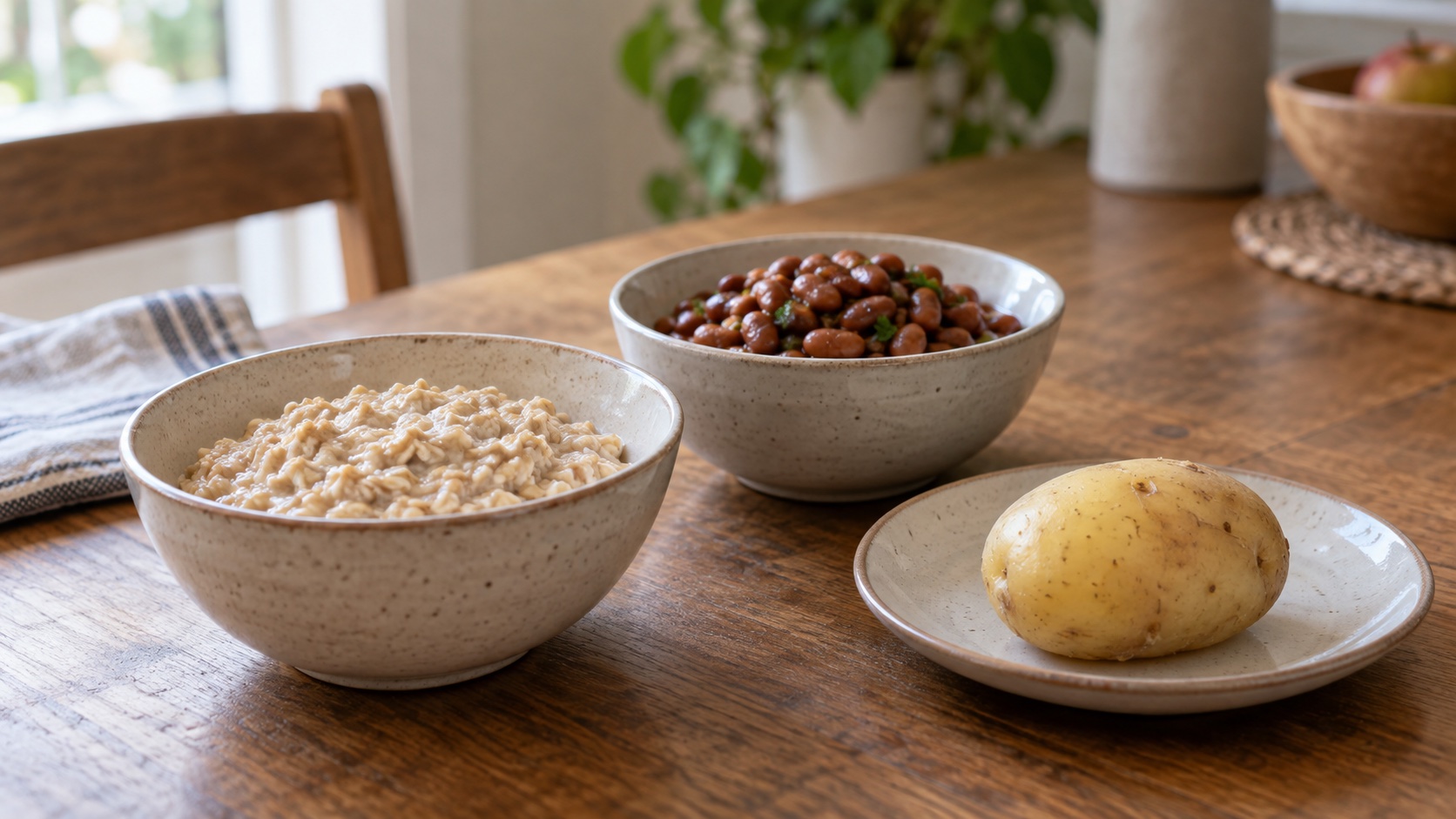
Whole foods rarely belong to one family. A bean delivers soluble fiber, insoluble hulls, and resistant starch in one package; oats carry β-glucan alongside bran. That is the practical lesson: you do not need to plan your week by fiber family — you need variety across plant foods, which delivers all three families without taxonomy homework.
Rolled oats
A soluble-fiber food option where an article specifically teaches oats as part of a gradual fiber increase.
⚠️ Increase fiber gradually; GI symptoms vary and gluten cross-contact matters for people who require certified gluten-free products.
Check price on Amazon →The Fermentation Divide
Underneath the labels, the families differ most in what happens to them in the colon. Roughly: resistant starch ferments extensively, soluble fiber ferments variably depending on structure (pectin yes, psyllium barely), and insoluble fiber ferments little — passing through to do its bulking job. The chart shows approximate, source-dependent ranges rather than fixed values; the point is the gradient, because fermentation is where the microbiome and its short-chain fatty acids enter the story.
Which Family Matters? The Anti-Answer
The Lancet dose-response was built on total fiber, not on families — and that is the right resolution to think at. Your colon cannot read nutrition labels; it receives a mixture and responds to the whole pattern. The practical translation of all the taxonomy above fits in a table:
| Family | Members | Main jobs | Where it lives |
|---|---|---|---|
| 🥣 Soluble (gel) | β-glucan, psyllium, pectin | LDL ↓, glucose blunting, satiety | Oats, barley, beans, apples, citrus |
| 🌾 Insoluble (bulk) | Cellulose, lignins, bran | Bulk, transit, regularity | Wheat bran, vegetable skins, seeds |
| 🍌 Resistant starch | RS1–RS4 | Butyrate production, insulin-sensitivity signal | Cooled potatoes & rice, green bananas, legumes |
One plate that lands all three families without any planning: oats with berries at breakfast (the gel formers), a whole-grain sandwich and an apple with its skin at lunch (the bulk formers), and a dinner bowl of beans over rice cooked earlier and cooled (resistant starch, plus both other families riding along). Eat across plant categories and the taxonomy sorts itself out in the background — which is the real reason this page exists as context rather than as a shopping algorithm.
Questions, Answered Briefly
- 🍌 Does cooling potatoes really create fiber? It creates resistant starch — cooling allows the starch to recrystallize into a form digestion skips. The effect is real but modest, and reheating does not fully reverse it. Potato salad is not a health food; it is a starch that leaves more for your bacteria.
- 🧽 Does insoluble fiber "scrub" the colon? No — that's imagery, not physiology. Insoluble fiber works by holding water and adding lattice, not by abrasion (Journal of the Academy of Nutrition and Dietetics, 2017).
- 💊 Which family should I buy as a powder? If you supplement at all, the trial support is strongest for viscous soluble fibers — psyllium for LDL and regularity, oat β-glucan for cholesterol. The supplements page scores the shelf honestly.
- 📊 Do I need to track grams per family? No. Eat across plant categories — grains, legumes, vegetables, fruit, seeds — and the families sort themselves out. Tracking the split is effort spent on a taxonomy, not on your health.
- 🍽️ Is oat bran a gel fiber or a bulk fiber? Mostly gel in behavior — the β-glucan in oat bran drives its cholesterol and glucose effects, with the bran hull contributing some bulk on the side. That mixture is the rule in whole foods, which is exactly why the family labels blur at the edges.
Psyllium fiber supplement
May help increase soluble-fiber intake when food-first approaches fall short.
⚠️ Can cause gas, bloating, or constipation if fluids are inadequate; can affect absorption of some medicines, so separate timing and ask a pharmacist when unsure.
Check price on Amazon →Practical Rules
- 🥣 One gel former daily: oats or barley at breakfast, or beans at lunch, keeps the LDL and glucose machinery engaged.
- 🥗 Eat the skins. Vegetable peels and whole fruit are where the transit family lives — peeling discards it.
- 🍚 Cool some starch weekly. Batch-cooked potatoes, rice, or legumes eaten cold or reheated add resistant starch without extra shopping.
- 🫘 Let legumes do triple duty. Beans carry all three families plus protein — the protein topic and this one converge on the same shopping list.
The Bottom Line
- Three families, three jobs: soluble gels bind cholesterol and blunt glucose; insoluble bulks and speeds transit; resistant starch ferments into butyrate.
- The old soluble/insoluble split is crude — viscosity and fermentability predict a fiber's effects better than the water-bath assay.
- Trial support is strongest for viscous soluble fiber (oat β-glucan, psyllium) on LDL; weakest for insoluble fiber beyond regularity.
- Whole foods mix all three families automatically — variety across plants beats taxonomy, every time.
Related Topics
- McRorie & McKeown, "Understanding the physics of functional fibers in the gastrointestinal tract," Journal of the Academy of Nutrition and Dietetics (2017)
- Whitehead et al., "Cholesterol-lowering effects of oat β-glucan: a meta-analysis of randomized controlled trials," American Journal of Clinical Nutrition (2014)
- Anderson et al., "Cholesterol-lowering effects of psyllium intake adjunctive to diet therapy in men and women with hypercholesterolemia: meta-analysis of 8 controlled trials," American Journal of Clinical Nutrition (2000)
- Alberts et al., "Lack of effect of a high-fiber cereal supplement on the recurrence of colorectal adenomas," New England Journal of Medicine (2000)
- Robertson et al., "Insulin-sensitizing effects of dietary resistant starch and effects on skeletal muscle and adipose tissue metabolism," American Journal of Clinical Nutrition (2005)
- Johnston et al., "Resistant starch improves insulin sensitivity in metabolic syndrome," Diabetic Medicine (2010)
- Maki et al., "Resistant starch from high-amylose maize increases insulin sensitivity in overweight and obese men," Journal of Nutrition (2012)
- Mathers et al., "Cancer prevention with resistant starch in Lynch syndrome patients in the CAPP2-randomized placebo controlled trial: planned 10-year follow-up," Cancer Prevention Research (2022)