Fall prevention
Falls are the leading cause of injury-related death in adults over 65, and the hip-fracture numbers explain why. The good news is the trial record: balance and strength programs work, the dose-response is known, and most of what doesn't work has been ruled out too.
What the evidence supports
- Exercise programs reduce fall rates by about 23% across 108 trials; balance-challenging programs of 3+ hours weekly do about twice as well (Sherrington et al., Cochrane, 2019).
- Home-based strength and balance training cut falls by roughly a third in women aged 80+ (Campbell et al., BMJ, 1997).
- Multifactorial assessment — gait, medications, home hazards — reduced falls about 31% in a landmark trial (Tinetti et al., NEJM, 1994).
What remains uncertain
- Vitamin D supplementation alone does not prevent falls in meta-analyses outside severe deficiency (USPSTF evidence review, JAMA, 2018).
- The optimal mix of exercise types beyond the balance-challenge principle is not settled.
- Multifactorial programs help high-risk older adults most; their value in low-risk populations is less clear.
Evidence last reviewed: August 15, 2026. Conclusions may change as new research is published.
The Hip-Fracture Arithmetic
The reason fall prevention deserves a page of its own is simple: the hip fracture is among the most consequential events in geriatric medicine. More than 95% of hip fractures are caused by falling — usually a sideways fall from standing height — and the Centers for Disease Control and Prevention counts more than 300,000 hospitalizations for hip fracture among Americans 65 and older each year. That is a slow-motion epidemic with a known fix.
What happens after the fracture is the harder number. A meta-analysis in the Annals of Internal Medicine (Haentjens et al., 2010) found mortality risk climbs five- to eight-fold in the first three months after a hip fracture compared with people who never fractured, with excess mortality persisting for years. Functionally, the picture is equally stark: a large share of people who fracture a hip never fully regain their prior walking ability, and the fear of falling again often shrinks their world even when the bone heals. The intervention that prevents the fracture is, by a wide margin, the better medicine.
Product picks are generic categories, not brands. We may earn a commission on Amazon or iHerb purchases at no cost to you — this never changes our evidence conclusions. Full disclosure
Smart band or smartwatch
Can make activity, exercise, and routine patterns easier to notice over time.
⚠️ Step, heart-rate, and sleep estimates can be inaccurate and may encourage unhelpful over-monitoring; consumer readings are not medical diagnoses.
Check price on Amazon →What the Landmark Trials Found
| Trial | Population | What was tested | Result |
|---|---|---|---|
| Campbell et al., BMJ 1997 | Women aged 80+, living at home | Home-based strength and balance program with four home visits (the Otago program's ancestor) | 32% fewer falls over one year |
| Tinetti et al., NEJM 1994 | Adults 65+ living in the community | Multifactorial: gait and balance training, medication review, home-hazard changes | 31% reduction in falls over one year |
| Sherrington et al., Cochrane 2019 | 108 trials of exercise programs, community-dwelling older adults | Exercise programs, mostly balance and functional training | 23% lower fall rate overall; 42% lower where balance-challenging exercise reached 3+ hours weekly |
The Three Ingredients That Work
Reading across the Cochrane reviews, the effective programs share three components — and the dose of the first one is where most of the effect lives:
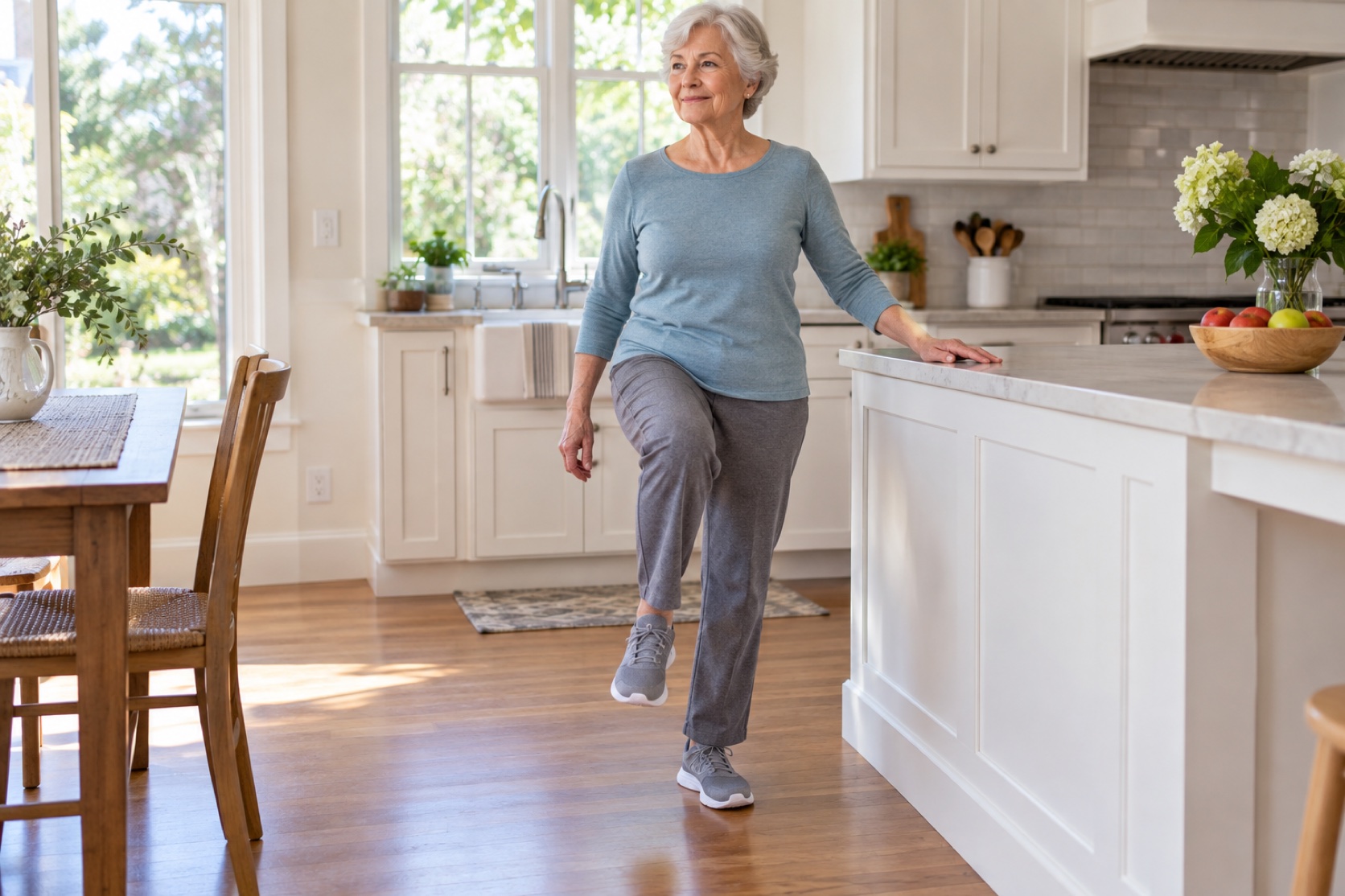
- ⚖️ Balance-challenging exercise, 3+ hours a week. Standing with a narrowed base, shifting weight, stepping — and crucially, making it harder over time. The balance ladder is this ingredient, spelled out.
- 🏋️ Progressive leg strength. Chair stands, step-ups, and squat patterns — the muscles that execute the catch when a stumble happens. The strength topic owns the dosing.
- 🚶 Functional practice. Sit-to-stands, tandem walking, stepping over objects, turning while walking — the movements falls actually occur in, practiced until automatic.
- 📈 Re-test to re-dose. The World Health Organization's 2020 guidelines echo the trial data: for adults 65+, multicomponent physical activity on 3+ days a week that emphasizes functional balance and strength. Progress the challenge as performance improves, or the adaptation stalls.
One definitional point matters, because the Cochrane reviewers found that the effect lives in the word "balance-challenging." Their definition: exercises conducted while standing, where the goal is to reduce the base of support or otherwise make staying upright harder — tandem stance, single-leg stance, minimal hand support, or deliberate movement of the center of mass. Brisk walking does not qualify; standing yoga poses and the ladder's upper rungs do. If a program never feels wobbly, it is not balance training in the sense the trials measured.
Non-slip exercise or yoga mat
Provides a stable, comfortable surface for mobility or floor-based exercise.
⚠️ None expected; it does not treat pain or replace injury-specific care.
Check price on Amazon →What Doesn't Work — So You Don't Waste the Decade
The negative results matter as much as the positives, because they redirect effort that would otherwise be spent on comfort-zone activities:
- 💊 Vitamin D alone. Despite a long run of enthusiasm, meta-analyses — including the USPSTF's 2018 evidence review — find vitamin D supplementation without exercise does not reduce falls, except possibly in people with severe deficiency. It is not a fall-prevention program.
- 🚶 Walking-only programs. In the 2019 Cochrane review, programs consisting mainly of walking did not reduce fall rates. Walking is wonderful for many things — aerobic health first among them — but it does not challenge balance enough to prevent falls.
- 🪑 Restriction out of fear. Cutting activity to avoid falls backfires: activity avoidance accelerates the strength and balance losses that make falls more likely. The protective instinct is the risk factor.
- 👓 One-size vision correction. Some trials of updated multifocal glasses actually found an early increase in falls — new prescriptions change depth perception and gait confidence before adaptation. Vision care belongs in a fall plan, but changes need an adjustment period.
Underneath several of these dead ends sits a common mechanism: fear of falling. After a fall — or after watching a peer fracture a hip — activity shrinks, and the shrinking does the damage the fall threatened to do. Balance confidence is trainable alongside balance itself: the same progressive practice that improves single-leg time reliably improves people's sense of what they can safely attempt, which in trials shows up as more activity, not less.
Beyond Exercise: The Home and Medication Audit
Exercise carries the evidence, but two non-exercise ingredients round out the multifactorial programs that the trials validated. Home-hazard modification — securing rugs, clearing walkways, improving lighting, adding grab rails — reduces falls most clearly in higher-risk people (Gillespie et al., Cochrane, 2012). And medication review belongs in any fall discussion: sedatives, sleep medications, blood-pressure drugs, and polypharmacy of any kind are among the strongest modifiable fall risks in clinical practice. That part is not a home project.
⚠️ Recurrent falls are a symptom, not a habit
One fall can be bad luck. Two falls in a year — or any fall with dizziness, fainting, or loss of consciousness — deserves a clinical evaluation: blood pressure and heart rhythm, medications, vision, vestibular function, and neurology. This is clinician territory, and it belongs at the top of the workup, not the bottom of an exercise plan.
A Sample Week at Three Hours
The 42% figure came from programs averaging three or more hours a week of balance-challenging exercise — a number that sounds large until you budget it:
- 📅 Daily: 10 minutes. The mobility routine with its balance minute — 70 minutes a week.
- 🏋️ Twice weekly: 55 minutes. A strength-and-balance circuit: chair stands, step-ups, tandem walking, single-leg work from the ladder, plus a squat or hinge pattern with weight.
- 🚶 Everything else is bonus. Walks, gardening, stairs, and errands add volume but don't replace the challenge work — the three hours budgeted above are what carry the evidence.
Start Where You Are
The entry point is smaller than most people expect. The daily ten-minute routine embeds one balance task into every day; the ladder turns that task into a progression; and the quarterly self-tests — the ten-second single-leg stand and the thirty-second chair stand, covered in the hidden vital signs topic — tell you whether the program is working. The numbers on this page are the stakes: a fracture that is more than 95% preventable by preventing the fall, a five- to eight-fold mortality spike in the quarter after it, and a 42% fall reduction available to anyone willing to spend three hours a week on the balance challenge. Few investments in longevity have this combination of evidence and price.
Questions, Answered Briefly
- 🩺 When should I start worrying about falls? The screeners are the signal: under 10 seconds on the single-leg stand, or any fall in the past year, means the program on this page stops being optional.
- 🦴 Do I need a bone scan first? Not to start balance and strength work — that's safe territory. A bone-density assessment is worth discussing with a clinician if you have fracture history or other risk factors, because the stakes of a fall depend on bone quality as much as balance.
- 👥 Do men benefit equally? The trials enrolled mostly women because they fracture more often, but the mechanisms — balance and strength — are sex-neutral, and the mixed-sex trials show the same direction of effect.
The Bottom Line
- The stakes are quantified — 300,000+ hip-fracture hospitalizations a year, >95% caused by falls, and a 5–8× mortality spike in the quarter after.
- Exercise works, dose matters — 23% lower fall rates overall, rising to 42% with 3+ hours a week of balance-challenging practice.
- The effective trio — balance challenge, progressive leg strength, and functional practice, re-tested and re-dosed quarterly.
- Skip what doesn't work — vitamin D alone, walking-only programs, and fear-driven restriction; and let a clinician own the medication and recurrent-fall workup.
Related Topics
- Sherrington et al., "Exercise for preventing falls in older people living in the community," Cochrane Database of Systematic Reviews (2019)
- Campbell et al., "Randomised controlled trial of a general practice programme of home based exercise to prevent falls in elderly women," BMJ (1997)
- Tinetti et al., "A multifactorial intervention to reduce the risk of falling among elderly people living in the community," New England Journal of Medicine (1994)
- Gillespie et al., "Interventions for preventing falls in older people living in the community," Cochrane Database of Systematic Reviews (2012)
- Haentjens et al., "Meta-analysis: excess mortality after hip fracture among older women and men," Annals of Internal Medicine (2010)
- Guirguis-Blake et al., "Interventions to prevent falls in older adults: updated evidence report and systematic review for the US Preventive Services Task Force," JAMA (2018)
- Centers for Disease Control and Prevention, "Older Adult Falls" fact sheet (2023)
- World Health Organization, Guidelines on Physical Activity and Sedentary Behaviour (2020)