The Apnea Threat
Sleep apnea breaks the one rule the brain's clearance system depends on: the night must stay deep and continuous. Every apnea event jerks the brain toward wakefulness and drops blood oxygen — the exact conditions that switch the slow-wave pump off. This page looks at the fragmented-sleep cost: what apnea does to the wash, what the amyloid data show, how far the treatment evidence reaches, and when screening stops being optional.
What the evidence supports
- Apnea fragments sleep and drops blood oxygen repeatedly each night — the opposite conditions from the slow-wave state that drives clearance.
- Apnea severity tracks amyloid accumulation over time in cognitively normal older adults.
- Sleep-disordered breathing associates with earlier cognitive decline in cohorts, and CPAP improves sleepiness and some cognitive measures in trials.
What remains uncertain
- Whether CPAP measurably slows amyloid accumulation or prevents dementia long-term is not established.
- Apnea travels with obesity, age, and vascular disease — isolating apnea's own contribution to brain changes is difficult.
- Whether the clearance mechanism is the operative pathway in humans is plausible but unproven.
Evidence last reviewed: August 15, 2026. Conclusions may change as new research is published.
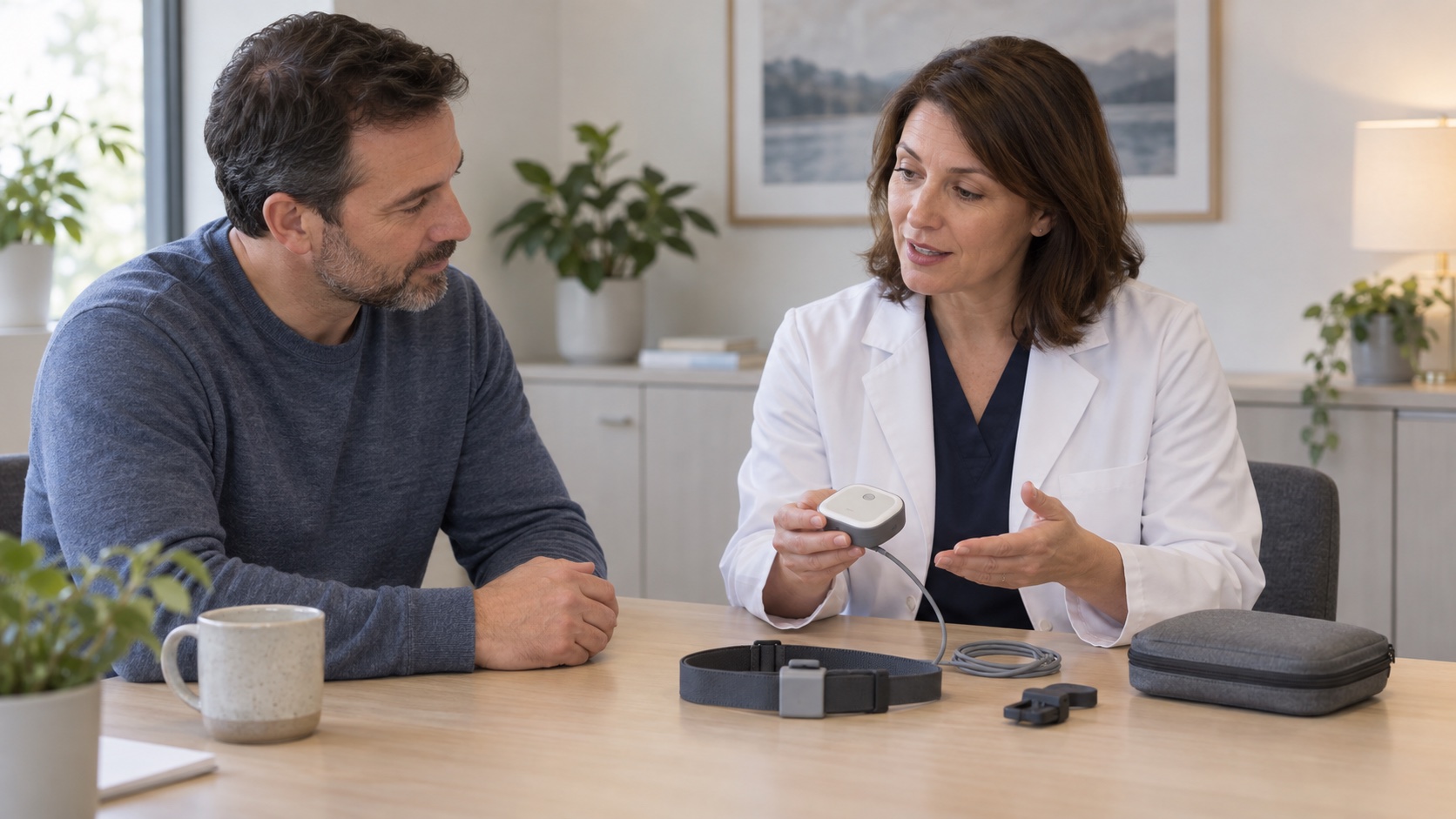
What Apnea Does to the Night
In obstructive sleep apnea, the airway narrows or collapses during sleep, again and again. Each event plays out as a cascade the wash cycle cannot survive:
- 🫁 The oxygen dips. Blood oxygen falls, sometimes sharply, until the brain forces a partial awakening to reopen the airway.
- ⏰ The sleep fragments. Dozens to hundreds of micro-arousals per night shred the sleep architecture — even if the person never fully wakes.
- 🌊 The deep sleep is stolen. Slow-wave sleep — the stage that drives glymphatic clearance, as the first page mapped — is repeatedly interrupted and may be largely absent in severe untreated apnea.
- 💓 The pressure surges. Each arousal spikes blood pressure and sympathetic drive; the arterial pulsatility that pumps cerebrospinal fluid is stressed all night (Mestre et al., Nature Communications, 2018).
Diagnosis and treatment — the STOP-Bang screen, sleep testing, CPAP and its alternatives — are owned by the Sleep pillar's apnea topic. This page owns the brain side of the bill.
The Clearance Case Against Fragmented Sleep
The mechanistic case is direct. Ju and colleagues disrupted slow-wave sleep in healthy young adults using sound — no sleep deprivation, no oxygen drops, just repeated nudges out of deep sleep — and spinal-fluid amyloid-beta levels rose the next day (Brain, 2017). Deep sleep, specifically, is the pump; apnea destroys deep sleep specifically. The parent topic's evidence trail and the human CSF-wave imaging (Science, 2019) complete the picture: fragmented nights mean the wash never gets its uninterrupted run. Apnea adds a second insult — the oxygen dips — that stresses neurons between events. Two hits, one night, every night.
Apnea Severity and Amyloid: The Longitudinal Signal
The observational layer ties apnea to the amyloid story directly. Sharma and colleagues followed over 200 cognitively normal older adults for about two years and found that more severe apnea predicted a steeper decline in cerebrospinal fluid amyloid-beta 42 — the pattern seen when amyloid deposits in brain tissue rather than draining out (American Journal of Respiratory and Critical Care Medicine, 2018). Bubu and colleagues' systematic review of three decades of research found sleep-disordered breathing consistently associated with Alzheimer's disease biomarkers and earlier cognitive decline (Sleep Medicine Reviews, 2020), and Osorio and colleagues showed sleep-disordered breathing advancing the onset of mild cognitive impairment in elderly cohorts (Neurology, 2015). The honest caveat, stated once and firmly: apnea travels with obesity, age, and vascular disease, and no statistical adjustment fully separates them. The signal is consistent, longitudinal, and plausible — not proof that apnea alone drives the amyloid clock.
The Mild End of the Spectrum
The threat is not limited to textbook severe cases. The clearance argument runs on a continuum: anything that fragments slow-wave sleep nightly eats into the wash, whether or not it crosses a diagnostic line. Mild apnea, heavy snoring without apnea, and periodic limb movements all chip away at deep sleep on the same mechanism — and the dose-response data from the amyloid studies suggest the brain does not wait for the severe end before the signal appears. The honest caveat cuts the other way too: the mild end is where confounding lives, and the evidence for treating subclinical fragmentation is far weaker than the evidence for treating diagnosed apnea. The practical stance: treat symptoms and thresholds as the guide to evaluation — the screening page covers which questions earn a test — and treat consistent, deep, continuous nights as the goal regardless of diagnosis.
Does Treating Apnea Help the Brain?
The treatment evidence is real but humbler than the mechanism suggests. The trials, honestly graded:
| Evidence | What it found | Read |
|---|---|---|
| 🧪 CPAP & cognition, 3-month RCT (Dalmases et al., AJRCCM, 2015) | Improved some cognitive domains in severe apnea — a small trial | Mixed |
| 🧪 SAVE trial (McEvoy et al., NEJM, 2016) | Neutral cognition and cardiovascular outcomes — with adherence averaging only about 3.3 hours per night | Mixed |
| 👥 Observational CPAP-adherence studies (Bubu et al., 2020 review) | Consistent users show better cognitive trajectories than intermittent users — association, not experiment | Promising |
| 🧠 Long-term dementia prevention by CPAP | No trial has settled it — the question is open | No direct evidence |
The SAVE result deserves its reputation as the sobering one: when adherence is partial, benefits are hard to find — in the brain or the heart. What the trials do support: treating apnea restores sleep architecture, resolves sleepiness, and improves the conditions the clearance system needs. Whether that translates into slower amyloid accumulation over decades is the open question — which is why this page links apnea to Alzheimer's prevention as a candidate lever, not an established one.
Why This Page Sits in the Cognitive Pillar
Division of labor, stated plainly: the Sleep pillar's apnea topic owns diagnosis, testing, treatment options, and apnea's metabolic toll. This page exists because the clearance argument reframes the stakes — apnea is not just a sleep problem with a sleep solution, it is the most common way a person's nights get fragmented enough to interrupt the brain's maintenance shift. From the Cognitive pillar's vantage, treating apnea is a candidate neuroprotective act — one of the few on this pillar with a longitudinal biomarker signal behind it. From the Sleep pillar's vantage, it is a breathing problem with a machine attached. Both are true; the pages cross-reference rather than repeat, and the Alzheimer's prevention topic is where apnea's candidacy sits inside the wider risk list.
The Screening Question
- 📋 Start with the STOP-Bang screen. Eight questions, two minutes, designed to catch people worth testing — the screening page walks through it.
- 🤫 "I don't snore" does not rule apnea out. Many people — women especially — present with fatigue, insomnia, and morning headaches instead of classic snoring (the not-just-obesity page covers the profiles).
- 🚩 The red flags worth acting on: witnessed pauses in breathing, gasping awakenings, unrefreshing sleep despite adequate hours, and daytime sleepiness that impairs driving or focus.
- 🩺 The next step is a clinician, not a gadget. Home sleep tests and treatment decisions — CPAP, mandibular devices, positional therapy, weight loss — are medical territory, not a shopping list.
🚫 Apnea is a medical diagnosis, not a lifestyle tweak
If your nights are fragmented — especially with loud snoring, witnessed breathing pauses, or daytime sleepiness — the next step is a sleep evaluation, not a better pillow or a position experiment. CPAP and the alternatives are clinician territory. This page explains the brain stakes; it does not prescribe the treatment.
Questions, Answered Briefly
- 🌊 Does CPAP "wash the brain"? Not established — what it does do is restore continuous sleep architecture, the plausible prerequisite for the wash to run its course.
- 🤫 I don't snore — can I still have apnea? Yes. Snoring is common with apnea but not required, and women in particular often present with fatigue and insomnia instead (the not-just-obesity page).
- ⚖️ Is apnea a weight problem only? No — lean people get apnea too, through airway anatomy and other causes; weight loss helps many but is not the whole answer.
- 📍 Where do I start? The STOP-Bang screen, then a conversation with a clinician about whether a sleep study makes sense.
The Bottom Line
- Apnea attacks the wash twice — fragmentation shuts off slow-wave sleep, and oxygen dips stress the brain between events.
- The amyloid signal is real — apnea severity tracked cerebrospinal-fluid amyloid changes over two years in cognitively normal older adults.
- Treatment evidence is honest but partial — CPAP restores sleep architecture and some cognitive measures; long-term dementia prevention is not established.
- If the nights are fragmented, screen — the STOP-Bang screen and a sleep evaluation are the right next moves, not a lifestyle tweak.
Related Topics
- Ju et al., "Slow wave sleep disruption increases cerebrospinal fluid amyloid-β levels," Brain (2017)
- Sharma et al., "Obstructive sleep apnea severity affects amyloid burden in cognitively normal elderly: a longitudinal study," American Journal of Respiratory and Critical Care Medicine (2018)
- Bubu et al., "Obstructive sleep apnea, cognition and Alzheimer's disease: a systematic review integrating three decades of multidisciplinary research," Sleep Medicine Reviews (2020)
- Osorio et al., "Sleep-disordered breathing advances cognitive decline in the elderly," Neurology (2015)
- Dalmases et al., "Effect of CPAP on cognition in patients with obstructive sleep apnea syndrome: a 3-month randomized controlled trial," American Journal of Respiratory and Critical Care Medicine (2015)
- McEvoy et al., "CPAP for prevention of cardiovascular events in obstructive sleep apnea," New England Journal of Medicine (2016)
- Mestre et al., "Flow of cerebrospinal fluid is driven by arterial pulsations and is reduced in hypertension," Nature Communications (2018)