Marriage, Partnership & Longevity
The statistics say married people live longer. The honest read is more interesting — and more useful for the unmarried: the benefit tracks relationship quality, not the certificate. Here's what the partnership data really shows.
What the evidence supports
- Meta-analyses find married adults have lower all-cause mortality than unmarried adults — the gap is larger for men.
- Marital quality strongly modifies the effect: distressed marriages erase or reverse the benefit.
- Widowhood and divorce carry measurable mortality risks in the following years, especially for men.
What remains uncertain
- Selection is unmeasured: healthier people are more likely to marry and stay married — the causal share is unknown.
- Whether marriage itself or cohabitation-quality support explains the benefit is debated.
- Modern cohorts show narrowing gender gaps as roles converge.
Evidence last reviewed: August 13, 2026. Conclusions may change as new research is published.
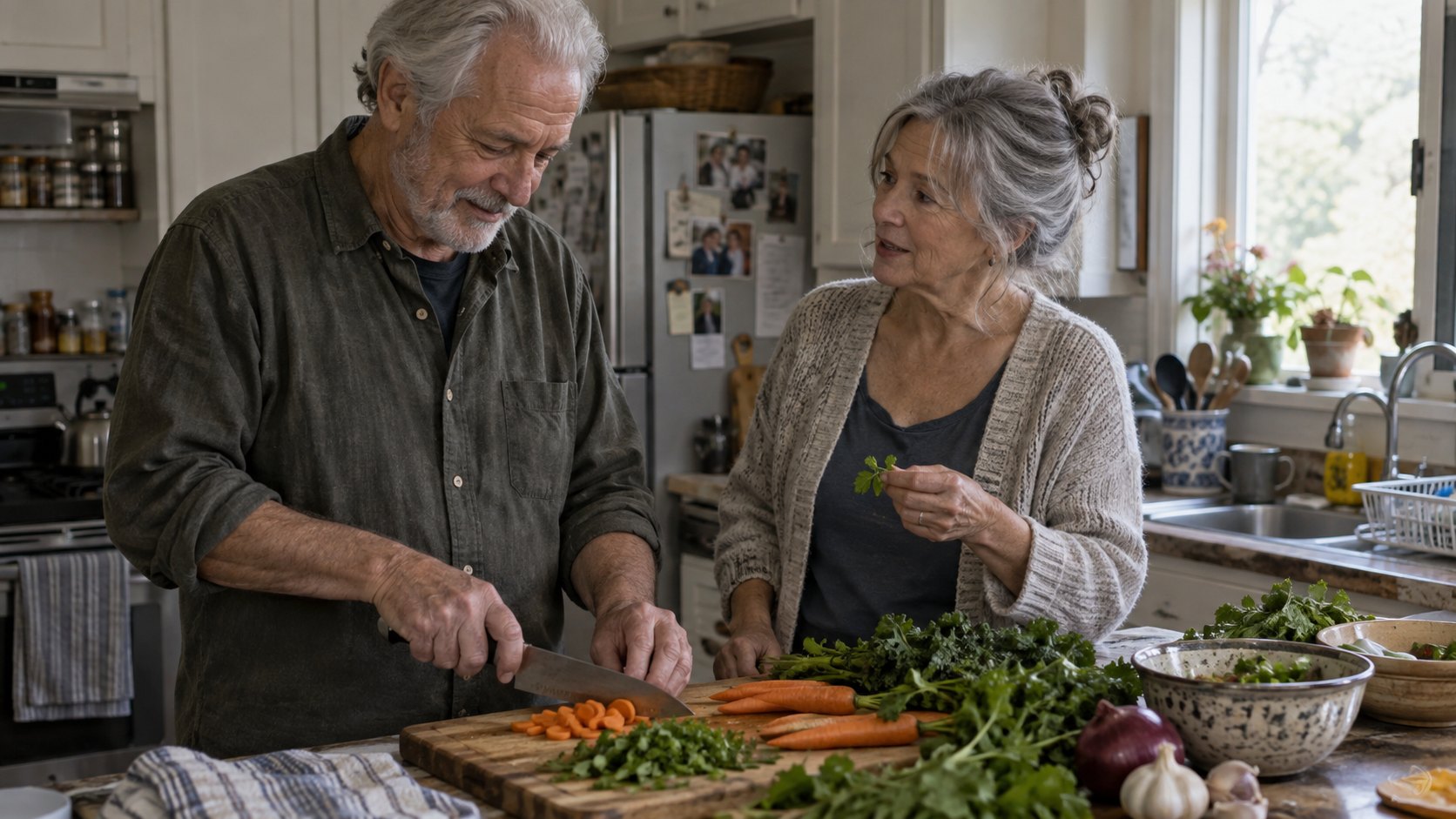
The Headline Numbers
The core finding, consistent across decades and countries: married adults die later. Meta-analytic estimates put the survival advantage in the range of 10–20% lower all-cause mortality for married versus unmarried adults, with the gap consistently larger for men — in some cohorts, the marriage benefit for men is double that for women. The mechanisms are a catalog of the previous topics' biology: a built-in confidant (buffering), health-behavior monitoring (the spouse who notices the mole and books the checkup — men historically outsource this monitoring, which may explain the gender gap), shared economic and routine stability, and lower rates of the risk behaviors (drinking, smoking) that cluster in single young men. The statistical caveat that must accompany every word: selection — healthier, more sociable people marry more and divorce less — explains an unknown share of the gap, and no experiment can randomize marriage.
Quality Is the Actual Variable
The most important finding for practical purposes: the benefit lives in the quality of the relationship, not in the ring. Studies that measure marital quality find the survival advantage concentrates in high-quality marriages; distressed, hostile marriages are associated with worse health than being single — higher blood pressure, worse cardiovascular recovery, and a mortality pattern that erases the "married advantage" entirely. The laboratory version is vivid: couples instructed to discuss a conflict show measurable cardiovascular and hormonal stress spikes, and couples in chronically hostile marriages show slower wound healing — the biology of the previous topics, running in reverse. The honest translation: the longevity question isn't "are you married?" but "is your closest relationship a source of safety or a source of stress?"
What the Good Partnerships Do
If quality is the variable, the follow-up question is what quality is made of — and the relationship literature has a surprisingly concrete answer. The longitudinal predictors of relationship health, in order of evidence: positivity ratio (the famous Gottman finding — stable couples maintain roughly five positive interactions per negative one, and the ratio is a better predictor of survival than almost anything else measurable), responsiveness (answering bids for attention — the small "look at this" moments — which predicts connection better than grand gestures), repair skill (conflict is survivable if ruptures get repaired; the couples who fail aren't the ones who fight, they're the ones who fight without reconciliation), and capitalization (celebrating each other's wins — from the tribe topic's maintenance habits). None of this is about finding the perfect person; it's about running small, repeatable behaviors. The practical implication for a longevity site: the single highest-leverage "relationship intervention" available to most people is repairing their repair skill — and the interventions that do this are old, cheap, and evidence-backed (the structured couple therapies with decades of outcome data).
The Male Vulnerability Finding
One gender pattern deserves its own heading because it shapes so much downstream advice: men's health is more dependent on marriage than women's. The data is consistent — men's survival gap between married and unmarried is roughly double women's, divorced men's risk exceeds divorced women's, and widowed men's first-year mortality spike is steeper. The mechanisms are behavioral more than biological: men's health monitoring, health habits, and emotional disclosure disproportionately route through their partner — while women maintain the wider friendship networks (the deep-vs-weak-ties topic's gender section) that substitute when a marriage ends. The actionable reading is not "men should marry" — it's "men should build the network women already have": a confidant outside the marriage, a health routine that doesn't depend on a partner's nagging, and a friendship portfolio that survives loss. The marriage effect, read correctly, is partly a warning about outsourcing your health to one person.
Divorce, Widowhood, and the Aftershock
The other side of the data is about loss. Divorce carries an elevated mortality risk for years afterward — more for men, and partially explained by the behavior cluster (men's health habits deteriorate more after marital dissolution). Widowhood shows a well-documented "widowhood effect": mortality risk spikes in the months after losing a spouse, strongest in the first year, before gradually settling. The findings aren't fate — the spike concentrates in those left without other supports — but they underline the practical lesson this pillar repeats: one relationship is a risky portfolio. The married with a rich network outside the marriage fare far better after loss than the married whose spouse was their entire social world. Diversification is as sensible in connection as it is in finance.
Cohabitation vs. Marriage: Does the Ring Matter?
A question the data can actually address: is the marriage benefit about the legal status or the living arrangement? The short answer from cohort research: the health benefit tracks cohabitation and commitment more than paperwork. Cohabiting couples show most of the survival advantage of married couples in modern cohorts, and the differences that remain are partly explained by the stability and selection that marriage signals (married relationships are less likely to dissolve, and the mortality benefit grows with duration). The practical conclusion mirrors this topic's theme: the ring is a proxy for the actual active ingredient — a stable, high-quality, cohabiting bond. For the unmarried, the data is permission: build the bond; the certificate is downstream of everything that matters.
Partnership Questions, Answered Briefly
- Is staying single a health risk? Only if single means isolated. The risk attaches to missing support, not missing a spouse — the unmarried with strong networks show no penalty.
- Can a bad relationship be worse than none? Yes — the distressed-marriage data says so explicitly. Leaving an actively hostile relationship, with support, is a health intervention.
- Does having children change the equation? Parenthood's health effects are mixed and life-stage dependent — the robust findings in this literature concern partners, not offspring.
🤝 The unmarried are fine
The strongest single conclusion from this literature, stated for the record: the benefit is support, not paperwork. Unmarried adults with strong friendships, family ties, and community involvement show health outcomes matching or exceeding the average marriage — and better than bad marriages. No one should read this topic as an argument to marry. The intervention it argues for is having at least one relationship of safety — which takes many forms.
The Health-Behavior Channel
A large share of the marriage benefit runs through a surprisingly mundane mechanism: health behavior monitoring. Partners notice the changing mole, enforce the sleep schedule, book the appointments, and — the literature's starkest example — men's five-year survival after a heart attack or cancer diagnosis is measurably better when married, partly because treatment adherence improves with a spouse in the house. The mechanism's honest implication: it's replicable without marriage. A friend who will ask the uncomfortable question ("when did you last get that checked?"), a standing health appointment you never cancel, a wearable that flags the trend — all are partial substitutes for the spouse effect. The marriage literature, read closely, isn't about romance; it's about not being the only person watching your own back.
The Relationship-Quality Ledger
| Relationship state | Associated health pattern | The honest read |
|---|---|---|
| 💍 High-quality marriage | Protective — the survival advantage lives here | Safety beats the certificate |
| 🔥 Distressed marriage | Worse than single — blood pressure and wound healing suffer | The ring isn't the variable; the relationship is |
| 🏠 Committed cohabitation | Most of the married benefit | Support and stability, not paperwork |
| 💔 Divorce / widowhood (year 1) | Elevated mortality — the loss window | Deliberate support belongs in the first year |
The Bottom Line
- The marriage advantage is real but modest — and it's about support, monitoring, and routine, not the certificate.
- Quality is the variable: a distressed marriage is worse for health than being single.
- Loss is a risk window: the first year after divorce or widowhood deserves deliberate support.
- Diversify your bonds: one relationship — however good — is a fragile portfolio.
Go Deeper: Subtopics
- 🔎 The marriage-mortality evidence — the protective numbers, and the crucial caveat: quality, not license. Read it →
- 🔎 Relationship quality vs status — the hostile-marriage cardiovascular data: why a bad marriage beats none in reverse. Read it →
- 🔎 The roommate phase — long-term cohabitation drift and the renewal mechanics. Read it →
- 🔎 Caregiving & the partner's health — the caregiver burden evidence (links Stress pillar). Read it →
- 🔎 Solo by choice — the data on the happily unmarried, and when partnership isn't the goal (links the pillar's own honesty section). Read it →
Related Topics
- Holt-Lunstad, Smith & Layton, "Social relationships and mortality risk: a meta-analytic review," PLOS Medicine (2010)
- Robles et al., "Marital quality and health: a meta-analytic review," Psychological Bulletin (2014)
- Kiecolt-Glaser & Newton, "Marriage and health: his and hers," Psychological Bulletin (2001)
- Rendall et al., "The protective effect of marriage for survival," Journal of Marriage and Family (2011)
- Elwert & Christakis, "The effect of widowhood on mortality by the causes of death of both spouses," American Journal of Public Health (2008)