Behavior Change During Travel, Holidays & Busy Seasons
Every tool in this series is built for ordinary weeks. Travel, holidays, and overloaded seasons are the real test — the weeks when cues vanish and the chain is most likely to break. This page closes the series with a playbook for continuity through the chaos: a floor that keeps habits alive, pre-commitments made before the disruption, and a re-entry plan for the week after, when habits actually break.
What the evidence supports
- Pre-committed if-then plans reliably survive disruption better than in-the-moment willpower (Gollwitzer & Sheeran, 2006).
- Habits are context-bound: change the setting and the cue disappears, so deliberate cue reinstatement is the evidence-backed move (Wood & Neal, 2007).
- Missing a single day did not measurably slow habit formation in the classic 12-week study — one lapse is noise, not a verdict (Lally et al., 2010).
- Holiday weight gain is real but modest — about half a kilogram on average — and most of it was not lost afterward (Yanovski et al., 2000).
What remains uncertain
- No trial has tested a full multi-habit protocol across a holiday season; the transfer from simpler behaviors is plausible, not directly measured.
- The famous "21 or 66 days to automaticity" figures are medians with very wide ranges (18 to 254 days) — treat them as ranges, not deadlines.
- Whether "floor versions" of habits fully protect automaticity is untested; the approach is pragmatic design, not a studied intervention.
Evidence last reviewed: August 20, 2026. Conclusions may change as new research is published.
Why Disruption Is the Real Test
Habits are built in a context and live there: the walk fires because the shoes are by the door, the sit because the cushion is in the corner. Remove the context and the cue stops firing — context change is one of the most reliable habit-breakers in the literature (Wood & Neal, 2007), and travel and holidays are context change on a schedule.
- 🌍 Habits are rented, not owned — a habit holds as long as its cues hold. A hotel room, a relative's kitchen, a 9 a.m. meeting: not failures of discipline, just missing cues. The fix is planned cues, not more effort.
- 📉 Willpower is the wrong backup — travel fatigue, disrupted sleep, and decision overload are exactly where self-control is weakest. Pre-commitment beats restraint, every time (see Part 2 for the mechanism).
- 🔗 The chain, not the streak — the 2-day rule still applies mid-chaos: one miss in a disrupted week is expected; the second miss is the decision.
The Continuity Floor: The Smallest Version That Counts
The core device on this page is the continuity floor: a pre-decided, deliberately small version of each habit that still counts as doing it. The floor exists so a disrupted day ends with a tick on the scorecard instead of a zero, and so re-entry starts from a warm habit rather than a cold rebuild. It is a plan, not a loophole: the floor is set before the trip, and the full version has a scheduled return date.
- 🪜 What a floor looks like — the 5-minute walk, two sets of bodyweight moves, a 3-minute sit. Small enough to survive a 14-hour travel day, real enough that the cue-behavior loop keeps firing.
- ⚖️ Floors are per-habit and per-trip — the floor for a long weekend is bigger than the floor for a two-week international trip. Write both down; deciding mid-trip is how floors become zeroes.
- 🧱 The floor is not a permission slip — its job is to protect the chain. If the floor becomes the routine for months, that is a reset decision (the review page owns it), not a quiet downgrade.
| Habit | Full version | Continuity floor (disrupted days) |
|---|---|---|
| 🚶 Daily walk | 45-minute neighborhood loop | 5 minutes around the hotel block |
| 🏋️ Strength training | Gym session, three sets per movement | Two sets of bodyweight moves in the room |
| 🧘 Meditation | 20-minute sit, morning | 3 minutes before bed, eyes closed |
| 🍽️ Meal structure | Planned home cooking | One deliberate anchor choice per day |
Floor versions are decided in advance, written down, and scheduled to end.
Product picks are generic categories, not brands. We may earn a commission on Amazon or iHerb purchases at no cost to you — this never changes our evidence conclusions. Full disclosure
Comfortable walking shoes
May improve comfort and consistency for walking-based activity.
⚠️ Footwear cannot correct every pain problem; persistent foot, knee, or hip pain warrants appropriate evaluation.
Check price on Amazon →Travel Days: Decide Before You Board
The research on implementation intentions is blunt: a plan written as "if situation X, then behavior Y" roughly doubles the odds the behavior happens, even where willpower is exhausted (Gollwitzer & Sheeran, 2006). That is the travel-day strategy: decide before you board, because the decision-making capacity will not be there after you land.
- ✈️ Write the travel-day if-then — "If I land after 9 p.m., I do the 3-minute floor before bed." One sentence, written before the taxi arrives. The Pre-Commitments for Travel page has the full template.
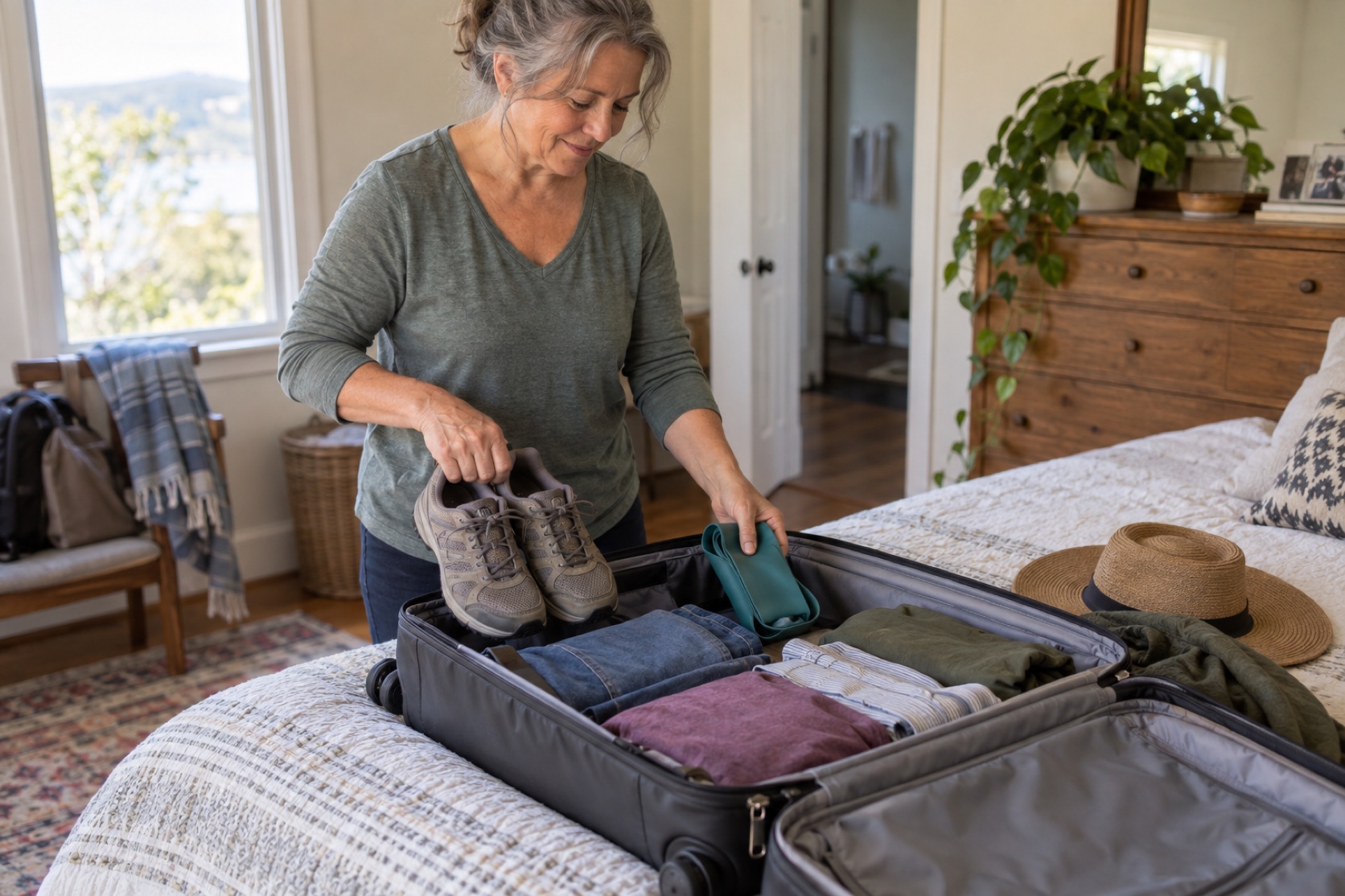
- 🧳 Pack the habit, not just the clothes — walking shoes that actually get worn, a resistance band, the scorecard in the phone. Environment design is the lever here; the friction page explains why the packed shoe beats the good intention.
- 📱 Keep the 0/1 tick alive — a ticked floor counts as the habit. A week of zeroes is how trips become restarts.
- 🤝 Tell one person the floor — one message — "this week's floor is the 5-minute walk" — recruits the witness effect from the social-accountability page.
- ⏰ Book the first re-entry slot before you leave — a calendar block on the first morning home, set while you still have a calendar.
Medications Across Time Zones: Ask First
This page is about habits, and habits have limits: travel, holidays, and busy seasons are never a reason to stop, skip, or shift a medication or clinical care plan. If a trip changes when medication is taken — which time-zone changes genuinely can — the timing question belongs to a clinician or pharmacist, asked before departure.
- 💊 No self-adjustment — stopping or rescheduling prescribed treatment around a trip is a clinical decision; the tools on this site do not override prescriptions.
- 🕐 Timing across time zones is a professional question — ask a clinician or pharmacist how a schedule shift should be handled, and ask before you travel.
- 📋 Keep the care plan visible — refill dates, provider contacts, and the plan in one place for the trip. Logistics are a habit too.
💊 Medications don't take holidays
Nothing on this page overrides a prescription or a care plan. If travel changes when or how you take medication, check with a clinician or pharmacist before adjusting anything — and never let a busy week become the reason a scheduled treatment gets skipped. Flexibility is planning, not perfection.
Holidays: Gather, Eat, Keep the Chain
The holiday table is not the problem; the story that follows it is. The best-known study of holiday weight gain followed 195 adults from Thanksgiving to New Year and found an average gain of about half a kilogram — modest, and most of it was still there months later (Yanovski et al., 2000). The damage was the weeks after, not the meal. That is a planning problem, not a metabolism verdict.
- 🍽️ One meal is a meal, not a collapse — an off-plan dinner is a data point. The chain breaks on the third week of "well, it's ruined anyway," not on the second helping.
- 🧠 The restart story is the real threat — "I already blew it" converts one off-plan day into an off-plan month. The Holidays Without the Restart Story page is devoted to defusing it.
- 🔄 Run the floor through the peak — floors during the holiday week, full versions resuming on a fixed date. The date is the commitment; the floor is the bridge.
- 🎯 Pick one anchor — one habit stays fixed through the holiday (for most people, the walk or the wind-down). One anchor is easier to protect than six, and it keeps the identity story intact.
- 📅 Write the resume date in advance — "full versions return January 2" is a plan. "Sometime after the holidays" is a wish.
Resistance bands
A low-space way to begin or supplement resistance training.
⚠️ Bands can snap and unstable anchoring can cause injury; stop movements that provoke pain.
Check price on Amazon →The Overload Week: Triage, Don't Abandon
A deadline crunch is not the moment for a six-habit protocol — and not the moment to quit the whole stack either. Overload weeks need triage: the same logic as an emergency room, applied to a scorecard. Cut scope, keep the system, and let the week end.
- 🚦 Protect the habit with the most momentum — the one that has been automatic for months survives as a floor; the fragile one gets paused deliberately, not quietly dropped. The Overload-Week Protocol page lays out the triage in order.
- ✂️ Cut scope, not the system — shrink to floors, keep the scorecard ticking. A week of floors is continuity; a week of nothing is a restart.
- 📉 Shrink the scorecard — track one to three habits instead of five during overload. A small honest scorecard beats a large abandoned one.
Re-Entry Is the Danger Zone
The trip itself is rarely where habits die. The week after — luggage, laundry, inbox, and the quiet conviction that you will "get back to it Monday" — is where the chain breaks. Re-entry deserves a plan as serious as the departure, and the pattern is predictable enough to chart.
- 🛬 Treat the first week home like a travel day — floors, pre-decided, with the calendar block already booked. The Re-Entry Week page is the day-by-day version.
- 🧹 Run the weekly review on the first Sunday home — the five minutes from the review page turn "the trip happened" into a score, a fix, and a plan.
- 🌅 Fresh starts are real, and double-edged — temporal landmarks like the first Monday home measurably boost motivation (Dai, Milkman & Riis, 2014). Use the bump, but do not wait for a landmark to restart a chain a floor kept alive.
- 🧯 Do not play catch-up — doubling the session to "make up" for the trip is how the chain breaks a second time. Return to the schedule; the schedule was the plan.
The Disruption Dial
Not all disruptions are equal, and the floor should match the storm. One dial, three settings, decided in advance.
| Disruption | What it looks like | The floor to keep | Setting |
|---|---|---|---|
| 🌤️ Mild | A long weekend, house guests, a lighter week | Keep most habits; drop only the optional extras | Full pace |
| 🌀 Moderate | A week of travel or a real deadline crunch | Floors only, plus one anchor habit kept whole | Floor only |
| 🌪️ Severe | Holiday peak plus a project crunch, or an illness in the family | One habit, three-minute version, on the scorecard | Survival mode |
The dial is set before the disruption, and the recovery date is set with it.
What the Evidence Actually Shows
- 📊 Pre-commitment is the strongest card — implementation intentions roughly double follow-through across dozens of studies (Gollwitzer & Sheeran, 2006), and self-monitoring ranks among the most effective diet-and-activity techniques in meta-regressions (Michie et al., 2009). Both work because they are done before the hard moment.
- 🧭 Context dependence is real — Wood and Neal's habit-goal account (2007) is the theoretical backbone of the floor: habits fire on cues, cues live in contexts, and planned cue reinstatement is the counter to disruption.
- ⚖️ One miss is noise — in the 12-week habit-formation study, a single missed day did not measurably change the trajectory (Lally et al., 2010). The 2-day rule exists because the second miss, not the first, is where the pattern starts.
- 🎄 Holiday drift is small and sticky — the Yanovski study's half-kilogram average is the honest scale of the problem; its lesson is that the weeks after the holiday decide the outcome.
- ❓ What remains untested — no study has run a full multi-habit protocol through a holiday season, and "floor versions" are a design choice, not a measured intervention. Treat the floor as sensible engineering on solid parts, not a tested therapy.
Questions, Answered Briefly
- ❓ What if I miss the entire trip? — Then you missed it. The 2-day rule starts counting from the first day home: one floor session that day, one the next, and the chain reconnects. The restart story is what turns one missed week into a missed month.
- ❓ Should I tell people I'm traveling with? — It helps. A one-line heads-up recruits the witness effect from the social-accountability page and sets the expectation that the floor is real. Most people cheer for it.
- ❓ Isn't it better to just take the week off? — The evidence points the other way: habits are context-bound, and a full stop removes the cues entirely, making the restart a new habit-formation project. The floor keeps the cues alive at near-zero cost. Restarting is the expensive option.
- ❓ What is the single most useful preparation? — The pre-trip if-then, written down: which floor runs on which day, and the date the full versions return. That one sentence is the plan.
🪞 The restart story is the real enemy
One off-plan meal does not break a habit. The story — "well, it's ruined anyway" — is what breaks it, because the story justifies the second week, and the second week is the pattern. The floor exists so the story never gets its opening: continuity is decided in advance, not negotiated mid-chaos.
The Bottom Line
- The floor beats the full version on a disrupted day — a 5-minute version keeps the chain alive; a skipped day is a zero. Perfection was never the goal; continuity is.
- Pre-commit before the disruption, not during it — the if-then written before the trip survives conditions where willpower does not.
- One bad day is a data point, not a verdict — the restart story is the actual threat, and the 2-day rule contains it.
- Re-entry needs its own plan — the week after the trip is when chains break; book the floor, run the review, skip the heroic catch-up.
Go Deeper: Behavior Change During Travel, Holidays & Busy Seasons
These five companion pages turn the topic into smaller, testable practices.
- 🔗 The Continuity Floor
- 🔗 Pre-Commitments for Travel
- 🔗 Holidays Without the Restart Story
- 🔗 The Overload-Week Protocol
- 🔗 The Re-Entry Week
Related Topics
- Lally et al., "How are habits formed: Modelling habit formation in the real world," European Journal of Social Psychology (2010)
- Wood & Neal, "A new look at habits and the habit-goal interface," Psychological Review (2007)
- Gollwitzer & Sheeran, "Implementation intentions and goal achievement: A meta-analysis of effects and processes," Advances in Experimental Social Psychology (2006)
- Yanovski et al., "A prospective study of holiday weight gain," New England Journal of Medicine (2000)
- Michie et al., "Effective techniques in healthy eating and physical activity interventions: A meta-regression," Health Psychology (2009)
- Dai, Milkman & Riis, "The fresh start effect: Temporal landmarks motivate aspirational behavior," Management Science (2014)