Cold Exposure: Plunges, Showers & Brown Fat
Cold exposure is the trendiest hormetic practice in the world and the thinnest on mortality evidence. What it does have: real physiology, a documented mood effect, and a safety profile that deserves more respect than it gets. The honest map.
What the evidence supports
- Cold exposure reliably spikes norepinephrine — one study measured ~250% increases.
- Cold showers associated with ~29% fewer sickness-absence days in a randomized workplace trial.
- Repeated cold activates brown fat, which burns calories and improves glucose handling in small studies.
What remains uncertain
- Zero mortality data — the "cold plunge for longevity" claim is extrapolation from mechanisms.
- Brown fat's metabolic contribution is modest — tens of extra calories per day, not a furnace.
- Optimal dose/temperature/duration is genuinely unknown.
Evidence last reviewed: August 13, 2026. Conclusions may change as new research is published.
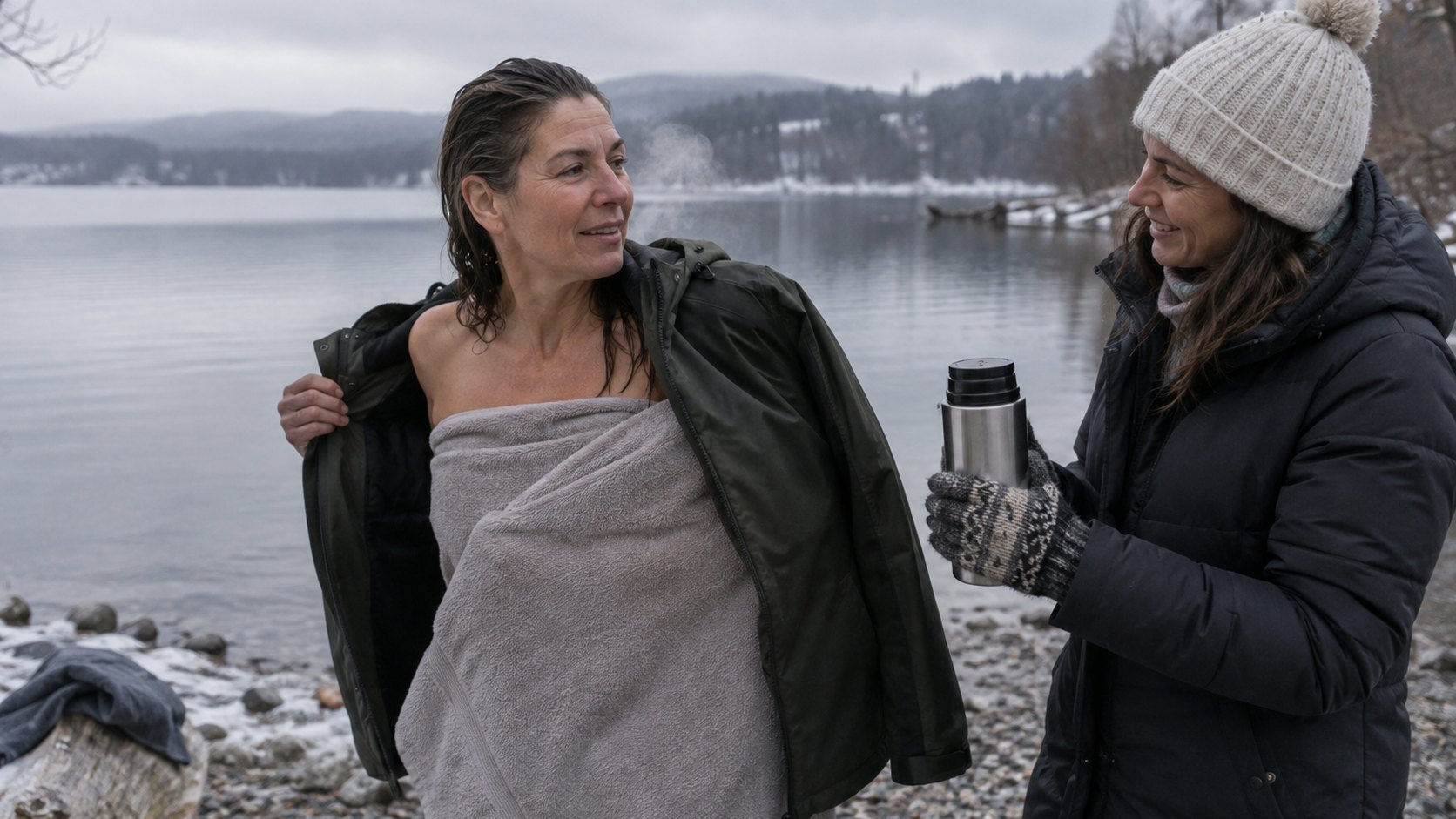
What Cold Actually Does
- ⚡ Norepinephrine surge. Cold shock dumps noradrenaline — the documented 250% spike is the basis of the mood and focus claims, and the basis of the "wired calm" people report after plunges.
- 🐻 Brown fat activation. Cold recruits brown adipose tissue — the heat-generating fat — improving cold tolerance and modestly boosting energy expenditure and insulin sensitivity in repeated-exposure studies.
- 🛡️ Immune nudge. The Dutch trial (~3,000 employees): those ending showers cold reported ~29% fewer sick-leave days — a real, randomized, if modest, finding.
- 🧘 Stress inoculation. Repeated voluntary cold exposure may dampen the startle/stress response — preliminary evidence for the psychological half of the story.
The Honest Limits
What the influencer content rarely includes:
- 📉 No mortality data. Unlike sauna, cold has no cohort showing it extends life. The case rests entirely on mechanisms and small trials.
- 🔥 Brown fat is real but small. The extra calorie burn is measured in tens per day — meaningful for glucose handling, negligible for weight loss.
- 🏋️ Timing vs. muscle. Cold-water immersion immediately after resistance training may blunt muscle growth — evidence-based reason to separate cold and lifting by hours.
- 💊 The "immune boost" is a nudge, not armor — the sick-day reduction is modest and short-term.
🚨 The safety section — read this one
Cold water kills people every year. The cold shock response — the involuntary gasp — happens in the first seconds and can cause drowning. Never plunge alone, never into unfamiliar water, enter gradually on your first exposures, and skip cold entirely with cardiovascular disease, Raynaud's, or during pregnancy without medical clearance. The "embrace the shock" culture is not evidence-based; the gradual-adaptation culture is.
Who Should Skip Cold Entirely
- ❤️ Cardiovascular disease — the cold-shock blood-pressure spike is a genuine risk; clearance first, always.
- 🤰 Pregnancy — evidence for safety during pregnancy is absent; the default is skip.
- 🤚 Raynaud's and cold-sensitive conditions — cold exposure can worsen symptoms.
- 🌊 Anyone without water competence or supervision — the drowning risk is not theoretical.
Cold Questions, Answered Briefly
- Showers vs plunges — is there a real difference? Plunges are a stronger stimulus (bigger norepinephrine spike); showers are the evidence-backed practical dose (the Dutch sick-day trial used showers). Start with showers; graduate only if you enjoy it.
- What temperature counts as "cold"? Cold-adaptation research typically uses 10–15°C water; the shower equivalent is "uncomfortably cold, then a bit colder." Precision matters less than consistency.
- Morning or evening? Morning — cold is an arousal signal, and evening cold can delay sleep for the same reasons late training does (the Pitfalls topic).
The Brown Fat Story, In Full
- 🧱 What it is: brown adipose tissue is fat wired to burn — its mitochondria generate heat instead of storing energy.
- 🐻 Who has it: babies have lots (their furnace); adults retain deposits around the neck and spine — more in lean, younger, cold-adapted people.
- 📊 What repeated cold does: trials show cold acclimation grows brown-fat activity, improves cold tolerance, and nudges insulin sensitivity.
- ⚖️ What it won't do: the extra energy burn is tens of calories daily — brown fat is a metabolic health signal, not a weight-loss furnace. Anyone selling it as one is selling.
Cold and Mood: The Dopamine Question
The most reliable subjective effect — the post-plunge lift — has an emerging mechanistic story: cold exposure raises dopamine, with one controlled study measuring increases comparable to some stimulants, though slower-rising and longer-lasting. The honest caveats: the data is thin (small n, mostly young men), the effect size varies enormously, and whether it's the cold or the ritual, the achievement, or the contrast with comfort that produces the mood change is genuinely unclear. The practical read: if cold reliably makes you feel better, that's a real benefit regardless of mechanism — but it's a mood intervention with a safety manual, not a longevity treatment.
The Bottom Line
- Cold is a legitimate hormetic stressor — with real physiological effects and a documented mood kick.
- But the evidence is far behind sauna — no mortality data, small trials, modest metabolic effects.
- Safety is the headline: never alone, never after alcohol, gradual adaptation over heroics.
- Treat it as optional seasoning — the protocol topic gives the beginner's ramp.
Go Deeper: Subtopics
- 🔎 Brown fat & the cold response — what shivering and non-shivering thermogenesis actually build. Read it →
- 🔎 Cold showers vs plunges — the dose question: what the (thin) human evidence supports at each intensity. Read it →
- 🔎 Cold & mood — the norepinephrine spike and the mood-lift findings, honestly sized. Read it →
- 🔎 Cold after training — recovery gains vs hypertrophy interference: the timing question. Read it →
- 🔎 The Wim Hof phenomenon — what the trials show (immune response claims) and what remains marketing. Read it →
Related Topics
- Buijze et al., "The effect of cold showering on health and work: a randomized controlled trial," PLOS ONE (2016)
- Šrámek et al., "Human physiological responses to immersion into water of different temperatures," European Journal of Applied Physiology (2000)
- van der Lans et al., "Cold acclimation recruits human brown fat and increases nonshivering thermogenesis," Journal of Clinical Investigation (2013)
- Roberts et al., "Post-exercise cold water immersion attenuates acute anabolic signalling," The Journal of Physiology (2015)
- Tipton, "The initial responses to cold-water immersion in man," Clinical Science (1989)