Lifting Through Symptoms
The menopause transition throws heat, pain, and broken sleep directly at the training habit — usually in the same week. The goal of this page is not to argue that exercise cures symptoms; it doesn't always. It is to make the case, symptom by symptom, for which adjustments keep the habit alive, and which signals mean the next step is a clinician, not a different rep scheme.
What the evidence supports
- Exercise reduces knee-pain intensity and improves physical function in knee osteoarthritis with moderate-quality evidence (Cochrane).
- Structured physical activity improves menopause-related quality of life and mood in randomized trials.
- Training on reduced sleep is manageable with autoregulation — the evidence is consistent that performance drops, not that training must stop.
What remains uncertain
- Whether exercise reduces hot-flush frequency or severity: a Cochrane review found insufficient evidence; trials conflict.
- Optimal training adjustments around individual symptom patterns have not been tested in trials — the guidance is reasoned practice, not experiment.
- How much of exercise's mood benefit in midlife is physiology versus the structure and mastery the habit provides.
Evidence last reviewed: August 15, 2026. Conclusions may change as new research is published.
The Symptom Stack vs the Training Habit
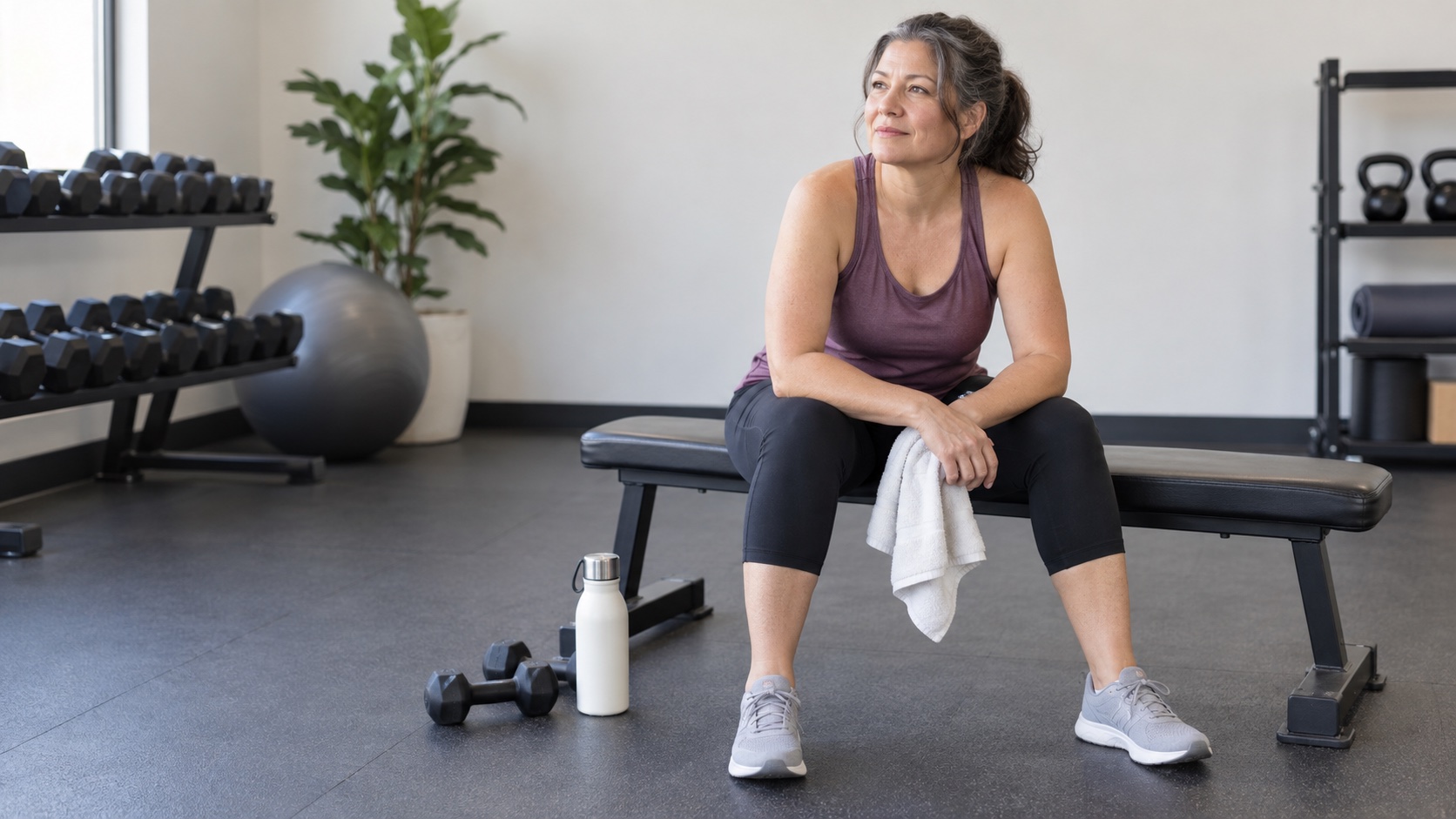
The threats to training through the transition are rarely dramatic — they are a stack of daily frictions. Hot flashes make exercise clothes and heated rooms unpleasant. Night sweats fragment sleep, and sessions on four hours of bad sleep feel harder than the same session on eight. Joint aches make loading scary, and the fear that exercise is "wearing the joints out" is persistent and wrong — the loading is, if anything, the treatment, as the next section shows. Mood dips drain the motivation that starting requires. The net effect is that the intervention with the strongest evidence for exactly this population is the one most likely to be skipped on the days it would help most. The design principle that follows: protect the habit first, optimize second. A modified session beats a skipped one, every time, because the habit — not any single session — is what carries the long-term benefit the parent topic documents.
Hot Flashes: What the Evidence Does Not Promise
Start with the honest null. The Cochrane review on exercise for vasomotor symptoms concluded there was insufficient evidence that exercise reduces the frequency or severity of hot flushes (Daley et al., Cochrane, 2014) — the trials are small, short, and contradictory. One Finnish randomized trial found six months of aerobic training reduced night sweats and improved quality of life even while daytime flush frequency barely moved (Luoto et al., Annals of Medicine, 2012), and a review of the whole exercise-in-menopause literature reached a similar split verdict (Stojanovska et al., Maturitas, 2014). The practical reading: do not train because it will stop the flushes — evidence will not back that promise. Train because of muscle and bone, and manage the flushes around it: schedule sessions for your coolest time of day, wear layers you can shed between sets, keep water cold, and skip pre-session caffeine and alcohol if they predictably trigger yours. The temperature problem is an environment problem, and environment problems are fixable.
Joint Pain: The Better News
Joint pain is where the evidence actually smiles. In knee osteoarthritis — common by midlife, and more common in women — exercise reliably reduces pain and improves function, with moderate-quality evidence and an effect size around half a standard deviation on pain (Fransen et al., Cochrane, 2015). The mechanism is not "wearing the joint out faster"; cartilage responds to regular loading by improving its lubrication and the muscles around the joint share the load it would otherwise carry alone. The adjustments that keep loading comfortable are specific:
- 🪜 Range first, load second. Work through the pain-free range of motion with light or no weight, and add load only through ranges that stay comfortable.
- 🔁 Prefer higher reps at lower load. When a joint is angry, 12–15 smooth reps at reduced weight keep the muscle stimulus without the joint's peak load.
- 🚶 Motion is the countermeasure. Joints stiffen from stillness; the morning walk or a few minutes on a bike before lifting warms the fluid and sets the tone for the session.
- 📈 Progress by tolerance, not schedule. Add load when the joint is quiet, hold when it isn't — the strength still accumulates, just on a wavier line.
The line that matters: soreness that settles with movement and mild stiffness are normal; a hot, swollen joint, or pain that worsens sharply during or after loading, is a clinician's call, not a program-design problem. The strength-training-after-40 topic owns injury-proofing in depth.
Training on Bad Sleep
Broken sleep is the transition's most reliable training tax. The physiology is consistent: after poor sleep, perceived effort rises, mood sags, and maximal performance dips a few percent, while submaximal strength is surprisingly preserved (Fullagar et al., Sports Medicine, 2015). Two consequences follow. First, a bad night is not a reason to skip — a reduced session still counts, and keeping the appointment is what preserves the habit. Second, the right reduction is in volume and complexity, not in showing up: drop a set, keep the same movements, keep loads light to moderate, and treat the session as maintenance rather than progress. Save the session you are proud of for the week you slept. The deeper fix — the insomnia itself — belongs to the Sleep, Mood & the Shift topic and the sleep protocol; this page is about training around it.
The Autoregulation Rules
| Symptom | What training does | In-session adjustment | Evidence note |
|---|---|---|---|
| 🔥 Hot flashes | Little direct effect on frequency | Cool time of day, layers, cold water; lower intensity on flush-heavy days | Weak evidence |
| 🦵 Joint pain | Reduces pain, improves function | Pain-free range, higher reps, lighter load; progress by tolerance | Good evidence |
| 😴 Sleep debt | Performance dips modestly; habit is preserved | Drop a set or load; maintenance session, not progression | Mixed |
| 🌧️ Mood and motivation | Consistent improvement in trials | Commit to the first five minutes; let the session earn its keep from there | Good evidence |
| 🥱 Fatigue | Transient cost, long-run energy gain | Shorten the session; keep the two-day rhythm even at half volume | Mixed |
- 📏 Rate effort, not absolutes. Keep sessions in the RPE 5–7 band — hard enough to matter, easy enough to repeat. On symptom-dense weeks the same RPE simply lands on lighter weights, and that is the system working, not failing.
- 📓 Log symptoms next to sessions. Ten seconds of note-taking reveals the patterns — which days of your cycle, which sleep totals, which movements — that make training feel terrible, and lets you schedule around them.
- ⏱️ Keep a fifteen-minute floor. On the worst days, do the warm-up and one movement well. The floor protects the appointment, and the appointment is the asset.
- 🔁 Swap, don't skip. A flare in one joint is a chance to train the other three limbs and the opposite movement pattern. The body does not need a unanimous vote to adapt.
⚠️ When the symptom is a sign, not a nuisance
A hot, swollen joint; pain that is sharp, mechanical, or wakes you at night; chest pain or unusual breathlessness with exertion; dizziness; or night sweats accompanied by fever or weight loss — these are not program-design problems. They warrant a clinician's eyes before the next session, and nothing on this page substitutes for that conversation. Training around ordinary transition symptoms is fine; training through red flags is not.
Questions, Answered Briefly
- 🔥 Should I skip training on hot-flash days? No — the flushes don't care, and skipping costs you the session. Schedule cool, dress in layers, and reduce intensity if the heat itself is exhausting.
- 🦴 Will lifting make my joints worse? The evidence runs the other way for osteoarthritis: regular loading reduces pain and improves function. What needs respect is acute, sharp, or swollen pain — that pauses training and books an appointment.
- 🌙 Is it better to train tired or not at all? Train, reduced. A bad night costs a few percent of performance, not the session's worth; do one fewer set and keep the appointment.
- 😩 I have no energy to start — is something wrong? Fatigue is a real transition symptom, and it is also a load-management problem: if you can start, you will usually finish better than you feared. If fatigue is unrelenting, that is a clinician conversation about anemia, thyroid, and sleep.
- 📅 What counts as a successful week? Two sessions completed at any sensible volume, plus one walk. The muscle does not know the difference between a perfect and a reduced week nearly as well as it knows the difference between two sessions and zero.
The Bottom Line
- Protect the habit, optimize second — a modified session beats a skipped one, and the habit is what carries the muscle and bone benefits.
- Do not oversell exercise for hot flushes — the Cochrane verdict is insufficient evidence; manage the environment instead of expecting the training to stop the heat.
- Joint pain is the one symptom where exercise is the treatment — moderate-quality evidence for knee osteoarthritis, with range-first, tolerance-paced loading as the method.
- Autoregulate, don't abandon — RPE 5–7, a fifteen-minute floor, symptom logging, and a sharp eye for the red flags that belong to a clinician.
Related Topics
- Daley A et al., "Exercise for vasomotor menopausal symptoms," Cochrane Database of Systematic Reviews (2014)
- Fransen M et al., "Exercise for osteoarthritis of the knee," Cochrane Database of Systematic Reviews (2015)
- Luoto R et al., "Effect of aerobic training on hot flushes and quality of life — a randomized controlled trial," Annals of Medicine (2012)
- Elavsky S, McAuley E, "Physical activity and mental health outcomes during menopause: a randomized controlled trial," Annals of Behavioral Medicine (2007)
- Fullagar HH et al., "Sleep and athletic performance: the effects of sleep loss on exercise performance, and physiological and cognitive responses to exercise," Sports Medicine (2015)
- Stojanovska L et al., "To exercise or not during menopause: the role of exercise in women's health," Maturitas (2014)