Orthosomnia & Over-Tracking
A device meant to measure sleep began, for some people, to ruin it. In 2017 a team of sleep clinicians named the pattern — "orthosomnia," the perfectionistic pursuit of a better sleep score — and the case files read like a fable: patients whose obsession with the number was the thing keeping them awake. This page unpacks the quantified-self trap, sorts what trackers measure well from what they don't, and ends with the data-detox prescription.
What the evidence supports
- A named clinical literature documents people whose sleep measurably worsened under obsessive self-tracking (Baron et al., Journal of Clinical Sleep Medicine, 2017).
- Consumer devices estimate total sleep time and wake timing reasonably well but classify sleep stages poorly compared with lab polysomnography.
- Sleep-related anxiety raises bedtime arousal — a mechanism that makes score-chasing self-defeating by design.
What remains uncertain
- How common orthosomnia is in the general population — the case literature is suggestive, not a prevalence estimate.
- Whether tracking helps or harms on average: trials of consumer wearables show mixed and mostly modest effects on sleep.
- Where the line sits between useful awareness and harmful obsession for any given person.
Evidence last reviewed: August 15, 2026. Conclusions may change as new research is published.
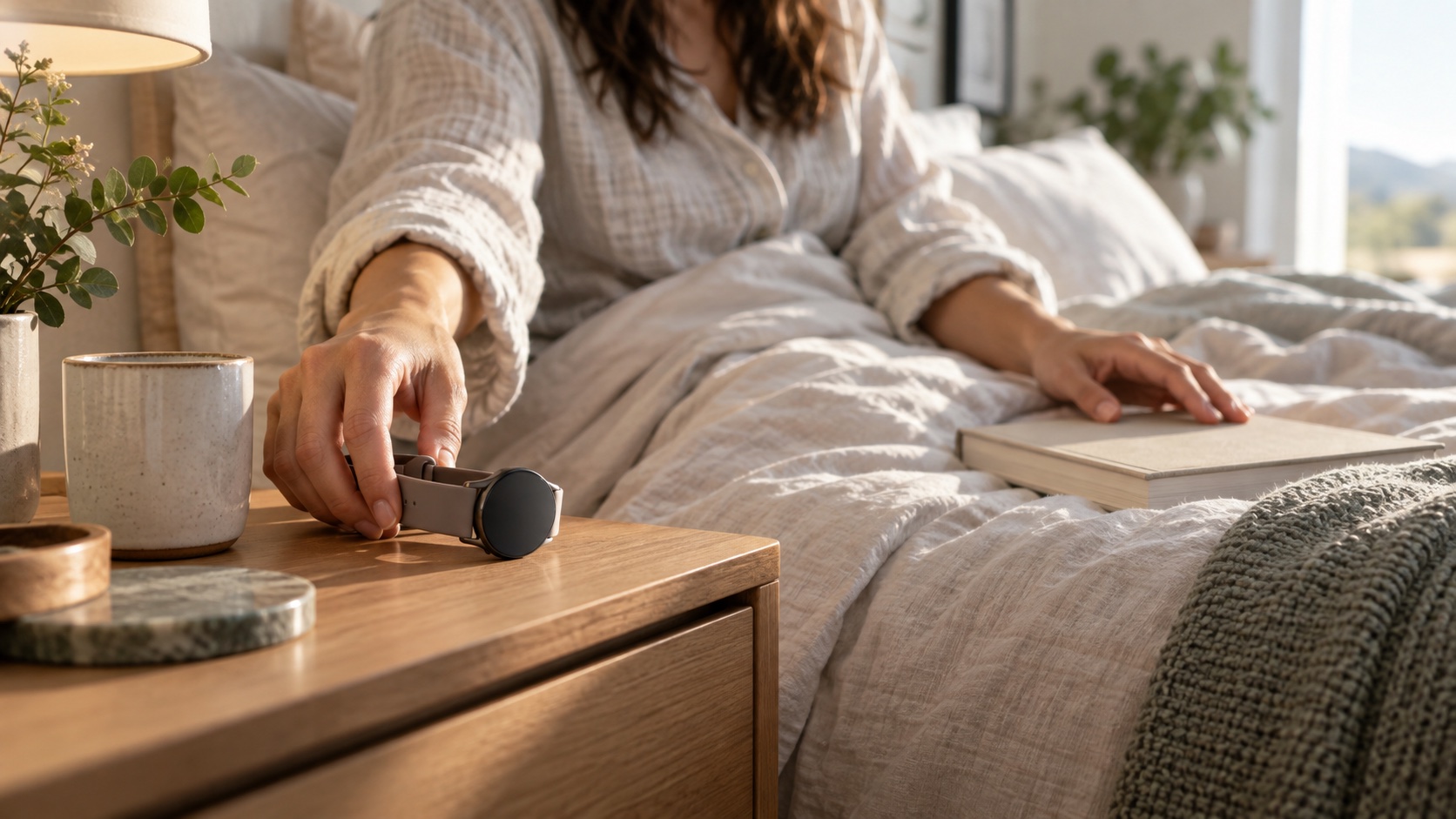
What Orthosomnia Is
The term entered the literature through a clinical observation, not a theory. Baron and colleagues, writing in the Journal of Clinical Sleep Medicine in 2017, described patients who arrived at sleep clinics armed with months of tracker data — and whose chief complaint was, in effect, the tracker. They spent hours in bed chasing a perfect sleep score, woke in the night to check the app, and treated a "fair" recovery rating as a personal failure. The trap is structural: a metric that was supposed to measure sleep became a stressor inside it, and bedtime arousal is the precise opposite of what the Sleep pillar's repair science says the first minutes of the night need. The cortisol topic explains the physiology: vigilance at lights-out keeps the arousal system on, and sleep onset is a process of standing it down.
Product picks are generic categories, not brands. We may earn a commission on Amazon or iHerb purchases at no cost to you — this never changes our evidence conclusions. Full disclosure
Smart band or smartwatch
Can make activity, exercise, and routine patterns easier to notice over time.
⚠️ Step, heart-rate, and sleep estimates can be inaccurate and may encourage unhelpful over-monitoring; consumer readings are not medical diagnoses.
Check price on Amazon →What Trackers Measure Well — and Badly
The device is not the villain of the story; the category confusion is. Consumer trackers estimate sleep from movement and heart rate, not from brain activity, and the two methods agree on some things and diverge sharply on others. In a 2021 comparison of seven consumer devices against laboratory polysomnography, devices were reasonably close on total sleep time but substantially worse at classifying the architecture of sleep — the deep-versus-REM split that scores love to emphasize (Chinoy et al., Sleep, 2021). In plain terms: your watch has a decent guess about how long you slept and a rough guess about which stages you visited. It does not have an opinion you should feel anxious about.
The chart's shape is the finding. Tracking changes the person more than the sleep: awareness and anxiety move, while duration and quality barely do. When a tool's main measurable effect lands on the user's nervous system rather than the user's sleep, it has become a stressor — and the question stops being whether it works and becomes whether it is worth it.
How the Trap Works
- 🎯 The goal migrates. It starts as "sleep better" and quietly becomes "make the number go up" — a target the device can measure but you cannot directly control, which is the psychological formula for bedtime rumination.
- 🔄 The feedback loops on the wrong lag. Sleep quality responds to what you did all day and all week, but the score refreshes nightly — so the optimization reflex attaches to tonight, the one thing you can't control.
- 📉 The error bars vanish. A device that can miss total sleep time by 30–60 minutes presents its estimate as a precise integer. Precision theater plus anxiety equals overreaction to noise.
- 🌙 Bedtime becomes performance. The person who needs their wind-down most — the high-achiever who already treats life as a scoreboard — is exactly the person the device converts into a night-shift auditor.
None of this requires the device to be wrong about everything. The trap runs on the metrics that are half-right: the ones persuasive enough to believe and noisy enough to mislead.
Why the Strongest Self-Trackers Suffer Most
The cruelest detail in the case reports is who gets caught: not careless people, but conscientious ones. The trait that makes someone a disciplined tracker — perfectionism, high standards, comfort with metrics — is the same trait that converts a noisy number into a nightly verdict. Sleep is uniquely vulnerable to this, because effort works against it.
- 📈 Optimizers start at a disadvantage. The people drawn to tracking often already run their lives as scoreboards; sleep becomes one more column, and bedtime becomes a performance review.
- 🧠 Anxiety compounds nightly. Reviews of tracker users find that more anxious individuals derive more worry from the same data — the feedback loop tightens exactly where it should loosen.
- 🎯 Sleep is a self-sabotaging target. The harder you aim at falling asleep, the further it recedes — performance effort raises arousal, and arousal is the enemy. No other health metric punishes trying as directly.
The Data-Detox Prescription
The prescription in the orthosomnia literature is almost embarrassingly simple, which is probably why patients resist it: stop measuring. The parent topic frames this as the tracker's own hormesis problem — the habit that outgrew its dose.
📵 The one-to-two-week data detox
Take the device off — not just at night, but entirely, including the app — for one to two weeks. If you want data afterward, keep exactly one metric: wake-time consistency, checked in the morning, never in bed. The purpose of the detox is diagnostic as much as therapeutic: if your sleep anxiety evaporates without the tracker, you have identified the stressor, and it was not your mattress. If genuine sleep problems persist with no tracker in sight — chronic insomnia, unrefreshing sleep, witnessed pauses in breathing — that is the signal to talk to a clinician rather than to reinstall the app, because some sleep problems deserve a lab, not a wearable.
Tracking Well: The Keep List
The honest conclusion is not "trackers are bad" — it's that most of the value sits in the boring columns. The same minimalist logic the zone 2 topic applies to training — one honest, cheap signal, trended over weeks — applies to sleep.
| Metric | What it actually measures | How well | Read |
|---|---|---|---|
| 🌅 Wake-time consistency | Behavioral regularity — the circadian anchor | Accurate | Keep |
| 🛏️ Time in bed | Duration of the sleep opportunity | Good | Keep |
| ❤️ Resting HR trend | Autonomic state, week over week | Good | Keep |
| 🌙 Deep / REM split | Stage classification vs brain waves | Poor | Delete |
| 🔋 Readiness / sleep scores | Proprietary blend of the above | Unvalidated | Delete |
Two of the five rows are the point: the metrics worth keeping are the ones you could track with a pencil and a wall clock. The expensive columns — the stage split and the composite score — are where the trap lives, because they are the most interesting and the least accurate. The measuring-your-own-stress page applies the same keep-versus-delete discipline to stress metrics, and the red-flag triad page shows how the keep-list — resting HR, HRV trend, sleep continuity — doubles as an overtraining early-warning system when read weekly instead of nightly.
Questions, Answered Briefly
- 😴 My score says 3h deep sleep and I feel fine — which is right? You are. Stage estimates from consumer devices disagree with lab EEG often enough that a single night's stage split is not worth an emotion, let alone an intervention.
- ⌚ Should I track HRV instead of sleep stages? If you must track something, the red-flag triad — resting HR, HRV trend, sleep continuity — is the evidence-based set. Trend it weekly; ignore it nightly.
- 📵 How do I know the detox worked? Two markers: you stop thinking about the number at bedtime, and your sleep stops feeling like a test. Both usually arrive within the first week — which is itself the diagnosis.
- 🛏️ What if sleep is genuinely bad? Then treat it like the sleep protocol treats it: consistent timing, wind-down, dark, cool — the behaviors, not the score. Persistent problems without the tracker are a clinician conversation, not a data problem.
The Bottom Line
- Orthosomnia is a documented clinical pattern — for some people, the tracker becomes the stressor, and bedtime arousal is the opposite of sleep physiology.
- Trackers are good at duration and timing, poor at stages and scores — the most interesting columns are the least accurate ones.
- The trap runs on half-right metrics — persuasive enough to believe, noisy enough to mislead, refreshed often enough to obsess over.
- The prescription is boring and effective — one to two weeks off the device, then at most one metric, checked in the morning, never in bed.
Related Topics
- Baron, Abbott, Jao, Manalo & Mullen, "Orthosomnia: are some patients taking the quantified self too far?" Journal of Clinical Sleep Medicine (2017)
- Chinoy et al., "Performance of seven consumer sleep-tracking devices compared with polysomnography," Sleep (2021)
- Baron et al., "Feeling validated yet? A scoping review of the use of consumer-targeted wearable and mobile technology to measure and improve sleep," Sleep Medicine Reviews (2018)
- Depner et al., "Wearable technologies for developing sleep and circadian biomarkers: a summary of workshop discussions," Sleep (2020)