The Blue Zones Downshift, Evidence-Checked
The Blue Zones brand sells one idea better than any other: that long-lived people know how to stop. Sardinians gather at five, Ikarians nap, Okinawans honor ancestors, Adventists shut the week down. This page takes the four rituals out of the travel writing and puts each one against what the research actually measured — because some of them earn their reputation, and some ride along on it.
What the evidence supports
- Short, scheduled siestas associate with lower coronary mortality in cohort data — the effect is specific to deliberate naps of modest length.
- Regular attendance at religious services associates with meaningfully lower mortality, above and beyond standard risk factors.
- The social components of these rituals — unhurried, agenda-free company — carry independent stress-reduction evidence.
What remains uncertain
- The rituals cannot be isolated from everything else Blue Zone populations do — diet, movement, and social structure travel with them.
- Long, unplanned daytime dozing associates with worse outcomes, and the direction of that association is unresolved.
- Whether the wine adds anything beyond the social ritual is doubtful; at population level, alcohol's risks rise with every dose.
Evidence last reviewed: August 15, 2026. Conclusions may change as new research is published.
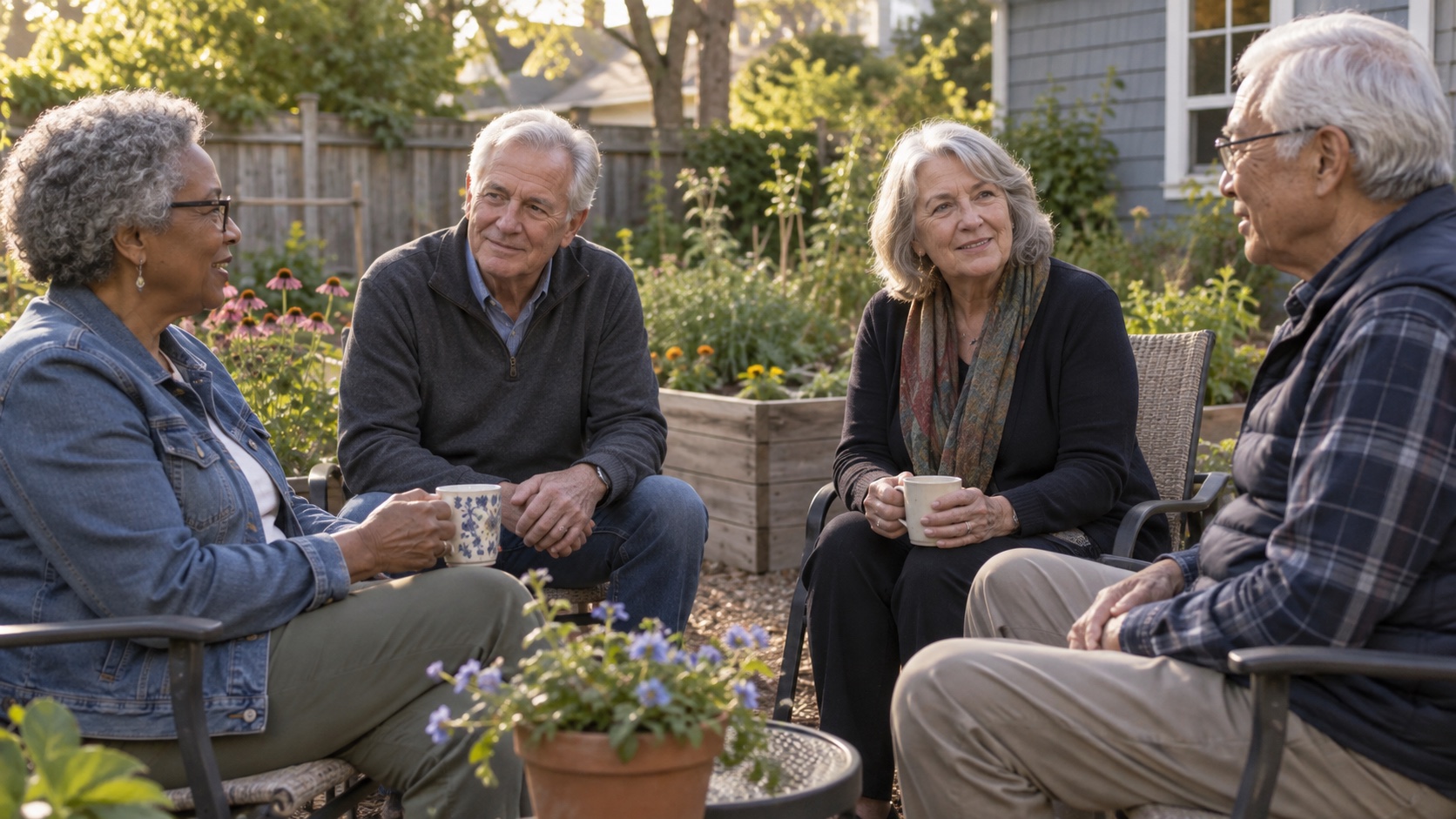
Four Rituals, Separated From Their Aura
The parent topic introduced the downshift as a category: scheduled rest that happens whether or not it was earned. This page does the accounting the parent deliberately skipped — ritual by ritual, what survives contact with the literature. The Blue Zone fieldwork itself is honest about its limits: Buettner and Skemp's review (American Journal of Lifestyle Medicine, 2016) describes patterns, not experiments, and the Relationships pillar has already documented how hard it is to separate any single Blue Zone habit from the community around it. So the question here is narrower and more useful: for each of the four rituals — siesta, happy hour, prayer, and the informal doze — what does the evidence say the ritual itself contributes?
- 😴 The siesta is a scheduled midday sleep, culturally protected, 20–30 minutes. It has the strongest evidence profile in the set.
- 🍷 The happy hour is a daily, agenda-free social gathering — in Sardinia, wine is present but incidental to the company.
- 🙏 Prayer & ancestor veneration is the daily reflective pause — Okinawan ancestor rituals and Adventist prayer bracket the day with quiet repetition.
- 🛋️ The informal doze — the unscheduled lie-down, no alarm, no ritual frame — is what people often mean by "napa," and it is the weakest leg of the table.
The Siesta: The Strongest Data in the Set
The headline number comes from the Greek EPIC cohort: among 23,681 adults followed for about six years, people who took regular midday siestas showed coronary mortality roughly a third lower than non-nappers — and in working men the association was strongest (Naska et al., Archives of Internal Medicine, 2007). Adjusted for age, smoking, diet, and physical activity, the association held. That is cohort data, not a trial, so it inherits all the usual caveats — but it is also the largest, most carefully adjusted look at scheduled napping we have, and its size (a hazard ratio near 0.66 for regular nappers) puts the siesta in the company of lifestyle factors people take far more seriously.
Two details matter for translation. First, the benefit tracked deliberate, modest naps — the 20–30-minute lie-down with an alarm, not an open-ended collapse. Shorter naps improve alertness and mood without sleep inertia, and experimental work on habitual nappers shows cognitive benefits on the same day (Dutheil et al., International Journal of Environmental Research and Public Health, 2021). Second, the dose-response bends the other way at the long end: naps beyond an hour associate with higher mortality in cohorts, and a large genetic analysis of daytime napping (Dashti et al., Nature Communications, 2021) suggests much of that is the body signaling, not causing — unwell people doze long. The honest read: short scheduled naps are a supported practice; long daily dozing is a sign to look at, not a habit to copy.
The Happy Hour: The Social Engine, Not the Wine
Sardinia's five-o'clock gathering is usually retold as a wine story — Cannonau, resveratrol, the "wine at five" line from the Power 9. The evidence splits sharply here, and the split matters. On the wine itself, the most comprehensive pooled analysis of US adults found a J-curve: light drinking associated with modestly lower cardiovascular mortality but higher cancer mortality at every dose, with the scales meeting somewhere near one small drink per day (Xi et al., Journal of the American College of Cardiology, 2017). There is no dose at which alcohol's net effect is clearly favorable — the cardiovascular bump and the cancer cost roughly cancel, and both are small.
But the happy hour has a second ingredient that survives the audit untouched: it is a daily, protected, agenda-free social hour. That is the Relationships pillar's entire thesis — frequent low-stakes contact is one of the best-replicated health findings in epidemiology — and in that frame the Sardinian ritual is a delivery mechanism for it. The honest translation: keep the hour, keep the company, and treat the glass as optional. Nobody's mortality data depend on the Cannonau.
Prayer & the Quieting Effect
The Okinawan version of the downshift is ancestor veneration — a few quiet moments each day before the household altar — and the Adventist version is Both are repetitive, reverent, and scheduled, which makes them cousins of a practice the stress literature already understands: the meditation topic documents what repetitive, attention-narrowing practice does to the stress axis the cortisol topic maps. The ritual supplies the container; the physiology responds to the repetition.
The outcome data come mostly from attendance, not private prayer. In the Nurses' Health Study, women who attended services more than once a week had all-cause mortality roughly a third lower than non-attenders over 16 years, adjusted for health behaviors and social support (Li et al., JAMA Internal Medicine, 2016). The review literature tells the same story with the same caveat: religious involvement consistently associates with lower mortality and better mental health, and most of the effect appears to run through social integration, meaning, and health behaviors rather than any supernatural mechanism (Koenig, ISRN Psychiatry, 2012). That is exactly why the Purpose pillar treats belief and belonging as separate, testable things — and why the downshift version of prayer works for the non-religious as a structured pause, not a doctrine.
The Informal Doze: Weakest Leg of the Table
"Napa" — the unscheduled doze, the recliner version, rest that happens without a frame — is where the Blue Zones story and the evidence part company. The distinction that keeps appearing in the data is the one between scheduled and unscheduled rest. The EPIC siesta was culturally regular: same time, same duration, an institution. The informal doze is the opposite — it happens when energy fails, not when the clock says so — and the literature reads it accordingly: daytime sleeping that is long, frequent, and unplanned associates with higher cardiovascular risk and higher mortality, with researchers leaning toward reverse causation (the genetics study by Dashti and colleagues supports this read).
| Ritual | Core ingredient | What the evidence supports | Read |
|---|---|---|---|
| 😴 Siesta (scheduled) | 20–30 min, culturally fixed, alarm-set | Lower coronary mortality in EPIC cohort; same-day alertness and mood gains | Good |
| 🙏 Prayer / ancestor ritual | Daily reflective pause; attendance adds community | Attendance strongly associated with lower mortality; mechanism partly social | Good |
| 🍷 Happy hour | Agenda-free daily social contact | Social component well supported; alcohol component nets out near zero | Moderate |
| 🛋️ Informal doze | Unscheduled, unplanned daytime sleep | Long or frequent dozing marks poor health; little support as a practice | Weak |
The practical rule that falls out: if you adopt a nap, adopt the frame around it — the clock time, the alarm, the protected slot. The frame is not ritual theater; it is what separates the practice the data support from the behavior the data flag.
🍷 The wine is the weakest leg of the table
Every Blue Zone retelling foregrounds the Cannonau, and the alcohol literature will not cooperate: cancer risk rises from the first drink (Xi et al., JACC, 2017), and what the happy hour actually contributes — company, predictability, permission to stop — needs no glass at all. The ritual survives intact if you hold sparkling water instead. The reverse is not true: wine without the ritual buys you the risks and none of the downshift.
Questions, Answered Briefly
- 📅 Should I nap every day? If your schedule and night sleep permit: yes — 20–30 minutes, before 3pm, alarm on. If napping becomes long or unavoidable, that is a signal about your nighttime sleep, not a lifestyle upgrade.
- 🙏 Do I need religion for the prayer benefit? No. The physiological layer — repetitive, reverent, scheduled attention — is portable, and the meditation topic covers the secular version. The attendance benefit is social; a standing weekly gathering of any kind carries part of it.
- 🍺 Is one glass of wine fine? Population data show no dose with a clearly favorable net balance; individual risk depends on your own history. This is a conversation for you and your clinician, not a ritual requirement.
- 🌍 Which ritual should I start with? The siesta — it has the strongest evidence and the smallest lifestyle cost. The daily unplug ritual page shows the portable version for schedules that will never see a Mediterranean afternoon.
The Bottom Line
- The rituals are not equal. The scheduled siesta and weekly service attendance carry real cohort evidence; the informal doze and the wine do not.
- The frame is the intervention. What separates the supported siesta from the flagged doze is the schedule, the alarm, and the protected slot — not the sleep itself.
- Social company is the happy hour's engine. Keep the hour and the people; the alcohol contributes risks, not protection.
- Copy the pattern, not the props. The portable versions of all four rituals are covered in the daily unplug ritual and the Sabbath page.
Related Topics
- Naska et al., "Siesta in healthy adults and coronary mortality in the general population," Archives of Internal Medicine (2007)
- Xi et al., "Relationship of alcohol consumption to all-cause, cardiovascular, and cancer-related mortality in U.S. adults," Journal of the American College of Cardiology (2017)
- Li et al., "Association of religious service attendance with mortality among women," JAMA Internal Medicine (2016)
- Buettner & Skemp, "Blue Zones: lessons from the world's longest lived," American Journal of Lifestyle Medicine (2016)
- Dashti et al., "Genetic determinants of daytime napping and effects on cardiometabolic health," Nature Communications (2021)
- Dutheil et al., "Effects of a short midday nap on habitual nappers' alertness, mood and cognitive performance," International Journal of Environmental Research and Public Health (2021)
- Koenig, "Religion, spirituality, and health: the research and clinical implications," ISRN Psychiatry (2012)