Nighttime Blood Pressure and the “Dipping” Pattern
Blood pressure usually falls while a person is asleep, but the size of that overnight change varies—and a cuff reading is not a verdict. This guide explains what ambulatory nighttime measurements capture, what “dipping” means, and why clinicians interpret the numbers alongside the actual sleep period, symptoms, and the rest of a person’s health.
What the evidence supports
- Ambulatory monitoring can estimate awake and asleep blood pressure across an ordinary day and night.
- A sleep-time fall of about 10% is a common definition of a “dipping” pattern, not a stand-alone diagnosis or treatment target.
- Sleep-time blood pressure and its day–night pattern are associated with cardiovascular risk in observational research.
What remains uncertain
- A single recording may not represent a person’s usual night; sleep disruption and the timing of readings can affect classification.
- There is no simple rule that turns an isolated dipping label into an individual forecast or medication decision.
Evidence last reviewed: October 6, 2026. Conclusions may change as new research is published.
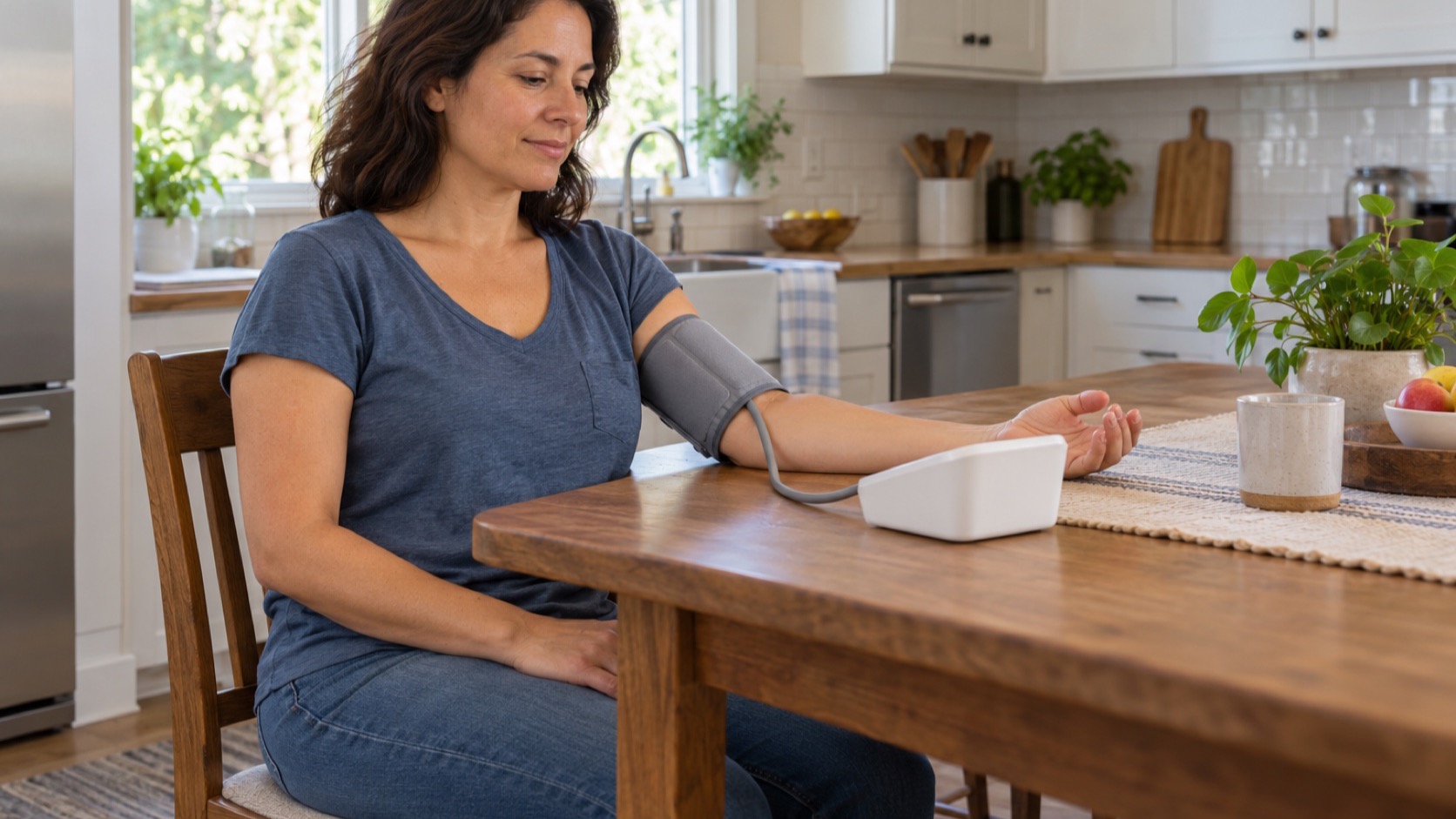
What “nighttime blood pressure” means
A clinic measurement is a short sample taken while someone is awake. Ambulatory blood-pressure monitoring (ABPM) instead uses a portable cuff to collect readings during daily activities and sleep, commonly over about 24 hours. The aim is not to catch one dramatic moment; it is to estimate average pressure across the person’s waking and sleeping periods. Research reviews describe sleep-time blood pressure as clinically informative, while also emphasizing that the method and interpretation need care (Kwon et al., Blood Pressure Monitoring, 2020).
“Night” should mean the individual’s sleep interval, not automatically a fixed block on the clock. A day worker who sleeps at night, a rotating-shift worker sleeping in the morning, and a person who naps have different rest windows. A diary that records when the person tried to sleep, woke, and got out of bed helps the interpreting clinician align the readings with sleep and wakefulness. Some devices also use actigraphy or patient-entered times. If the intervals are assigned incorrectly, an average labelled “night” may include time awake, or miss part of sleep.
ABPM measurements are intermittent, not a continuous artery-pressure trace. Cuff inflation can wake a person or change their position. That does not make the result useless, but it is part of the measurement context. A report is strongest when it includes the measurement schedule, number of valid readings, sleep diary, and whether the night was typical. One cuff reading from a consumer device cannot recreate the full-day information from a properly fitted ambulatory monitor.
The dip is a comparison, not a heart-health score
During consolidated sleep, blood pressure often averages lower than during wakefulness. A conventional calculation compares the mean asleep value with the mean awake value: subtract the sleep average from the awake average, divide by the awake average, then express the result as a percentage. A fall around 10% to 20% is often called a dip; a smaller fall is called a blunted or non-dipping pattern. A fall greater than 20% may be called an extreme dip, while a sleep average above the awake average is sometimes called a reverse-dipping pattern. Labels differ slightly across reports and guidelines, so the report’s definition matters.
The label compresses a continuous, noisy pattern into a category. Two people with the same percent dip can have very different awake and asleep averages. Conversely, a similar nighttime average can be assigned a different dip category if the awake average changes. That is one reason many clinical interpretations examine actual asleep pressure, 24-hour average, and measurement quality rather than reading the dip label in isolation.
| Pattern label | Common shorthand definition | What the label cannot settle |
|---|---|---|
| Typical dip | Sleep average about 10–20% below awake average | Whether either average is in range for this patient. |
| Blunted dip | Sleep average falls by less than about 10% | Why it occurred or whether it persists on another night. |
| Extreme dip | Sleep average falls by more than about 20% | Whether the pattern is clinically important in this context. |
| Reverse pattern | Sleep average is higher than awake average | Whether sleep timing, illness, medication, or measurement affected it. |
Why clinicians look beyond the category
Blood pressure is not constant. It responds to movement, posture, emotion, temperature, meals, breathing, and the transition into and out of sleep. In non-REM sleep, cardiovascular activity often settles; brief awakenings and rapid-eye-movement sleep can produce temporary changes. A single average smooths over these moments. It is useful for describing a broad pattern, not for reconstructing every pressure surge.
Higher sleep-time pressure and abnormal day–night patterns have been associated with cardiovascular and kidney outcomes in observational studies. Association does not mean the dipping category itself causes an event, nor that changing the category will prevent one. Underlying hypertension, kidney disease, diabetes, obstructive sleep apnea, autonomic conditions, age, and medication exposure can influence both the nighttime profile and later outcomes. A nighttime pattern may therefore be a clue to investigate, not an independent diagnosis.
Measurement details matter. The cuff must fit and be worn correctly; a report should have enough usable readings distributed across the sleep interval. A poor night, repeated awakenings, unusual activity, or an inaccurate sleep diary can alter the denominator or the presumed asleep period. When a finding is unexpected and would change care, a clinician may consider whether it needs confirmation or another measurement method. That decision depends on the patient and the reason the monitor was ordered.
An ABPM report should also say whether the recording met the local service’s quality criteria and how the asleep and awake intervals were assigned. The number of readings can differ by device and protocol, so the report’s own quality summary is more helpful than a universal minimum borrowed from another method. If many readings were missed, the sleep interval was unusual, or the monitor repeatedly woke the person, the clinician may judge that the result answers the original question only partly. A repeat test is not automatic; it depends on whether uncertainty would change care.
There is no single consumer label that captures all of this. A phone app may display “dipper,” “non-dipper,” or a sleep score, but without validated blood-pressure measurements and a reliable sleep window the label has little clinical meaning. Bring the actual report rather than a cropped graph or percentage.
⚠️ A dipping label is not a diagnosis
Do not use an app, a single home reading, or a percentage category to diagnose hypertension or change treatment. Nighttime blood pressure needs clinical context: actual awake and asleep averages, symptoms, sleep schedule, measurement quality, and relevant conditions all matter. Discuss an ambulatory report with the clinician who ordered it.
How stable is a person’s dip?
Repeatability is one practical limitation. In a study of 225 people at high cardiovascular risk, each participant underwent four 24-hour ABPM recordings across five months. The agreement of systolic and diastolic dipping between sessions was modest, and the authors cautioned against basing interventions on a person’s dipper or non-dipper label alone (Burgos-Alonso et al., Journal of Clinical Hypertension, 2021). That does not mean all ambulatory measurements are unreliable: averages and categorical patterns are different measures, and reliability varies with population, protocol, and interval between tests.
There are several reasons a label may shift: actual sleep duration changes, the cuff interrupts different sleep stages, a person has a different activity day, a new medication or illness changes pressure, or the awake and asleep windows are defined differently. At the group level, a pattern can be informative even when it is not perfectly stable for every individual. Clinicians can weigh the whole report and broader cardiovascular risk rather than treating a category as a personal score.
For people who work at night or rotate shifts, a clock-defined “night” may be especially misleading. The relevant question is when the person was asleep during the recording, and whether the monitor captured enough readings in that period. This is also why shift work and circadian alignment are discussed separately in the shift-work article in this series; one ABPM result cannot explain a complex work-and-sleep exposure.
What to do with an ABPM report
- 📝 Check the timing record. Note when you intended to sleep, when you were awake, and whether the cuff woke you. The labels are easier to interpret when the diary matches the real schedule.
- 📊 Read the averages first. Review awake, asleep, and 24-hour values and how many readings were valid, before drawing conclusions from dipper status.
- 🩺 Bring context to the visit. Share the reason for monitoring, symptoms, diagnoses, and current medication schedule. The blood-pressure overview covers how clinicians assess pressure across settings.
- 🔁 Ask whether confirmation matters. If an isolated category would lead to a major decision, ask the ordering clinician whether the result is adequate for that decision.
This page does not set a personal nighttime target. Guidance for thresholds and follow-up depends on the measurement protocol, clinical history, and the clinician’s chosen standard. A daytime clinic threshold should not be copied into a sleep-time report without checking which guideline and measurement method the report uses.
Questions, answered briefly
- 🌙 Is a nighttime dip always healthy? A fall during sleep is common, but “more” is not automatically better. The size of a dip must be read alongside absolute pressure and a person’s condition.
- ⌚ Can a smartwatch measure dipping? Most watches do not collect the repeated cuff-based blood-pressure readings used for ABPM. Sleep and pulse estimates are not a substitute for a clinical pressure monitor.
- 🛌 What if I barely slept during monitoring? Tell the clinician. A disrupted night may affect the result, and the team can decide whether it remains interpretable.
- 🧾 Does “non-dipper” mean I need bedtime medication? No. A category by itself does not establish a medication choice or timing. Treatment decisions belong with the clinician who knows the full record.
The Bottom Line
- ABPM measures a day and sleep interval. Use the actual sleep schedule, not an assumed clock-time night.
- “Dipping” is a relative pattern. A roughly 10% fall is a common cut point, not a personal target.
- Nighttime BP can add risk information. Observational association does not make a dip category a diagnosis or cause.
- Read the report in context. Averages, data quality, symptoms, sleep, and clinical history matter more than one label.
Related Topics
- Kwon et al., “Blood Pressure Monitoring in Sleep: Time to Wake up,” Blood Pressure Monitoring (2020).
- Burgos-Alonso et al., “Reproducibility study of nocturnal blood pressure dipping in patients with high cardiovascular risk,” Journal of Clinical Hypertension (2021).
- Bo et al., “Short-term reproducibility of ambulatory blood pressure measurements: a systematic review and meta-analysis of 35 observational studies,” Journal of Hypertension (2020).