What actually boosts deep sleep
Deep sleep responds to a short list of physiological levers — mostly free, mostly boring — and a long tail of supplements that mostly don't work. This page ranks what the evidence actually supports, with the timing details that decide whether a habit helps or backfires.
What the evidence supports
- Regular exercise increases slow-wave sleep, with meta-analytic support — magnitude modest, direction consistent.
- A falling core temperature at bedtime is part of the machinery of deep sleep; warm baths and cool rooms support it.
- Alcohol and late caffeine suppress slow-wave activity; timing rules for exercise matter at the margins.
What remains uncertain
- Whether any supplement meaningfully raises N3 minutes in healthy people — most trials are small and short.
- How much of exercise's benefit comes from the activity itself versus from weight loss, timing, or better mood.
- Whether wearable "deep sleep scores" track real N3 closely enough to judge any of this at home.
Evidence last reviewed: August 15, 2026. Conclusions may change as new research is published.
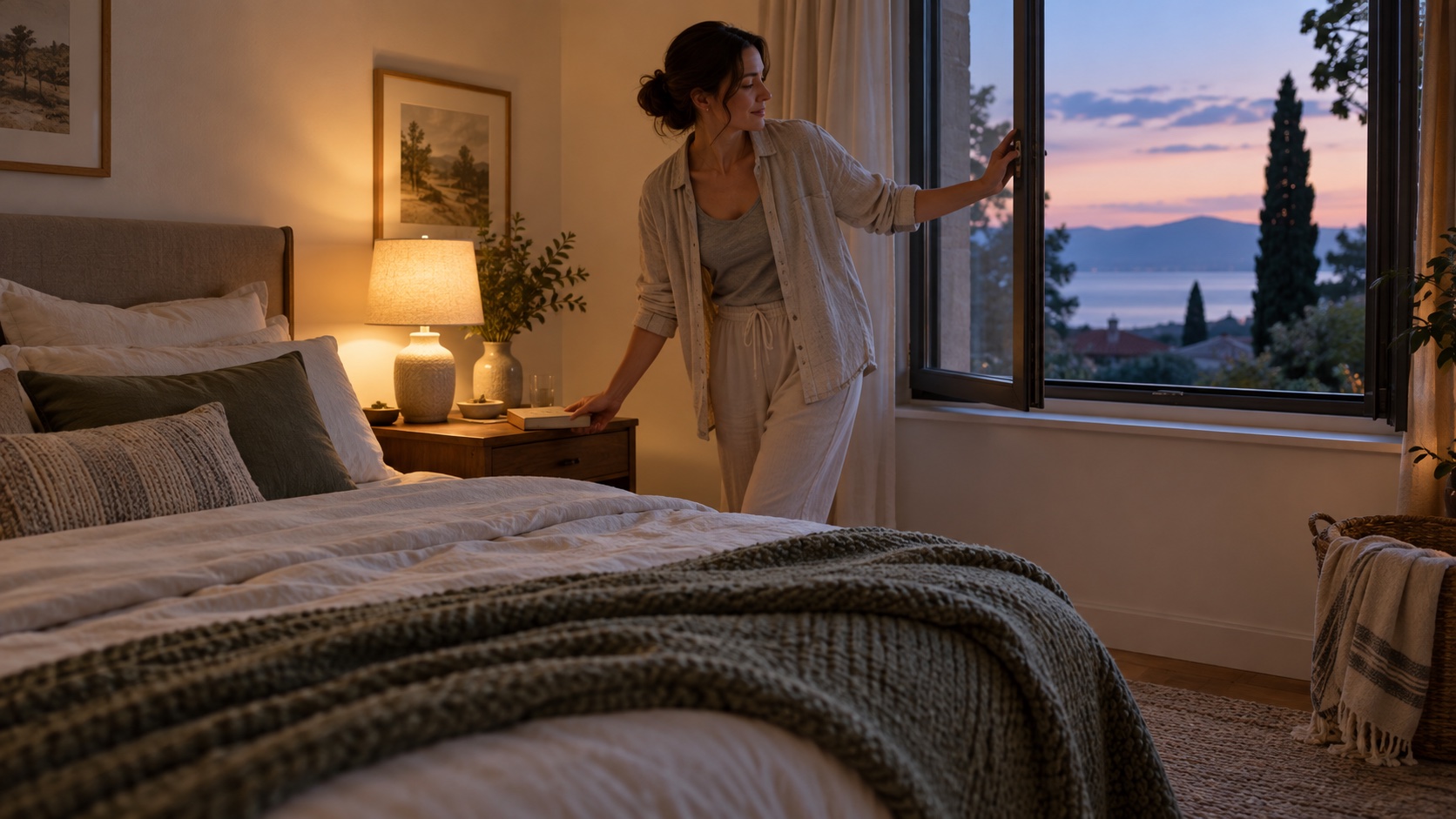
The Short List of What Matters
N3 deep sleep is gated by two physical conditions: enough sleep pressure built up during the day, and a falling core body temperature as you enter the night. Almost everything that reliably increases deep sleep works through one of those two channels — which is why the effective interventions are unglamorous. Here is the honest ranking, with the evidence status of each lever summarized:
| Lever | What the evidence shows | Verdict |
|---|---|---|
| 🏃 Regular exercise | Meta-analyses find increased slow-wave sleep; effects modest but consistent | Strong |
| 🛁 Warm bath 1–2 h before bed | Meta-analysis of heating studies: faster sleep onset, more early-night slow-wave sleep | Strong |
| 🌡️ Cool bedroom (~18–19°C) | Supports the temperature drop N3 needs; direct trials on stage minutes are thinner | Moderate |
| 💊 Glycine (3 g) | Small trials report subjective improvement and some objective signals; N3 gains unclear | Limited |
| 💊 Magnesium | Helps mainly where deficiency exists; insomnia trials are small and mixed | Limited |
| 🌿 Valerian | Meta-analysis finds effects close to placebo on objective sleep measures | Weak |
| 🍷 Alcohol | Suppresses N3 and fragments the night — the opposite of a deep-sleep aid | Avoid |
Product picks are generic categories, not brands. We may earn a commission on Amazon or iHerb purchases at no cost to you — this never changes our evidence conclusions. Full disclosure
Blackout shades or curtains
May reduce unwanted bedroom light and make a dark sleep setting easier to maintain.
⚠️ None expected from the product itself; install securely and preserve a safe route to exits.
Check price on Amazon →Lever One: Exercise — With a Timing Rule
Physical activity is the best-documented behavioral way to increase deep sleep. Kredlow and colleagues (Journal of Behavioral Medicine, 2015) meta-analyzed the literature and found exercise reliably improves sleep quality and increases slow-wave sleep, with small-to-moderate effect sizes. The mechanism is plausibly direct — exercise raises body temperature and builds homeostatic pressure, both of which deepen subsequent N3 — and plausibly indirect, via mood and weight (Driver & Taylor, Sleep Medicine Reviews, 2000). For a sense of scale: you should expect a modest, real increase, not a doubling. The Zone 2 topic covers how to accumulate the exercise itself.
Timing matters, but less than feared. Intense exercise too close to bedtime can delay sleep onset — core temperature is still elevated and the sympathetic system is still wound up — while moderate activity appears fine in the evening. A review of evening-exercise studies (Stutz et al., Sports Medicine, 2019) concluded that evening exercise does not harm sleep except when vigorous and within about an hour of bedtime. The practical rule: train whenever you actually will, and if you train hard, finish roughly 2–3 hours before bed.
Lever Two: The Core-Temperature Drop
Your body's thermostat works against you at bedtime. To initiate and maintain deep sleep, core temperature must fall by roughly half a degree to a degree; your brain achieves this by opening blood flow to your hands and feet so heat escapes through the skin. Kräuchi and colleagues (Nature, 1999) showed the point directly: warming the feet — and thereby dilating peripheral vessels — shortened sleep onset in young adults. The drop precedes deep sleep and is part of its trigger, not just a side effect (Murphy & Campbell, Sleep, 1997).
Two household tactics amplify this drop. First, a warm bath or shower 1–2 hours before bed: heating the skin triggers the same peripheral dilation, and a meta-analysis of passive body-heating studies found it improved sleep onset and slow-wave sleep (Haghayegh et al., Sleep Medicine Reviews, 2019). The timing matters — bathe too close to bed and you carry the heat in with you. Second, a cool bedroom, roughly 18–19°C, keeps the heat escape route open all night; reviews of the thermal-environment literature find consistent effects of mild cooling on sleep quality, with the evidence strongest for supporting sleep onset and reducing awakenings (Okamoto-Mizuno & Mizuno, Journal of Physiological Anthropology, 2012). The habits topic and the bedroom engineering page cover the setup. Evening sauna sessions plausibly work the same way as the bath — heat first, cool after — with the sauna topic owning that evidence.
Sleep Pressure: The Hidden Multiplier
None of the temperature work matters if the brain hasn't accumulated the drive to sleep deeply. Deep sleep is homeostatically regulated: the longer and more actively you have been awake, the harder the pressure for N3 that night. This is why the brain's first response to a short night is to deepen the next one — slow-wave sleep rebounds before anything else recovers, a priority visible across decades of sleep restriction studies (Banks & Dinges, Journal of Clinical Sleep Medicine, 2007). The practical reading is simple and free:
- ⏰ Wake at a consistent time. A stable wake time builds predictable pressure; weekend lie-ins of more than an hour quietly deflate it.
- 🚫 Keep naps short and early. Long or late naps spend the pressure before the night can use it.
- 🏃 Spend the day moving. Wakefulness alone builds pressure, but physically active wakefulness builds more — one reason exercise and deep sleep travel together.
Lever Three: The Boring Protectors
- 🛌 Consistency is leverage. N3 runs on accumulated sleep pressure. Irregular bedtimes and chronic short sleep keep pressure low; a stable schedule is the cheapest deep-sleep intervention there is (see the pillar lead).
- ☕ Caffeine has a long tail. Caffeine reduces slow-wave activity even when you don't feel it — EEG studies show the effect deep into the night (Landolt et al., Neuropsychopharmacology, 2004). The saboteurs topic owns the half-life math.
- 🍷 Alcohol is anti-N3. The sedation is real; the sleep is not. Alcohol suppresses slow-wave sleep in the first half of the night and fragments the second (Ebrahim et al., Alcoholism: Clinical and Experimental Research, 2013).
- 🫁 Untreated apnea shreds N3. Every airway event yanks you out of deep sleep before it completes. If you snore, gasp, or wake unrefreshed, the apnea topic matters more than any supplement on this page.
- 🔇 Noise and light quietly tax N3. Even non-awakening noise fragments slow-wave sleep; a dark, quiet, cool room is the physical substrate everything else builds on.
💊 The supplement reality check
Nothing sold as a "deep sleep" supplement has evidence on par with the free levers. Glycine at 3 g is the least poorly supported — small trials show subjective benefits (Yamadera et al., Sleep and Biological Rhythms, 2007) — but the objective N3 evidence is thin. Magnesium helps where a deficiency exists, and valerian performs near placebo on objective measures (Bent et al., American Journal of Medicine, 2006). Melatonin is a phase shifter, not a deep-sleep booster — the saboteurs topic family covers it. And prescription sedatives: some reduce slow-wave activity while feeling like sleep. Combining sedatives — prescribed or not — is clinician territory, not experimentation.
A Working Checklist
- ✅ Exercise most days, finishing hard sessions 2–3 hours before bed.
- ✅ Warm bath or shower 1–2 hours before bed, not right at lights-out.
- ✅ Bedroom at ~18–19°C, dark, quiet, and consistent night to night.
- ✅ Cut caffeine by early afternoon, alcohol rare or zero, and treat snoring as a medical question before a supplement question.
Questions, Answered Briefly
- ❓ How fast do these levers work? The bath and a cool bedroom act the same night; exercise's deep-sleep gains build over weeks of consistent training rather than a single session.
- ❓ Can I see my own N3 accurately? Only with an EEG headband or a sleep lab; wrist wearables estimate stages with enough error to mislead (the parent topic covers device accuracy). Track trends — duration, timing, resting heart rate — not the N3 number itself.
- ❓ Does sauna help deep sleep? Plausibly, through the same heat-then-cool mechanism as the bath, with the direct sleep evidence thinner than sauna's cardiovascular data — the sauna topic has the details. Evening timing rules apply as with any heating.
The Bottom Line
- Deep sleep runs on sleep pressure and a falling core temperature. The interventions that work — exercise, baths, a cool room, consistency — all feed one of those two channels.
- Exercise is the strongest lever, with honest expectations: a modest, consistent gain, not a transformation.
- Timing rules are real but forgiving: avoid intense training and hot baths within an hour of bed; both are fine earlier in the evening.
- Supplements are the weak tail. Glycine is the least unsupported, valerian ≈ placebo, and no pill beats removing alcohol, caffeine, and untreated apnea.
Related Topics
- Kredlow et al., "The effects of physical activity on sleep: a meta-analytic review," Journal of Behavioral Medicine (2015)
- Driver & Taylor, "Exercise and sleep," Sleep Medicine Reviews (2000)
- Stutz et al., "Effects of evening exercise on sleep in healthy participants: a systematic review and meta-analysis," Sports Medicine (2019)
- Kräuchi et al., "Warm feet promote the rapid onset of sleep," Nature (1999)
- Murphy & Campbell, "Nighttime drop in body temperature: a physiological trigger for sleep onset?" Sleep (1997)
- Haghayegh et al., "Before-bedtime passive body heating by warm shower or bath to improve sleep: a systematic review and meta-analysis," Sleep Medicine Reviews (2019)
- Okamoto-Mizuno & Mizuno, "Effects of thermal environment on sleep and circadian rhythm," Journal of Physiological Anthropology (2012)
- Banks & Dinges, "Behavioral and physiological consequences of sleep restriction," Journal of Clinical Sleep Medicine (2007)
- Landolt et al., "Caffeine attenuates waking and sleep electroencephalographic markers of sleep homeostasis in humans," Neuropsychopharmacology (2004)
- Ebrahim et al., "Alcohol and sleep I: effects on normal sleep," Alcoholism: Clinical and Experimental Research (2013)
- Yamadera et al., "Glycine ingestion improves subjective sleep quality in human volunteers," Sleep and Biological Rhythms (2007)
- Bent et al., "Valerian for sleep: a systematic review and meta-analysis," American Journal of Medicine (2006)
- Abbasi et al., "The effect of magnesium supplementation on primary insomnia in elderly," Journal of Research in Medical Sciences (2012)