Secular belonging
The attendance findings raise an obvious question: does the benefit require a congregation, or just a container? This page tests the translation — the volunteering cohorts, the choir experiments, the group-exercise trials — and finds that the mechanism survives the move out of the pew. You do not need a faith; you need a shift.
What the evidence supports
- Volunteering associates with roughly 24% lower mortality in pooled analyses of older adults (Psychological Bulletin, 2013; BMC Public Health, 2013).
- A dose threshold near 100 hours per year keeps appearing across cohorts (Journal of Health and Social Behavior, 2002).
- Group exercise settings improve adherence over solo programs (Sport & Exercise Psychology Review, 2006), and synchronized group activity — choirs — bonds strangers quickly (Royal Society Open Science, 2015).
What remains uncertain
- The healthy-volunteer selection problem applies here as much as to attendance — volunteers are healthier before they start.
- Motives may gate the benefit: other-oriented volunteering shows the association; self-oriented volunteering does not (Health Psychology, 2012).
- Most mortality evidence comes from older adults; midlife data are thinner.
Evidence last reviewed: August 15, 2026. Conclusions may change as new research is published.
The Best-Studied Secular Analog: Volunteering
Volunteering is what the literature uses when it wants the attendance effect without the attendance variable. The pooled findings: across five large cohorts, volunteers showed a 22% lower mortality rate than non-volunteers (BMC Public Health, 2013), and a separate meta-analysis put the reduction at 24% (Psychological Bulletin, 2013). Individual cohorts agree: volunteering associates with delayed mortality in the Longitudinal Study of Aging (Journal of Health Psychology, 2005), and with better self-rated health and lower depression in the Wisconsin Longitudinal Study (Journal of Health and Social Behavior, 2007). The honest framing is the same as the attendance page gave: consistent, substantial, observational — and a volunteer corps is structurally a moai with a shift schedule. Same features, different uniforms.
The Dose Question: Where 100 Hours Comes From
The most useful number in this literature is a threshold, not a gradient. Analyses of older Americans repeatedly find the health and survival advantage concentrated in people volunteering roughly 100 hours per year or more — about two hours a week (Journal of Health and Social Behavior, 2002; Research on Aging, 2005). Above that threshold, more hours do not buy proportionally more benefit, and the depression data add a caution: very heavy volunteering loads can tip into role strain, with moderate involvement showing the best mood outcomes (Social Science & Medicine, 2003). The practical reading: the container works at shift scale, not at second-job scale. One regular weekly commitment is the dose that keeps appearing in the data.
Why the Motive Matters
One finding deserves special attention because it complicates the happy story. When researchers split volunteers by their stated motives, the mortality association concentrated in the people who volunteered to help others; those who volunteered primarily for their own benefit showed no survival advantage (Health Psychology, 2012). This is either the deepest point or the biggest confound in the literature — people who genuinely care about others may simply be healthier people — but the mechanism reading is consistent with everything else on this site: the active ingredient is being needed by specific people, not performing self-improvement. The Purpose pillar owns the "being needed" mechanism in detail; the practical upshot here is choose the container you would keep even if it were bad for you. That is the one the data say works.
The Club Effect: Choirs, Gyms, and the Group Advantage
- 🎤 Choirs bond faster than conversation: singing in synchrony raises pain threshold and positive affect — a proxy for endorphin release — and strangers who sing together report feeling closer than strangers who just talk (Evolutionary Psychology, 2012; Royal Society Open Science, 2015).
- 🏋️ Groups beat solo programs: meta-analytic reviews of exercise interventions find group settings produce better adherence and outcomes than individual programs (Sport & Exercise Psychology Review, 2006) — the gym is a third place with dumbbells.
- 🔗 Accountability is the glue: the mechanism is the one the social-accountability protocol operationalizes — people show up because someone would notice the empty bench, the missing harmony part, the unstaffed shift.
The Trial Evidence: Experience Corps
The closest thing this literature has to a randomized test is Experience Corps, which places older adults in elementary schools as reading tutors and classroom support — fifteen hours a week of real, needed, structured work (Journal of Urban Health, 2004). The findings worth knowing: participants showed improvements in executive function and physical activity relative to controls, with the clearest gains in women who had been at cognitive risk (Journal of Gerontology A, 2009). It is not a mortality trial — those take decades — but it demonstrates the middle of the causal chain: put people into a structured, needed role, and measurable health systems respond. That is the strongest evidence this page can offer, and it should be enough.
| Container | Rhythm | Roles & obligation | What the evidence says | Evidence |
|---|---|---|---|---|
| 🏃 Parkrun / running clubs | Weekly | Marshals, timekeepers, light obligation | Group exercise contexts improve adherence (Sport & Exercise Psychology Review, 2006) | Good |
| 🍲 Food-bank / kitchen shifts | Weekly | Defined shifts, real obligation | Volunteering ~100 hrs/yr tied to lower mortality (J Health Soc Behav, 2002) | Good |
| 📚 Tutoring, Experience Corps-style | Weekly, ~15 hrs | School roles, high obligation | Quasi-randomized program: executive function improved (J Gerontol A, 2009) | Moderate |
| 🎤 Community choir | Weekly | Sections, medium obligation | Synchronized singing bonds groups and lifts mood (Evol Psychology, 2012) | Moderate |
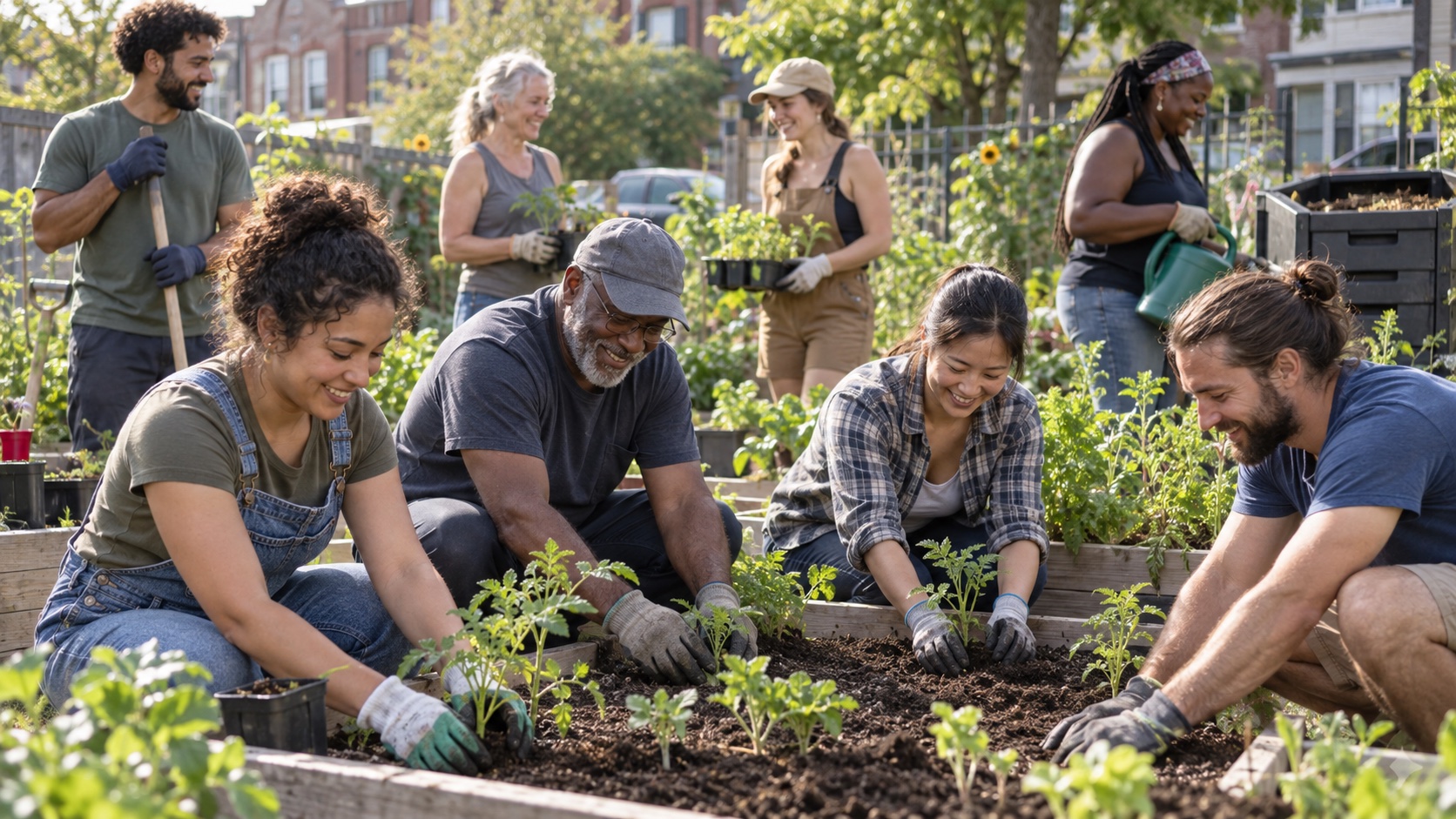
| 🌱 Community garden | Seasonal | Plots, workdays, medium obligation | Qualitative evidence; shared green space draws neighbors out — see the designing page | Limited |
| 🛠️ Makerspace / hobby club | Self-paced | Shop leads, light obligation | Same mechanism family as hobby clubs; thin direct mortality data | Limited |
💡 The threshold is lower than it feels
One hundred hours a year is two hours a week — a single volunteer shift, one rehearsal, one class. The literature does not ask you to become an organizer, a leader, or a saint; it asks for a standing weekly commitment where other people expect you. If you are deciding between an ambitious program you will quit by March and a modest shift you could keep for a decade, the data say take the shift. Duration is the mechanism — the two-day rule is the maintenance tool.
Assembling the Secular Moai
Put the findings together and a design emerges. Pick a container with all three features the Blue Zones page identified as transferable: a weekly rhythm (fixed slot, same people), roles (you staff something — the roster, the shift, the section), and obligation (someone is mildly inconvenienced if you vanish). The menu: food banks and kitchens, parkrun and amateur leagues, choirs and community orchestras, gardens and tool libraries, tutoring programs, volunteer fire and emergency services, and the full catalog in Building Your Tribe. Then give it the moai's defining feature — time. The cohorts that produced the 24% number were measuring years of standing participation, not a spring of enthusiasm.
Questions, Answered Briefly
- 👴 Is this only a retiree thing? The mortality evidence concentrates in older adults because those cohorts are older; the mechanism studies (choirs, group exercise) span ages. Midlife data exist but are thinner — treat the transplant as plausible, not proven.
- 💸 Does donating money count? The health association tracks participation, not checkbook philanthropy — the face-to-face component appears to be the mechanism (Social Science & Medicine, 2003).
- 🌙 How little can I actually do? Roughly two hours a week. Below that, the cohorts show no reliable signal — which is also permission: you do not need to overcommit.
- 🤐 What if I am introverted? Choose a container where the activity is the point and the people are the byproduct — choir, garden, running club. Conversation is optional; showing up is not.
The Bottom Line
- The attendance effect survives secularization. Volunteering cohorts show ~24% lower mortality — the same shape as the congregation findings.
- The dose is a shift, not a career: about 100 hours a year, and more is not better.
- Motive matters. Other-oriented volunteering carries the association; self-improvement volunteering does not.
- Pick the container with rhythm, roles, and obligation — and let decades, not intensity, do the work.
Related Topics
- Okun, Yeung & Brown, "Volunteering by older adults and risk of mortality: a meta-analysis," Psychological Bulletin (2013)
- Jenkinson et al., "Is volunteering a public health intervention? A systematic review and meta-analysis of the health and survival of volunteers," BMC Public Health (2013)
- Luoh & Herzog, "Individual consequences of volunteer and paid work in old age: health and survival," Journal of Health and Social Behavior (2002)
- Lum & Lightfoot, "The effects of volunteering on the physical and mental health of older people," Research on Aging (2005)
- Musick & Wilson, "Volunteering and depression: the role of psychological and social resources in different age groups," Social Science & Medicine (2003)
- Harris & Thoresen, "Volunteering is associated with delayed mortality in older people," Journal of Health Psychology (2005)
- Piliavin & Siegl, "Health benefits of volunteering in the Wisconsin Longitudinal Study," Journal of Health and Social Behavior (2007)
- Konrath, Fuhrel-Forbis, Lou & Brown, "Motives for volunteering are associated with mortality risk in older adults," Health Psychology (2012)
- Fried et al., "A social model for health promotion for an aging population: initial evidence on the Experience Corps model," Journal of Urban Health (2004)
- Carlson et al., "Evidence for neurocognitive plasticity in at-risk older adults: the Experience Corps program," Journal of Gerontology A (2009)
- Dunbar, Kaskatis, MacDonald & Barra, "Performance of music elevates pain threshold and positive affect," Evolutionary Psychology (2012)
- Pearce, Launay & Dunbar, "The ice-breaker effect: singing mediates fast social bonding," Royal Society Open Science (2015)
- Burke, Carron, Eys, Ntoumanis & Estabrooks, "Group versus individual approach? A meta-analysis of the effectiveness of interventions to promote physical activity," Sport & Exercise Psychology Review (2006)