Blue Zones' social architecture
The parent topic argued that the Blue Zones are community stories wearing diet costumes. This page takes the machinery apart zone by zone — the moai, the Sabbath, the village household — and then asks the uncomfortable question: which parts of the architecture survive contact with the critics, and which were marketing all along?
What the evidence supports
- Extreme-longevity clusters were identified with multi-source age validation in Sardinia, and similar clusters are documented elsewhere (Experimental Gerontology, 2004; Vienna Yearbook of Population Research, 2013).
- Every zone shows dense, lifelong social structures: small mutual-aid groups, multigenerational households, or congregational life (American Journal of Lifestyle Medicine, 2016).
- Loma Linda's Adventist cohort — the best-documented zone — shows longevity advantages of several years (Archives of Internal Medicine, 2001).
What remains uncertain
- Age-record quality varies by zone, and some extreme-age claims have been seriously challenged (bioRxiv, 2019).
- The social architecture cannot be isolated from diet, activity, and genetics — each zone bundles all of them.
- Whether zone features transplant to urban, secular, individualist settings is untested at scale.
Evidence last reviewed: August 15, 2026. Conclusions may change as new research is published.
Sardinia: The Village Is the Unit
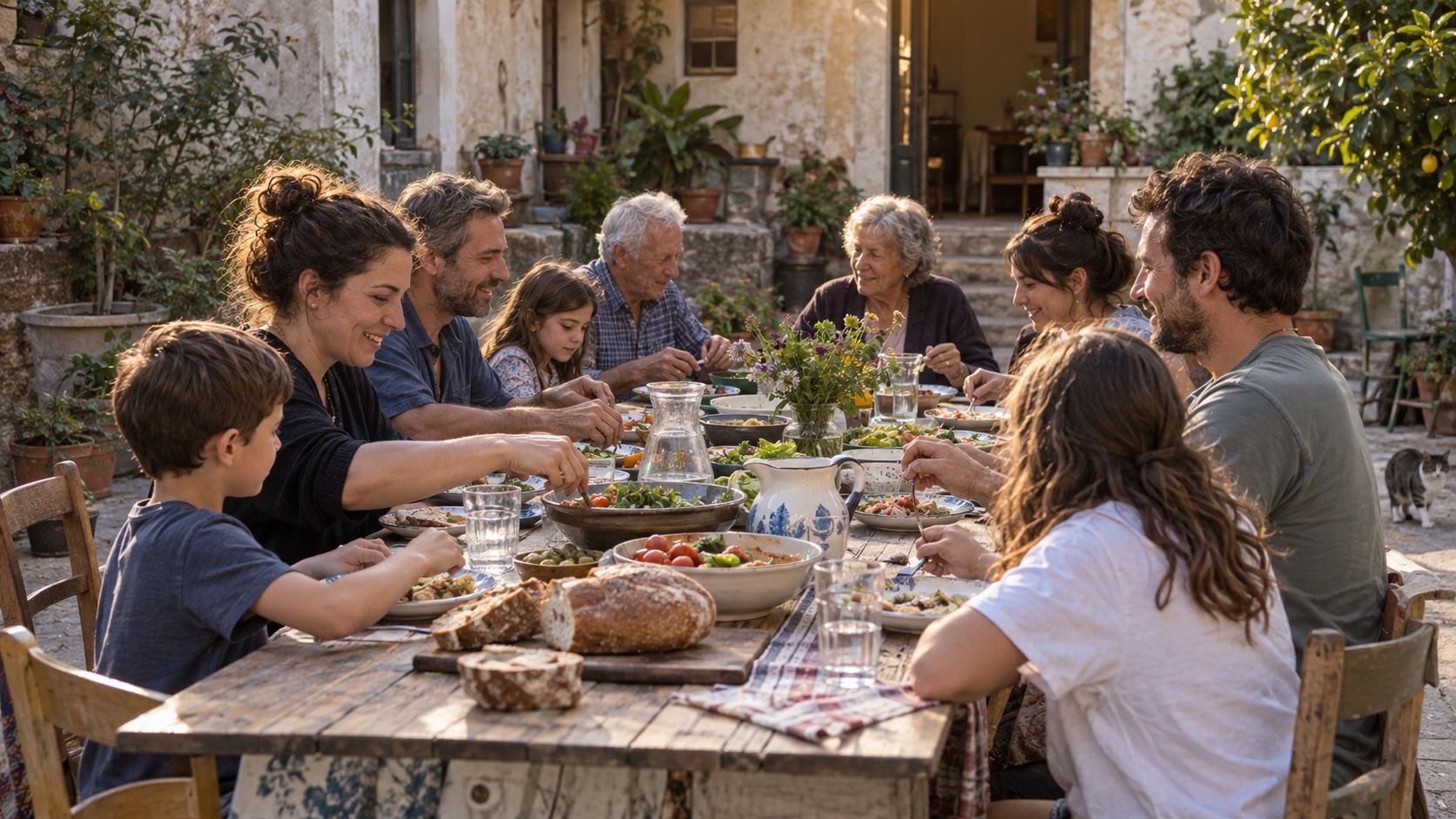
The Blue Zone story begins here, and it begins with demography, not diet. In the early 2000s, researchers combing the mountain villages of central Sardinia found an extraordinary concentration of centenarians — and did something unusual for the field: they validated ages against multiple records rather than trusting self-report (Experimental Gerontology, 2004). The "Blue Zone" label was coined from that work (Vienna Yearbook of Population Research, 2013). What the validated data showed was striking: in these villages, men reached extreme old age almost as often as women — a near-parity ratio demographers almost never see. The social structure that went with it: three generations under one roof or beside it, shepherding work that kept old men walking steep terrain daily, and the village piazza as the default evening venue. In the Barbagia villages, the community — not the household — is the unit of care, and the elderly are embedded in it until death, which is precisely the arrangement the built-environment page says modern cities have demolished.
Okinawa: The Moai Machine
Okinawa's signature structure is the moai: a mutual-aid group of roughly five or six people, formed in childhood and held for life, in which members pool money, labor, and problems (American Journal of Lifestyle Medicine, 2016). The ethnographic detail that matters is the obligation machinery. A moai is not a friendship circle; it is a standing insurance contract — members contribute to a shared fund that rotates to whoever has the crisis, and the group carries news of each member's health to everyone else. The cultural substrate, yuimaru ("the spirit of mutual aid"), makes help a norm rather than a favor. The parent page covers how to build one; the evidence point here is different: the Okinawa Centenarian Study documented this social fabric across decades (Annals of the New York Academy of Sciences, 2007), and the zone's own history is the strongest argument that the fabric — not the genes — did the work. Post-war Okinawans who adopted Western diets and car-dependent towns saw their longevity rankings collapse within two generations. Same gene pool, new environment, vanished advantage: the natural experiment runs against genetic explanations.
Loma Linda: A Congregation as a Public-Health System
Loma Linda is the zone that matters most for transferability, because it is not a remote village — it is a Southern California suburb. The Seventh-day Adventist community there has been studied through the Adventist Health Studies, large cohorts with unusually good documentation. The headline: Adventist men live about 7.3 years longer than their California peers, women about 4.4 (Archives of Internal Medicine, 2001), and vegetarian Adventists show meaningfully lower all-cause mortality than non-vegetarian members of the same faith (JAMA Internal Medicine, 2013). The architecture to notice: the congregation is the delivery system. Health practices — diet, exercise, rest — are embedded in doctrine and reinforced weekly; the Sabbath functions as a built-in day of rest and gathering; and the community is multigenerational by design. Loma Linda is the one zone where the social container comes with health instruction pre-installed, which is why it is also the zone where you cannot easily separate "the community" from "the lifestyle." Both are the intervention.
Ikaria and Nicoya: What the Smaller Datasets Show
The remaining two zones rest on thinner data, and deserve the lighter claims. The Ikaria Study followed a cohort of islanders past 80 and documented low rates of depression and dementia alongside the expected Mediterranean profile (Cardiology Research and Practice, 2011). The social texture researchers emphasized: family-centered living, afternoon naps, and the panigyria — village festivals that gather every generation of the community around food and dance on a shared calendar. Nicoya, in Costa Rica, shows its own puzzle: elderly men there reach extreme ages at rates closer to women's, and the region inverts the usual socioeconomic gradient — poorer Nicoyans outlive wealthier Costa Ricans, a pattern linked by its researchers to family networks and a culturally central sense of purpose (Vienna Yearbook of Population Research, 2013). These datasets are small and less validated than Sardinia's; treat them as supporting texture, not independent proof.
The Evidence Audit: What the Critics Got Right
The Blue Zone story has a critical literature, and this site would be failing its own standards if it hid it. Demographers have shown that extreme-age records concentrate in exactly the places with weak birth documentation, and that some supercentenarian counts look like data errors — or, in grim cases, pension fraud (bioRxiv, 2019). The Sardinia team's validation methods are the field's best defense, but the critique has real force for the less-documented zones. What survives the audit is important to separate from what does not. The counts of supercentenarians may be inflated. The existence of low-mortality, densely-connected populations is not in question — the Adventist data alone, with its birth certificates and death records, would establish that. And the structural observation — lifelong small groups, embedded elders, weekly communal rhythm — does not depend on anyone living to 110. It is visible at every age. Read the zones as illustrations of a social pattern that the rigorous cohort literature confirms independently, not as proof of their own centenarian numbers.
What Actually Transfers
- 🤝 The lifelong small group: any container with five to eight regulars and real mutual obligation replicates the moai's core machinery — the secular-belonging page documents the equivalents.
- 📅 The weekly scheduled rhythm: the Sabbath, the piazza, the panigyria all share one feature — a fixed slot on the calendar where everyone shows up. This is habit-formation territory, not geography.
- 👵 Embedded elders: roles for older people in daily group life, rather than age-segregated retirement. Reproducible through intergenerational volunteering and shared housing.
- ⛔ What does not transfer: the gene pools, the agrarian economy, the mountain terrain — and none of it needs to, because the cohort literature on attendance and volunteering finds the same health associations in ordinary modern populations.
| Zone | Signature social architecture | Strongest evidence | Weakest part | Evidence |
|---|---|---|---|---|
| 🏔️ Sardinia | Multigenerational village households, daily piazza sociality, elders embedded in work | Multi-source age validation (AKEA study) | Genetic-isolation explanations remain contested | Moderate |
| 🌊 Okinawa | Moai mutual-aid groups formed in childhood, yuimaru aid norms | Decades of the Okinawa Centenarian Study | Advantage eroded in post-war generations — environment, not genes | Moderate |
| ⛪ Loma Linda | Congregation as health system: doctrine-embedded practices, weekly Sabbath | Large, well-documented Adventist cohorts | Community and lifestyle cannot be separated | Good |
| 🏝️ Ikaria | Family-centered living, village festivals, shared daily rhythm | The Ikaria Study cohort | Small sample, less age-record validation | Moderate |
| 🌋 Nicoya | Dense family networks, culturally central sense of purpose | National census-linked analyses | Male longevity advantage not fully explained | Moderate |
🌍 The architecture, not the geography
Five zones on four continents do not share genes, cuisine, or climate. What they share is social infrastructure: a lifelong small group, a weekly rhythm, and elders with standing roles. The Okinawan decline — same island, same people, new lifestyle — is the closest thing to a natural experiment the zone literature has, and it points at the environment. You do not need the village. You need the container, which the Building Your Tribe topic turns into a checklist.
Questions, Answered Briefly
- 🔎 Are the Blue Zones even real? The demographic validation is real for Sardinia and the Adventist cohort, thinner elsewhere — and the social-architecture lesson stands regardless of the centenarian counts, because independent cohort data show the same associations.
- 🏙️ Which zone transfers best to city life? Loma Linda — it is already a modern suburb, and its data are the best documented. The Adventist model is the urbanized test case, and it works.
- 🧬 Is it just genetics? The Okinawan reversal argues against it: the same population lost its advantage within two generations of lifestyle change.
- 🏡 Do I need to move to a mountain village? No. The replicable features — small group, rhythm, roles — are transportable; the designing-for-belonging page covers how to assemble them where you already live.
The Bottom Line
- The zones share one architecture: lifelong small groups, weekly communal rhythm, and elders embedded in daily life.
- Loma Linda is the transferable case — a modern suburb whose congregation delivers health practices and belonging together.
- The critics got the counts right — some extreme-age claims rest on weak records, but the structural lesson does not depend on them.
- Genes are not the story. Okinawa's same-gene-pool decline is the strongest evidence that environment built the advantage.
Related Topics
- Poulain, Pes, Grasland et al., "Identification of a geographic area characterized by extreme longevity in the Sardinia island: the AKEA study," Experimental Gerontology (2004)
- Poulain, Herm & Pes, "The Blue Zones: areas of exceptional longevity around the world," Vienna Yearbook of Population Research (2013)
- Buettner & Skemp, "Blue Zones: lessons from the world's longest lived," American Journal of Lifestyle Medicine (2016)
- Fraser & Shavlik, "Ten years of life: is it a matter of choice?" Archives of Internal Medicine (2001)
- Orlich et al., "Vegetarian dietary patterns and mortality in Adventist Health Study 2," JAMA Internal Medicine (2013)
- Willcox et al., "Caloric restriction, the traditional Okinawan diet, and healthy aging," Annals of the New York Academy of Sciences (2007)
- Rosero-Bixby, Dow & Rehkopf, "The Nicoya region of Costa Rica: a high longevity island for elderly males," Vienna Yearbook of Population Research (2013)
- Panagiotakos et al., "Sociodemographic and lifestyle statistics of oldest old people (>80 years) living in Ikaria island: the Ikaria study," Cardiology Research and Practice (2011)
- Newman, "Supercentenarians and the oldest-old are concentrated into regions with no birth certificates and short lifespans," bioRxiv (2019)