Purpose & the Spouse
Most retirements are negotiated twice: once with an employer, once with a spouse. The couple literature is smaller and softer than the individual data, but its direction is consistent — mismatched retirements strain the relationship, and relationship quality moderates how well either partner adjusts. This page covers the collisions, the negotiation that doubles as a health intervention, and the shared stream that holds two retirements together.
What the evidence supports
- Spouses' wellbeing is coupled: one partner's retirement measurably affects the other's mood (Szinovacz & Davey, 2004).
- Marital quality moderates retirement adjustment — the same transition lands differently in strong vs strained marriages (Wang & Shi, 2014).
- Shared activities track with marital satisfaction (Reissman, Aron & Bergen, 1993).
What remains uncertain
- Most couple-retirement studies are small and draw on older cohorts with more gendered divisions; today's dual-career couples are understudied.
- Whether couples who plan the transition jointly actually fare better has not been tested causally.
- The mechanisms — time use, chores, care roles — are inferred more than measured.
Evidence last reviewed: August 15, 2026. Conclusions may change as new research is published.
Two Retirements, One Household
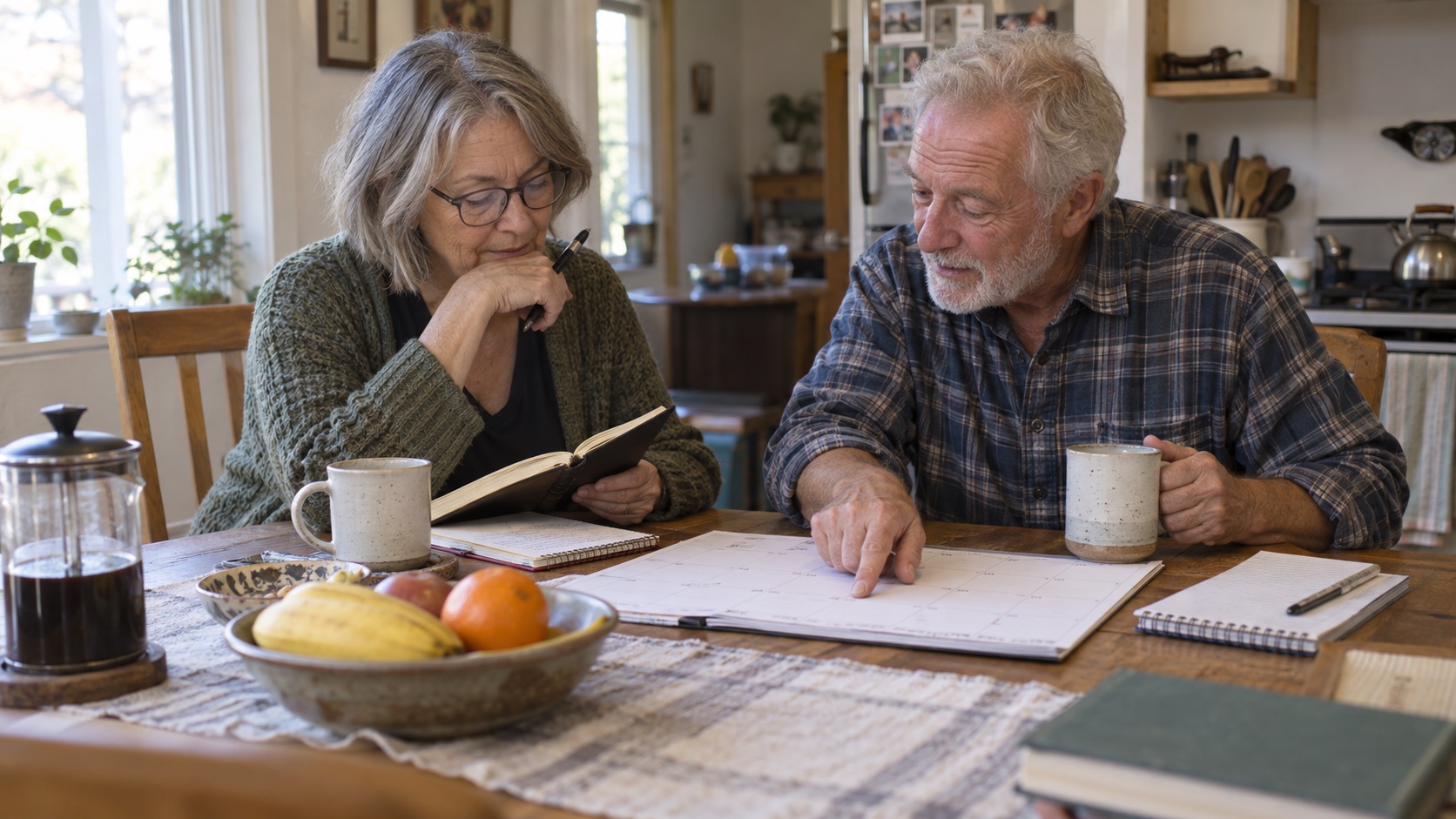
Couples rarely retire on the same day — the norm is a staggered pair of exits, sometimes years apart. But the household only has one calendar, which means the first retirement does not wait for the second: when one partner's 40-hour structure dissolves into the other's, the second retirement begins early and uninvited. The classic study of the gender asymmetry (Kim & Moen, Journal of Gerontology, 2002) found men's wellbeing in that era tracked closely to their work roles, while women's was spread across roles — spouse, parent, community — which buffered the transition differently. Those cohorts were more gendered than today's, and the honest caveat is that dual-career modern couples are the understudied group. What transfers regardless: retirement is a couple event, not an individual one, and the evidence on marriage and health — which the Marriage, Partnership & Longevity topic owns in full — says the relationship is one of the strongest health assets either partner has. Transitions that stress it are health events.
What the Couple Evidence Shows
The landmark study is Szinovacz and Davey (Journal of Gerontology, 2004), using national survey data on American couples. The headline finding is the coupling itself: when husbands retired, wives' depressive symptoms measurably rose — and the effect was strongest when the wife was still working or when the retirement was unexpected. Husbands' own mood, by contrast, improved. The study also caught the honeymoon pattern the first-six-months page documents: joint retirement begins with an elation phase — the famous "joint lunches" — that renegotiation eventually replaces. The honest limits: small effects, self-report, older cohorts. The direction, though, has held up across the literature: uncoordinated transitions leak stress from one partner to the other, and the leak runs both ways.
Later work adds the timing dimension: Ho and Raymo (Research on Aging, 2009) found that dual-worker couples who actually managed to retire together had usually planned it explicitly — joint retirement is a realized plan, not an accident — while couples who drifted into staggered exits reported more renegotiation friction. Planning, in this literature, looks less like a personality trait and more like the intervention itself.
The Three Classic Collisions
The couple-transition research keeps returning to three collision patterns. Named, they stop being mysterious.
| Collision | What it looks like | What the research suggests | Documentation |
|---|---|---|---|
| 🎭 Vision mismatch | One wants an encore career, the other wants rest | Name the mismatch early; neither vision is more legitimate; test small versions of each | Mixed |
| 🏠 Time intrusion | The retiree's presence disrupts the other's routine | Separate calendars; the friction is usually unrequested availability, not company | Limited |
| 🧹 Territory renegotiation | Chores and rooms get silently re-divided | Renegotiate explicitly; "I retired" is not a claim on every domestic domain | Limited |
Negotiating as a Health Intervention
Wang and Shi's review (Annual Review of Psychology, 2014) reports the moderator that makes sense of everything else: marital quality. The identical transition — same date, same finances, same health — lands differently in a strong marriage than a strained one, because the couple's baseline collaboration is the shock absorber. Which flips the framing: the negotiation is not a chore appended to retirement planning, it is part of the health plan. The practical version is unglamorous: two calendars and one monthly sync. The sync has a standing agenda — time together, time apart, money, chores — and one rule: each partner states their next month before hearing the other's plan, so neither calendar is drafted in reaction. Supporting each other's streams beats merging them; the couples who fare best in the qualitative record give each other room for independent purpose rather than demanding a joint one.
👫 Two solo streams, one shared
The couple version of The Portfolio Approach: each partner keeps at least one independent stream — theirs alone, scheduled without apology — plus one shared stream that belongs to the relationship. The solo streams prevent the marriage from becoming the sole purpose either person has; the shared stream prevents the streams from becoming two parallel lives. Neither alone is enough, and the shared stream needs a schedule like any other, per the first-six-months rules.
When One Retires First
The asymmetric years have their own failure modes, and Szinovacz and Davey's finding gives the map: the risky configuration is the retired-partner-plus-working-spouse one, where the working partner absorbs the other's drift. Three rules keep the asymmetry honest. First, the retiree's new schedule must not make the household's work heavier — "I retired" is not a delegation clause; the guarded week exists precisely so the freed hours do not all land on the working spouse's logistics. Second, keep the shared routines the working partner still needs — the evening overlap and the weekend rhythm are load-bearing. Third, set a date for the second retirement, not just the first: the asymmetry is easier to live with when it has a visible end, and the second transition deserves the same cliff mapping the first one got.
One asymmetry deserves its own warning: retirement can quietly become a claim on the other partner's calendar. The retiree's flexibility is real; the working partner's is not — and every "you have time, so you handle it" quietly converts the other person's margin into your convenience. The fix is to write the household's obligations into the guarded week explicitly, so the asymmetry stays visible instead of corrosive.
The Shared Stream
The evidence for the shared stream is the shared-activities finding: couples who do novel, engaging things together report higher satisfaction, and the association runs both ways (Reissman, Aron & Bergen, Journal of Social and Personal Relationships, 1993). The shared stream can be travel, a garden, grandchild care, a joint class, a cause — what matters is that it is scheduled, engaging, and genuinely shared rather than one partner's hobby with an audience. The honest limits apply: this is association, not trial evidence, and the shared stream supplements rather than replaces the solo streams. A couple with only a shared stream is as fragile as an individual with one big answer — the portfolio logic applies at household scale too. In practice the shared stream also answers the collision the table above lists first — time together versus apart — because a scheduled shared stream makes togetherness intentional instead of assumed, which is what couples in the qualitative studies keep describing as the difference between companionship and cohabitation.
When the Gap Is the Marriage, Not the Retirement
Retirement is a stress test, and stress tests reveal load-bearing failures. If the transition exposes long-standing distance — the couple who discover they had nothing but logistics in common — that is a relationship problem, not a scheduling problem, and the intervention is couple counseling, not a better hobby list. The Marriage, Partnership & Longevity topic documents what the relationship itself does for health, which is why this failure mode matters beyond the emotional register. And the same clinical rule from the first-six-months page applies to both partners: persistent low mood in either of you, through or after the transition, is a conversation for a qualified professional — the retirement did not cause it to be ignored.
Two-Retirement Questions, Answered Briefly
- 👫 We have completely different visions. Which wins? Neither; both get tested. Small versions of each, on the calendar, for 90 days — then the review decides, not the argument.
- 🗓️ Do we really need a monthly sync? The cadence is the mechanism: unstated expectations are the failure mode the couple studies keep finding, and a standing agenda makes the unstated stated.
- 🏠 My retirement is fine; my spouse's is the problem. Now what? It is one system, not two: the spouse's drift is your health event too — that is the entire premise of the coupling evidence.
- 💍 What if the transition reveals we have grown apart? Then the retirement is the messenger, not the cause — the marriage topic and a couple counselor are the next step, not a better hobby list.
The Bottom Line
- Retirement is a couple event — one partner's transition lands inside the other's life, and spouses' moods move together.
- Mismatch is the default, not the failure — name the two visions early, then test small versions of each.
- Two solo streams, one shared — the household portfolio that protects both partners and the marriage.
- If the transition exposes the marriage, treat the marriage — counseling is the intervention; retirement just turned the lights on.
Related Topics
- Szinovacz & Davey, "Honeymoons and joint lunches: effects of retirement and spouse's employment on depressive symptoms," Journals of Gerontology Series B (2004)
- Kim & Moen, "Retirement transitions, gender, and psychological well-being: a life-course, ecological model," Journals of Gerontology Series B (2002)
- Wang & Shi, "Psychological research on retirement," Annual Review of Psychology (2014)
- Reissman, Aron & Bergen, "Shared activities and marital satisfaction: causal direction and self-expansion versus boredom," Journal of Social and Personal Relationships (1993)
- Ho & Raymo, "Expectations and realization of joint retirement among dual-worker couples," Research on Aging (2009)