The 20-Minute Rule, Mechanized
The 20-minute rule is the most mechanized, least glamorous intervention in insomnia care — and one of the best supported. This page takes the rule apart: why the bed-awake association forms in the first place, what the trials actually show, and how to run the loop as a machine rather than a nightly act of willpower.
What the evidence supports
- Stimulus control — get out of bed when sleep doesn't come — reliably improves sleep-onset latency and sleep maintenance in trials and meta-analyses.
- The bed-awake association is a real learned response: hours of awake frustration in bed train the bedroom to mean worry, and the treatment is to break the pairing.
- Effects build over one to two weeks of consistency, not days — most trial protocols run the rule nightly for weeks.
What remains uncertain
- The "20 minutes" figure is a practical convention drawn from clinical protocols; individual trials vary in the exact cutoff.
- How much of the effect comes from getting up versus other parts of the protocol (fixed wake time, no clock-watching) is not cleanly separated.
- Response varies by person — a meaningful minority improve slowly and need the fuller cognitive behavioral therapy for insomnia (CBT-I) package.
Evidence last reviewed: August 15, 2026. Conclusions may change as new research is published.
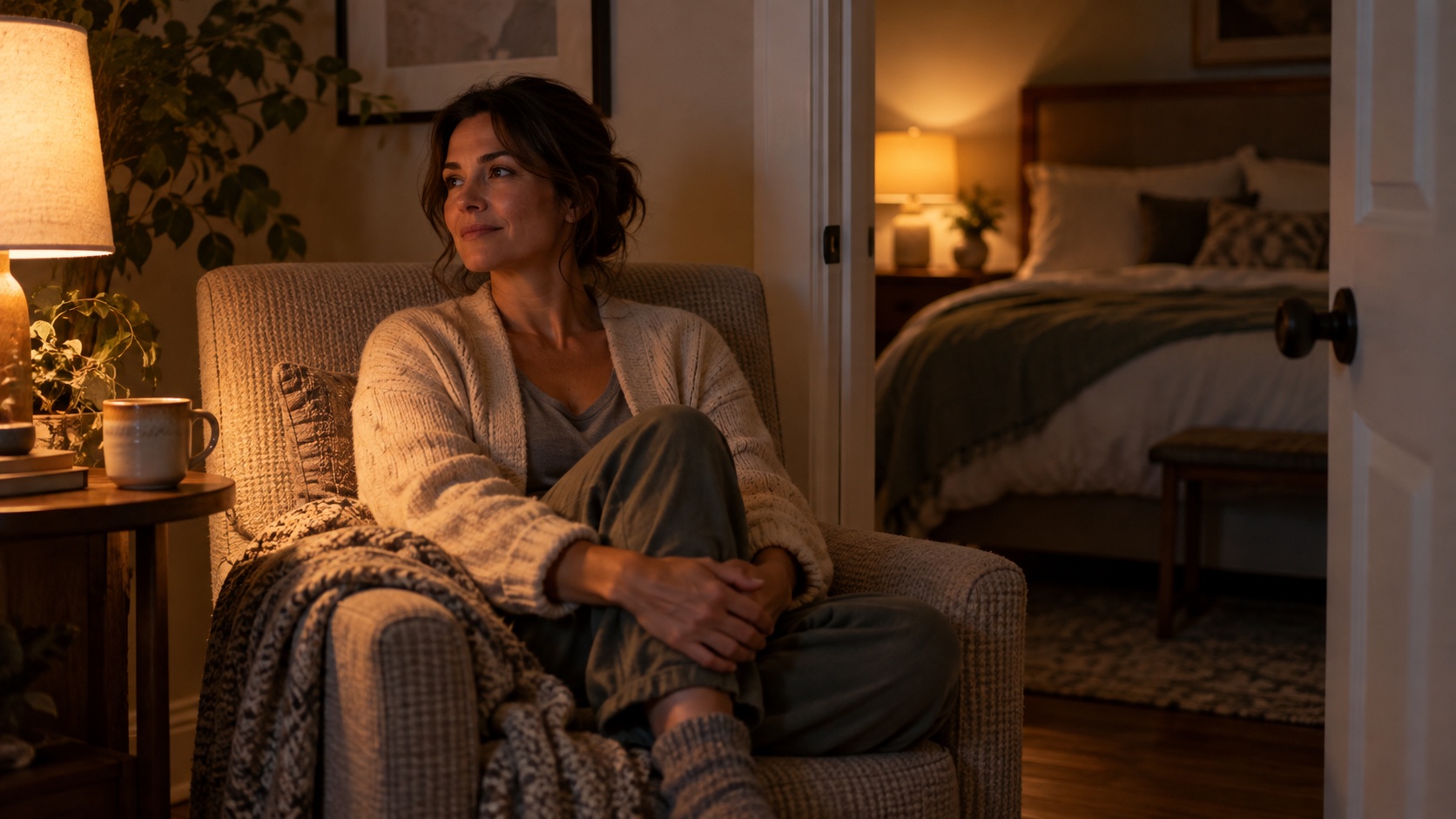
Why the Bedroom Learns to Mean Struggle
The rule rests on a simple piece of learning theory. Animals — humans included — form associations between a context and what happens in it. If a bedroom hosts twenty nights of frustration, clock-watching, and silent arithmetic about how little sleep remains, the room itself becomes a cue for vigilance rather than drowsiness. You lie down and your body braces, which is the opposite of what a bed should signal. This is the mechanism behind "learned" or "conditioned" insomnia, and it is the reason stimulus control works: it systematically un-teaches the pairing. The treatment is not a charm or a supplement — it is a behavior schedule that makes the bed reliably mean sleep again, one night at a time.
The practical consequence is counterintuitive: on a bad night, getting out of bed is the intervention, not surrender. Every minute spent lying still and willing sleep to arrive is another vote for "the bed is where I feel upset." Getting up for a stretch of boring calm is a vote the other way. View the rule as statistical — you are running trials on the bed-sleep association, not demanding a single night's victory. The parent page frames the loop at a glance; the rest of this page makes it precise enough to run on your own bad nights.
Product picks are generic categories, not brands. We may earn a commission on Amazon or iHerb purchases at no cost to you — this never changes our evidence conclusions. Full disclosure
Book or skill-learning workbook
Can support sustained reading or structured skill practice.
⚠️ None expected; a product cannot prevent dementia or replace assessment of new cognitive symptoms.
Check price on Amazon →The Rule, Run as a Clock
- ⏱️ The trigger — about 20 minutes of estimated wakefulness. Turn the clock away or face it from the room's far side; the estimate should be a guess, not a discipline. The exact number is less important than the habit of noticing "this is a struggle" and acting on it.
- 🚪 The exit — leave the bed, leave the bedroom. Dim light, no screens, no kitchen raid, no "quick check" of anything. The goal is calm, not productivity; you are not starting your day.
- 📖 The task — something boring, done by hand. A paper book, folding laundry, a slow stretch, a crossword. The task's job is to lower arousal while sleep pressure keeps climbing; drama and deadlines are counterproductive.
- 🛏️ The return — only when genuinely sleepy. Sleepy means heavy eyelids and a hard time staying upright, not merely tired of the couch. If sleep doesn't come within another spell, run the loop again.
- 🌅 The anchor — keep the wake time fixed. The unglamorous half of stimulus control: a stable rise time protects tomorrow night's sleep pressure even when tonight is a loss.
- 📓 The record — one line a day. Bedtime, estimated awake time, and a one-line read on the night. Data turns the loop from a feeling into a trend you can judge at two weeks.
What the Evidence Base Actually Shows
The strongest summary: stimulus control is one of the few insomnia treatments that consistently survives scrutiny. Classic work on psychological and behavioral treatment of insomnia found large, durable improvements in sleep latency and consolidation from behavioral packages, with stimulus control as a central component (Morin et al., Sleep, 2006). A landmark randomized controlled trial of cognitive behavioral therapy — which places stimulus control at its core — improved sleep and, unlike placebo, the gains persisted into follow-up (Edinger et al., JAMA, 2001). Meta-analytic work on CBT-I echoes this: clinically meaningful reductions in the time it takes to fall asleep and in time awake at night, with benefits that look durable rather than cosmetic (Trauer et al., Annals of Internal Medicine, 2015).
The honest rounding: trials measure groups, and the group averages hide wide individual spread. Some people see a large shift within two weeks; others move slowly and need the full CBT-I structure, which the series covers in its own page. The other honest point is that stimulus control is only as good as the context it runs in — caffeine that outlasts its dose, a loud room, or an untreated breathing condition will read as "the rule failed" when the rule was doing its job. The apnea screen on the red-flags page is worth running before you blame the technique.
Warm, dimmable bedside light
Makes a lower-light evening routine easier to follow.
⚠️ None expected; avoid treating a bulb choice as a cure for insomnia.
Check price on Amazon →The Do-and-Avoid Table
| Move | The rule | Why it works |
|---|---|---|
| ⏱️ Get up | Leave bed after about 20 minutes of estimated wakefulness | Core habit — breaks the bed-awake pairing |
| 📖 Boring task | Calm, dim-light activity done by hand until sleepy | Lowers arousal — boredom is the active ingredient |
| 🌅 Fixed wake time | Rise at the same time regardless of last night | Protects tonight — keeps sleep pressure honest |
| ❌ Forcing it | Never lie still and will yourself to sleep | Worst move — teaches the bed to mean struggle |
| 🕰️ Clock-watching | No sleep math, ever | Arousal fuel — arithmetic wakes the mind |
🚨 The safety exception runs first
Getting out of bed is a low-risk habit for most people — but not for everyone. If getting up in the dark is unsafe for you (fall risk, weakness, dizziness, disorientation), or if you live with bipolar disorder, run this and every other rule on this page past a clinician before adopting it. These are self-help steps for ordinary sleepless nights, not treatment, and they have no business overriding your safety or your medication plan. Your clinician should also see anything on the apnea red-flag list before you spend a month optimizing a technique that a breathing disorder will quietly defeat.
The Failures Are the Point of the Design
Most people quit the 20-minute rule in the first week, and the reasons are predictable enough to plan for. The first is the belief that getting up means "giving up on sleep" — the exact association the rule exists to break, so this feeling is a sign the mechanism is working. The second is a temporary, paradoxical worsening: the first nights of stimulus control are often the worst, precisely because the schedule interrupts the old, familiar (if miserable) routine. The third is mistaking the tool for the goal — people declare the rule "failed" because a single bad night happened, when the relevant measure is a two-week trend. Plan for these three and the rule survives long enough to do its job; the parent page's "what to do when it goes wrong" section spells out the specific rescues.
The other common failure is environmental and cheaper to fix than most people think: no stimulus-control program survives an honest two-week run against a partner's bright lamp, a warm room, or a 3 p.m. double espresso. The cascade pages on this site — dimming, screens, food, alcohol, and caffeine — are the support system the rule needs to look good. Run the rule against a hostile environment and it fails not because the science is wrong but because you weaponized the variable the science assumes is fixed.
Questions, Answered Briefly
- ❓ Is it really 20 minutes, or 15? The exact number is a clinical convention, not a precisely calibrated constant. What matters is the shared structure: notice the struggle, get up, stay calm, return when sleepy. Pick a number near twenty and hold it.
- ❓ Won't getting up make me more awake? Temporarily, for some people — and that's fine. The rule is not optimizing tonight's session; it is retraining the bed for the next hundred nights. One wakeful hour in the chair beats thirty nights of learned dread in the bed.
- ❓ Do I have to get up every single time? Consistency is what builds the association. Occasional nights where you doze within twenty minutes are information, not failure; a pattern of never getting up is the rule quietly being abandoned.
- ❓ When do I move to the next tool? After two honest weeks with little change — and after ruling out the apnea red flags — the natural escalation is careful sleep restriction and then CBT-I, both covered later in this series.
- ❓ Can I do this alone, or do I need a provider? For ordinary, recent sleeplessness the rule is safe and standard self-help. For chronic insomnia — roughly three nights a week for three months — the evidence favors doing it with the structure of CBT-I and a qualified clinician.
The Bottom Line
- The bed-awake association is a real learned response — and the 20-minute rule exists to un-teach it, one getting-up at a time.
- The rule is a clock, not a mantra — trigger at roughly 20 minutes, exit to a boring task, return only when sleepy, and keep the wake time fixed.
- The evidence is genuinely good — stimulus control is a central, durable component of the behavioral treatment packages that trials and meta-analyses keep validating.
- Plan for the first-week failure — temporary worsening is expected, judge at two weeks, and run the rule against a clean environment or it will look like it failed when it didn't.
Related Topics
- Morin et al., "Psychological and behavioral treatment of insomnia: update of the recent evidence (1998–2004)," Sleep (2006)
- Edinger et al., "Cognitive behavioral therapy for treatment of chronic primary insomnia: a randomized controlled trial," JAMA (2001)
- Trauer et al., "Cognitive Behavioral Therapy for Chronic Insomnia: A Systematic Review and Meta-analysis," Annals of Internal Medicine (2015)
- Bootzin & Epstein, "Understanding and Treating Insomnia," Annual Review of Clinical Psychology (2011)