The Sleep-Pain Loop
A bad night makes everything hurt more, and hurting makes the next night harder to sleep. The loop is real, and it is bidirectional — not a single cause pointing one way. This page walks the evidence for both directions, where it stops short, and how to read your own nights without sliding into self-diagnosis.
What the evidence supports
- Laboratory sleep deprivation and restriction reliably raise sensitivity to experimental pain in healthy volunteers.
- People living with chronic pain report disturbed sleep at high rates, and the two problems worsen together over time in longitudinal cohorts.
- Improving sleep is associated with better pain outcomes in some trials, which is why the loop is worth interrupting from either end.
What remains uncertain
- Most experiments test healthy volunteers over days, not people with persistent pain over years — the effect size in clinical populations is estimated.
- The association is bidirectional, so no study cleanly separates how much sleep loss drives pain versus pain driving sleep loss.
- Whether fixing sleep reliably shrinks pain — rather than just improving how pain is tolerated — remains an open question in the trial literature.
Evidence last reviewed: August 20, 2026. Conclusions may change as new research is published.
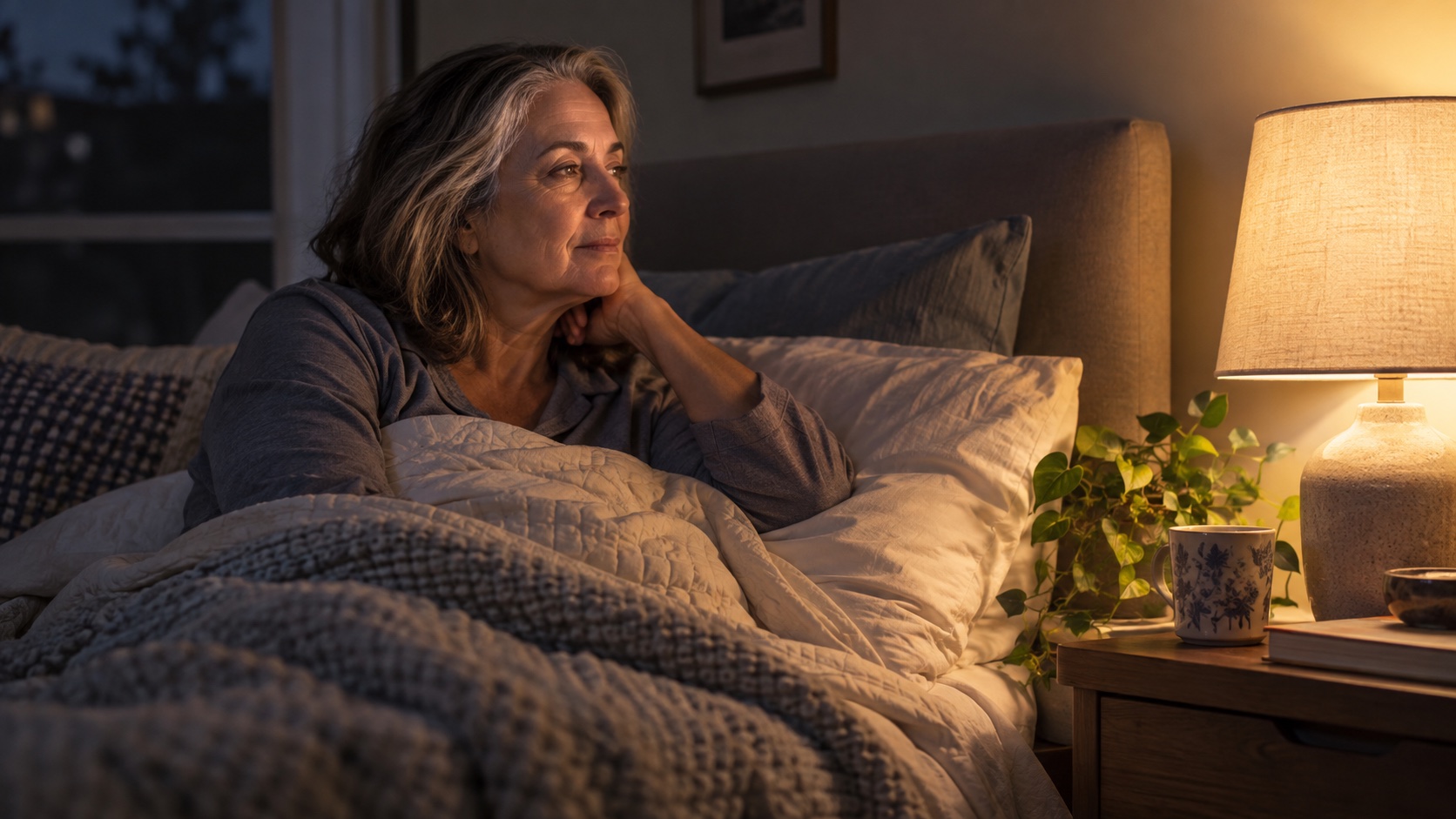
Two Problems That Share a Loop
Sleep and pain are not separate systems that happen to meet in the middle of the night — they regulate each other. The research community describes the relationship as a loop: disturbed sleep lowers pain tolerance, and pain fragments and lightens sleep, and each turn makes the next easier. That framing changes what you do about it. If sleep loss were merely a symptom of pain, the treatment would all be about the pain. If pain were merely a symptom of bad sleep, fixing the night would fix everything. The honest position is in between: the two are associated in both directions, and the Sleep Protocol series treats them as one shared problem worth attacking from whichever end is more accessible tonight.
- 🔄 Bidirectional, not one-way — cohort and trial data show sleep problems predict later pain and pain predicts later sleep problems (Koffel et al., Health Psychology, 2016).
- 🧠 The brain is the meeting point — the same arousal and emotion circuits that stay switched on in insomnia also amplify pain signals, which is why the two problems share treatment ground.
- 📖 The loop has an off-ramp — improving sleep is associated with better pain outcomes in some trials, so interrupting the cycle from the sleep side is a legitimate place to start.
Product picks are generic categories, not brands. We may earn a commission on Amazon or iHerb purchases at no cost to you — this never changes our evidence conclusions. Full disclosure
Bedroom thermometer and hygrometer
Can help identify whether a bedroom is consistently too warm, cold, dry, or humid for comfort.
⚠️ Readings do not explain persistent sleep symptoms and should not lead to extreme environmental changes.
Check price on Amazon →What Sleep Loss Does to the Pain Dial
The cleanest evidence comes from the sleep lab, where healthy volunteers give up sleep on schedule. The pattern is consistent: after a night or two of short sleep, people rate the same heat, cold, or pressure stimuli as more painful, and their bodies show less of the natural pain-inhibition response that normally damps signals down. Two nights of restricted sleep left healthy adults measurably more sensitive to pain than their own rested baselines (Roehrs et al., Sleep, 2006), and a single night of total deprivation blunted the body's pain-inhibition machinery in healthy women (Smith et al., Sleep, 2007). Held to four hours a night for twelve nights, volunteers reported spontaneous pain creeping upward with no stimulus applied at all (Haack et al., Pain, 2009). The direction is the story: short sleep does not merely make pain feel worse in the moment — it appears to shift the threshold at which the body treats ordinary input as painful.
- 🎚️ The threshold moves — sleep loss is associated with lower pain thresholds and higher ratings of the same stimulus, not just more complaining about it.
- 🛡️ The brakes weaken — pain-inhibition systems that normally quiet signals after the stimulus ends run less effectively after sleep loss.
- 🔄 It reverses — recovery sleep is associated with pain measures returning toward baseline, another sign the effect is state-dependent rather than permanent.
What Pain Does to the Night
The other half of the loop is just as well documented. Pain lengthens the time to fall asleep, pulls people out of deep sleep into lighter stages, and drives exactly the kind of middle-of-the-night waking this folder is about. Prevalence work puts the scale plainly — a meta-analysis found the large majority of adults with chronic pain report disturbed sleep (Mathias et al., Sleep Medicine, 2018). The mechanism is not mysterious: pain keeps arousal switched on, and arousal is the enemy of sleep maintenance. Even well-controlled pain can feel louder at night, with less competing input and more attention to settle on it.
- 🌗 Deep sleep is the first casualty — pain is associated with lighter, more fragmented sleep, and the restorative slow-wave stages are the ones that shrink.
- 🕐 Waking clusters in the second half — pain-driven awakenings concentrate in the later part of the night, which is why this problem shows up as nighttime waking rather than trouble falling asleep.
- 🔁 The morning read matters — how the night felt is filtered through next-day pain and fatigue, which is why the awakening log records both sides of the equation.
| Study shape | What happened | What it suggests |
|---|---|---|
| 😵 Two nights of restricted sleep | Healthy adults rated pain stimuli higher than at their rested baseline (Roehrs 2006) | Sleep loss raises sensitivity |
| 🛡️ One night of total deprivation | Pain-inhibition responses weakened in healthy women (Smith 2007) | The brakes on pain weaken |
| ⏰ Four hours nightly for 12 nights | Spontaneous pain crept upward with no stimulus applied (Haack 2009) | Restriction alone produces pain |
| 🔄 Recovery nights after restriction | Pain measures drifted back toward baseline | State-dependent, not permanent |
Why the Spiral Feels Self-Sustaining
Once both directions are running, the loop acquires momentum that feels like a single problem: a bad night lowers the pain threshold, the lower threshold means a more painful day, and the more painful day means a harder night. Longitudinal work makes the entanglement visible — people whose sleep was restorative were more likely to see chronic widespread pain resolve over time (Davies et al., Rheumatology, 2008), and in a trial secondary analysis, sleep complaints and pain moved together in both directions over weeks (Koffel et al., Health Psychology, 2016). The practical translation: you do not have to fix the pain to improve the sleep, or the sleep to improve the pain. Interrupting either side is a legitimate first move.
- 🧵 Both threads pull — the evidence supports improving sleep as a pain-relevant intervention and improving pain as a sleep-relevant one; neither direction is a dead end.
- 📉 Restorative sleep is protective — cohort work links consistently restorative sleep with better odds of pain improving, not merely with less suffering.
Where the Evidence Stops Short
The loop is real, but the precision of the laboratory does not carry into real life unchanged. Most experiments are short and small — dozens of healthy volunteers over days, not thousands of people with persistent pain over years — so the effect size in clinical populations is estimated, not measured. The loop is bidirectional by definition, which means no study cleanly isolates how much of the spiral is sleep driving pain versus pain driving sleep. And most important for this folder: an association is not a diagnosis. Sleep loss does not cause a person's pain condition, and pain does not cause a person's sleep disorder — they are entangled, and untangling them is a question a clinician is equipped to help with.
- 🔬 Lab ≠ life — experimental effects are measured in controlled conditions; real nights include medication, mood, work, and a thousand confounders.
- 🩺 Pain is information — persistent, worsening, or new pain deserves clinical assessment, not a self-diagnosis built from a sleep website.
- 🧯 The loop is not fate — even where the evidence is soft, interrupting the cycle from either end is low-risk and worth doing while a clinician is consulted.
⚠️ Pain Is Information — Read It That Way
Nothing on this page diagnoses anything. The sleep-pain link is a bidirectional association, not a single cause, and it is not a license to explain away a symptom. Pain that is persistent, worsening, or new deserves clinical assessment — and so does pain that wakes you repeatedly, pain that comes with chest symptoms or numbness, or pain that changes character. Use the loop to understand your nights; use a qualified clinician to understand your pain.
Reading Your Own Loop Without Self-Diagnosing
The practical value of this page is a frame, not a verdict: when nights and pain move together, treat them as one problem. The sleep science pillar owns why sleep is foundational, and the middle-of-the-night playbook owns the waking itself. If pain and sleep worsen in step, interrupt the loop from the side you can act on tonight — a consistent wind-down, a cooler room, a fixed wake time — while you collect the information a clinician will actually want. That collection is the next page's job.
The Bottom Line
- The loop is bidirectional — sleep loss raises pain sensitivity and pain fragments sleep; the association runs both ways.
- It moves fast and reverses — one or two bad nights measurably shift pain measures in the lab, and recovery sleep is associated with them settling back.
- Interrupt from either end — improving sleep is a legitimate pain-relevant move even before the pain is resolved, and vice versa.
- Pain is information, not a verdict — persistent, worsening, or new pain deserves clinical assessment; the loop explains nights, it does not diagnose them.
Related Topics
- Roehrs T, Hyde M, Blaisdell B, Greenwald M, Roth T, "Sleep loss and REM sleep loss are hyperalgesic," Sleep (2006)
- Smith MT, Edwards RR, McCann UD, Haythornthwaite JA, "The effects of sleep deprivation on pain inhibition and spontaneous pain in women," Sleep (2007)
- Haack M, Lee E, Cohen DA, Mullington JM, "Activation of the prostaglandin system in response to sleep loss in healthy humans: potential mediator of increased spontaneous pain," Pain (2009)
- Finan PH, Goodin BR, Smith MT, "The association of sleep and pain: an update and a path forward," Journal of Pain (2013)
- Lautenbacher S, Kundermann B, Krieg JC, "Sleep deprivation and pain perception," Sleep Medicine Reviews (2006)
- Koffel E, Kroenke K, Bair MJ, Leverty D, Polusny MA, Krebs EE, "The bidirectional relationship between sleep complaints and pain: analysis of data from a randomized trial," Health Psychology (2016)
- Davies KA, Macfarlane GJ, Nicholl BI, et al., "Restorative sleep predicts the resolution of chronic widespread pain: results from the EPIFUND study," Rheumatology (2008)
- Mathias JL, Cant ML, Burke ALJ, "Sleep disturbances and sleep disorders in adults living with chronic pain: a meta-analysis," Sleep Medicine (2018)