The Screen Step-Down
The honest blue-light verdict is more interesting than either the panic or the dismissal: evening screen light measurably delays melatonin and sleep, but the effect is moderate — the brightness, the wavelength, and the content all matter, and a night mode fixes at most two of the three. This page turns the screens-off rule into a step-down: three dials you can actually turn — brightness, warmth, and content — and a concrete plan for the phone's last hour that ends with the phone outside the room.
What the evidence supports
- Evening light, including room light at ordinary levels, suppresses melatonin — the body's sleep signal — and delays its onset (Gooley et al., 2011).
- Screen use in the hours before bed — eReaders included — delays circadian timing, suppresses melatonin, and reduces next-morning alertness (Chang et al., 2015).
- The circadian system is most sensitive to short-wavelength light, which is exactly what backlit displays emit in abundance (Cajochen et al., 2011; Zeitzer et al., 2000).
What remains uncertain
- How much of the screen effect is the light versus the content and the arousal of scrolling is not cleanly separable in most studies.
- Night-shift filters and dimming help, but their real-world sleep benefit in trials is mixed — they address wavelength, not brightness, content, or habit.
- The sensitivity of the circadian system varies widely between individuals, so the same screen can cost different people different amounts of melatonin.
Evidence last reviewed: August 15, 2026. Conclusions may change as new research is published.
Product picks are generic categories, not brands. We may earn a commission on Amazon or iHerb purchases at no cost to you — this never changes our evidence conclusions. Full disclosure
Book or skill-learning workbook
Can support sustained reading or structured skill practice.
⚠️ None expected; a product cannot prevent dementia or replace assessment of new cognitive symptoms.
Check price on Amazon →The Honest Blue-Light Verdict
Start with the scale of the effect, because both the hype and the denial get it wrong. Evening light is not a small curiosity: the circadian system is exquisitely sensitive to light, and even ordinary room light before bed suppresses melatonin and shortens its nighttime window (Gooley et al., 2011). Add a backlit screen and you get a measurable delay in circadian timing, melatonin suppression, and reduced next-morning alertness (Chang et al., 2015; Cajochen et al., 2011). Now the other side: for most people, the screen effect is moderate, not catastrophic, and it is dwarfed by other cascade lines like caffeine. The honest protocol is therefore a step-down — reduce what you can control in the order it matters — rather than a total screen ban at sunset. And the same biology cuts the other way in the morning: bright light early in the day is the strongest anchor for the clock, which is why this step-down pairs with the wake-anchor series' morning-light step rather than standing alone.
The Three Dials You Can Actually Turn
The step-down runs on three dials, in the order they matter. The first is brightness: a dimmed screen at a meter's distance delivers far less melatonin-suppressing light than the same screen at full brightness, and overhead room light is usually the bigger offender anyway. The second is wavelength: warm or night-shift modes cut the short-wavelength peak that the circadian system is most sensitive to. The third — and the one most people ignore — is content: the feed, the argument, the one-more-video supply their own arousal that is entirely independent of photons. The table below is the honest ledger for the last hour:
| In the last hour | What it costs | Verdict |
|---|---|---|
| 💡 | Overhead room light at full brightness + full-bright screen | Worst case |
| 🌗 | Dim screen, warm mode, but the argumentative feed still scrolling | Half-help |
| 📖 | Paper book or a calm, non-reactivity screen task in low light | Acceptable |
| 🌙 | No screen in the bedroom; phone charging outside the room | The reference |
Read the last row as the reference standard, the way the cascade always draws its best line. The middle rows are the honest compromises for people who will not give up the pillow scroll tonight — and the chart below shows why the first dial, brightness, is the one that does the most work.
Warm, dimmable bedside light
Makes a lower-light evening routine easier to follow.
⚠️ None expected; avoid treating a bulb choice as a cure for insomnia.
Check price on Amazon →Content Is the Second Half
The light science is clean, but it is half the story. A screen at 5% brightness showing the feed you cannot stop reacting to still costs the night — via the same cognitive-arousal machinery the work cutoff describes, not via photons. The step-down's content dial is therefore just as load-bearing: in the last hour, the goal is reactivity zero. That means no work email (the work cutoff's line), no doomscroll, no debate thread, and no video whose algorithm is designed to produce "one more." Passive, low-reactivity content — a calm show you've seen, a paper book, a crossword by hand under a dim lamp — is the honest acceptable zone, because it engages without activating. And the cleanest content fix remains the structural one: a phone that is not in the room has no feed to lose the night to.
A useful shorthand for judging any evening screen session is to ask which dial you are actually using: if you are reading something absorbing but unthreatening, the brightness dial alone may suffice; if you are spiraling through a feed, no filter fixes the content dial, and the honest move is the paper swap or the audio turn. The distinction matters because it tells you which dial to fix rather than blaming the screen as a whole — most people's "I can't use screens at night" is really "I can't use feeds at night," and the fix for that is much easier than a full screen ban.
The Phone's Last Hour, Practical
The step-down becomes a clock, not an intention, when you attach the three dials to times. Here is the plan the cascade assumes:
- ⏰ 90 minutes before lights-out: dim the house — lamps below eye level, overheads off. This is the parent page's dimming step, and it is the first dial because room light outranks screen light.
- 📱 60 minutes out: the screen step-down is now mandatory — switch to warm mode and lowest comfortable brightness, or put the device down for a paper wind-down.
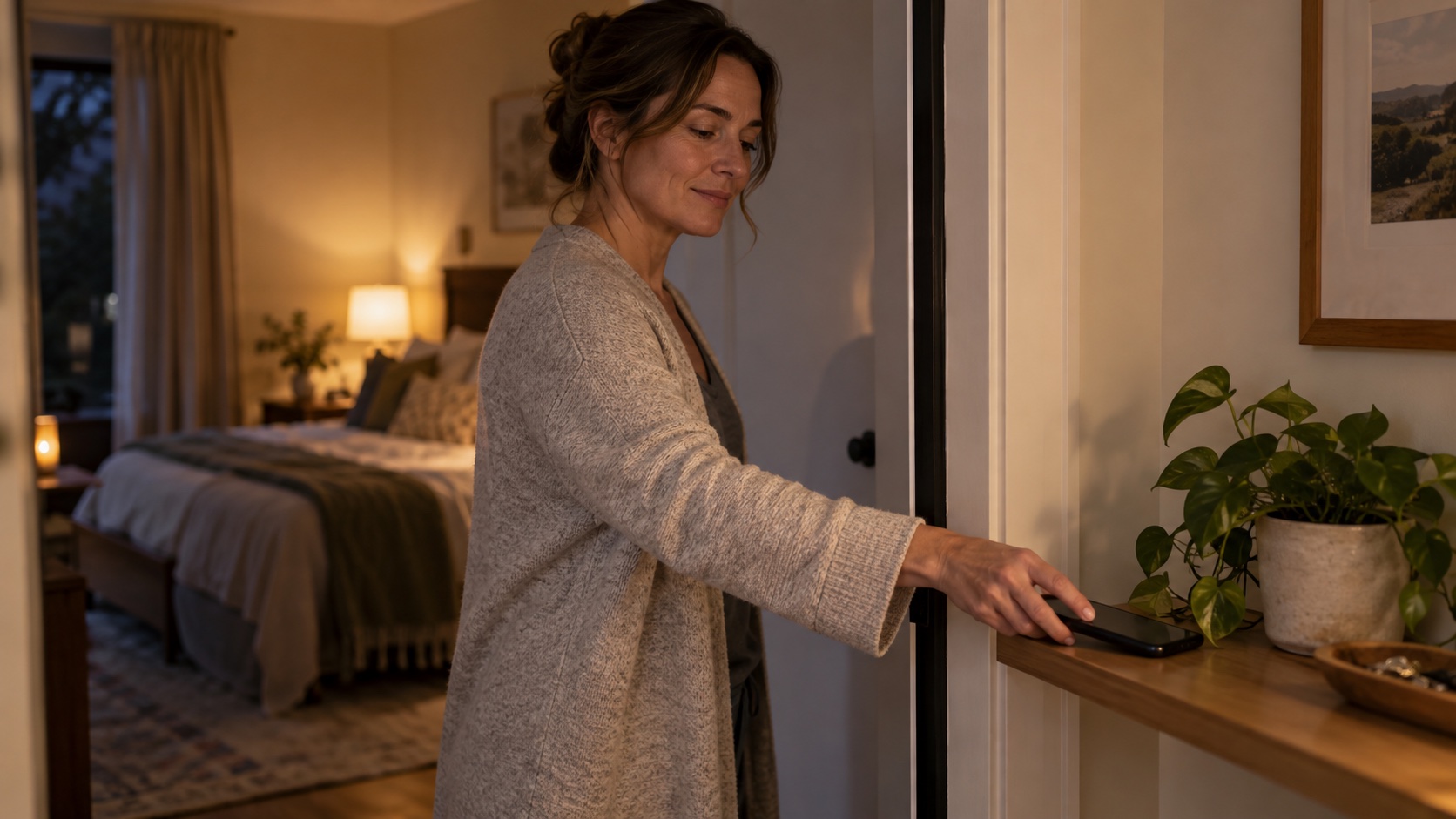
- 🌙 15 minutes out: the phone goes onto its charger — outside the bedroom. Charge it in the kitchen, not on the nightstand; the 2 a.m. check-in is a habit you can't keep if the phone is gone.
- 📵 The not-in-the-room rule is the whole trick. It converts three nightly negotiations — brightness, content, scroll — into one structural decision made once, when you have impulse control, rather than at 23:00 when you don't.
🌙 Night modes help — they don't fix it
The honest middle on filters: a warm, dimmed screen does measurably less to melatonin than the same screen at full brightness, so use the settings — they are free. But they cannot fix content arousal, they do nothing for the room's overhead lights, and trials on real-world sleep outcomes are mixed. Treat night mode as dial two of three, not as the excuse to keep scrolling at 22:50. Dim the house, step the screen down, and get the phone out of the bedroom — that is the whole sequence.
Questions, Answered Briefly
- ❓ Are blue-light-blocking glasses worth it? They genuinely attenuate some of the melatonin-suppressing light. As a bridge they are reasonable; as a license to keep the screen and the content at full blast they defeat their own purpose — the step-down still wins.
- ❓ Does watching TV count as a screen? A TV across the room at moderate brightness is far less potent than a phone at nose distance, but the content rule still applies. A calm show in a dim room is an acceptable compromise; a phone-flashlight combo is not.
- ❓ What about audio instead of scrolling? Audio — a podcast or an audiobook — removes the light problem entirely and most of the visual content problem. It is a legitimate step-down tool, within the content caveat: nothing that revs you up.
- ❓ Is an eReader as bad as a phone? The famous trial used an eReader and found real effects — suppressed melatonin, delayed sleep, less next-morning alertness (Chang et al., 2015). A paper book remains the clean reference; an eReader at low warmth is the compromise.
- ❓ When do I know the screen really is my leak? The honest test is structural, not introspective: run two weeks with the phone out of the room and watch onset and the 2 a.m. check-ins. If nothing changes, your leak was probably elsewhere — caffeine and the late meal are the usual suspects — and the cascade's other pages trace those.
The Bottom Line
- The blue-light effect is real and moderate — evening light suppresses melatonin and delays sleep, but it is one dial among three, not the whole story.
- Three dials, in order — brightness first (dim the house and screen), wavelength second (warm mode), content third (reactivity zero in the last hour).
- Night modes are a bridge, not a fix — they cannot address room light or the feed, and real-world trial results are mixed.
- The phone out of the room is the whole trick — one structural decision beats three nightly negotiations, and it converts this page's step-down into a clock.
Related Topics
- Chang, A. M., Aeschbach, D., Duffy, J. F., & Czeisler, C. A., "Evening use of light-emitting eReaders negatively affects sleep, circadian timing, and next-morning alertness," Proceedings of the National Academy of Sciences (2015)
- Gooley, J. J., et al., "Exposure to room light before bedtime suppresses melatonin onset and shortens melatonin duration in humans," Journal of Clinical Endocrinology & Metabolism (2011)
- Cajochen, C., et al., "Evening exposure to a light-emitting diodes (LED)-backlit computer screen affects circadian physiology and cognitive performance," Journal of Applied Physiology (2011)
- Zeitzer, J. M., Dijk, D. J., Kronauer, R. E., Brown, E. N., & Czeisler, C. A., "Sensitivity of the human circadian pacemaker to nocturnal light: melatonin phase resetting and suppression," Journal of Physiology (2000)