Window Length Versus Meal Size
Every eating window is a trade: shrink the hours and the same food has to fit into fewer meals, which usually means bigger meals. For most people that trade is invisible; for anyone whose digestion complains, it can turn a fasting experiment into a reflux experiment. This page explains why compression can worsen fullness and symptoms for some people, and how to rebalance the window so the fast still fits without the stomach paying the bill.
What the evidence supports
- Gastric distension triggers the sphincter relaxations behind most reflux episodes, making large meals mechanistically costly (Dent, J Clin Invest, 1980; Mittal & Balaban, NEJM, 1997).
- High-fat and large meals increase reflux in physiology studies and slow gastric emptying (Pehl, Am J Gastroenterol, 1999).
- Weight loss is linked to reduced reflux symptoms in a large population cohort, whichever meal pattern produced it (Ness-Jensen, Am J Gastroenterol, 2013).
What remains uncertain
- No trials compare different window lengths with reflux as an outcome; every claim here is physiology plus inference.
- Individual tolerance varies widely, and meal composition interacts with timing in ways studies have not untangled.
Evidence last reviewed: August 20, 2026. Conclusions may change as new research is published.
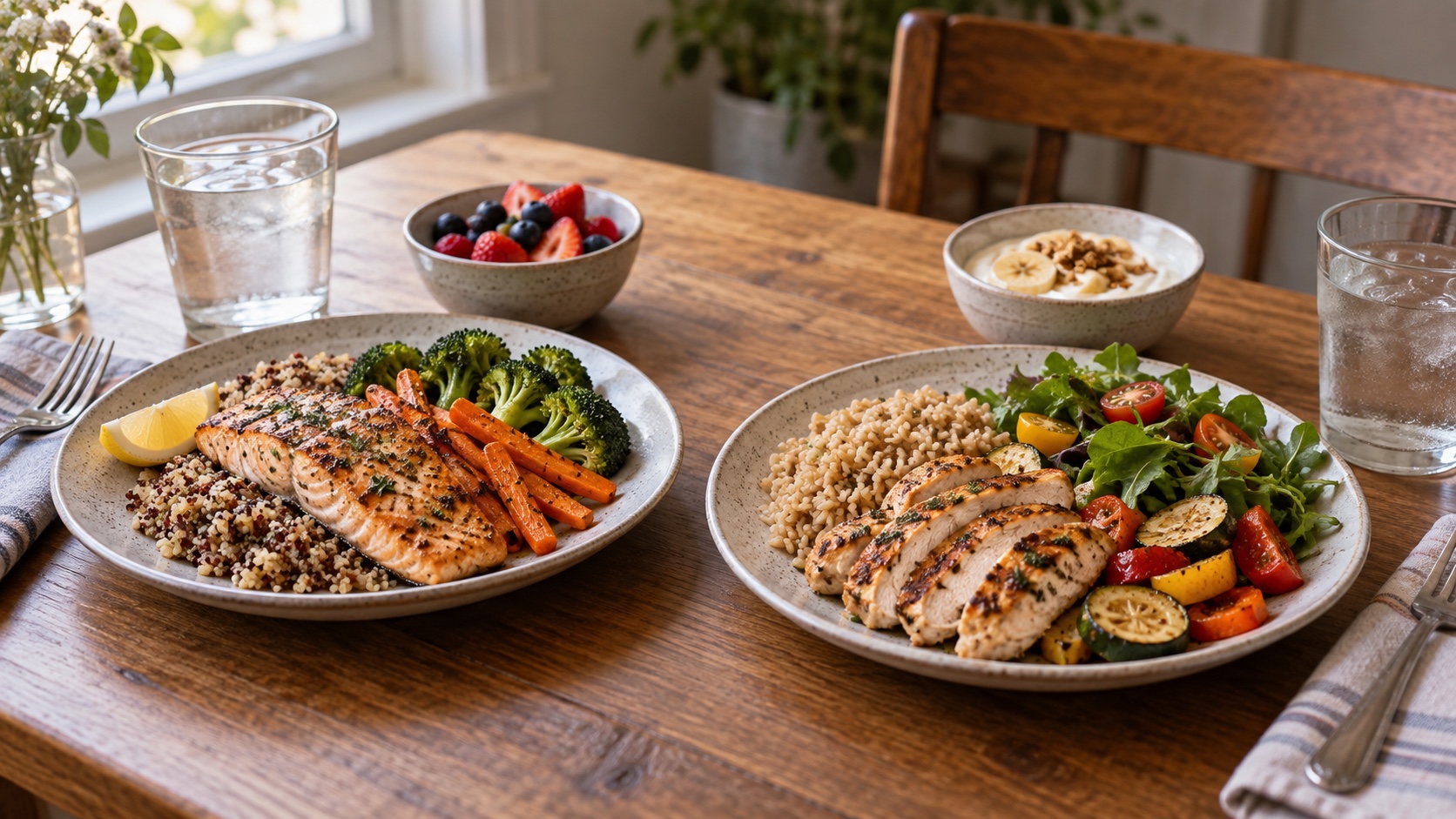
The Trade Inside Every Window
Time-restricted eating sets a container, not a menu: the window decides how many hours food can enter, and the day's calories and protein still have to fit inside. Halve the window and the arithmetic is unforgiving — the same food arrives in larger single doses. The honest rationale for why that can matter comes from the mechanism page of this series (meal timing and reflux, honestly): a stretched stomach fires more of the transient sphincter relaxations that let acid up, and a very full stomach lying down has nowhere to put it.
- ⚖️ Window length and meal size trade against each other — the shorter the window, the larger the average meal for the same intake.
- 🍽️ Portion, not the clock, drives distension — the stomach responds to volume and stretch; it does not know what time the window opened.
- 🕰️ The window is a scheduling tool — it changes when food arrives; what arrives and how much is still on you.
- 🥩 Protein still has to fit — the daily 1.6–2.2 g/kg target from the site's nutrition pages does not shrink with the window, so compression concentrates it into the meals that remain.
Product picks are generic categories, not brands. We may earn a commission on Amazon or iHerb purchases at no cost to you — this never changes our evidence conclusions. Full disclosure
Digital kitchen scale
Can help with recipe consistency and portion awareness when a person finds that useful.
⚠️ Detailed food tracking can be unhelpful for people with a current or past eating disorder; it is not necessary for healthy eating.
Check price on Amazon →Distension: The Mechanism That Makes Big Meals Costly
The relevant physiology is decades old and well replicated. Most reflux episodes in healthy people do not happen because the sphincter is weak; they ride on brief, spontaneous relaxations of a competent valve, and the most reliable trigger for those relaxations is stomach distension (Dent, Journal of Clinical Investigation, 1980). A large meal stretches the stomach wall, the stretch signals the sphincter to open, and the open sphincter lets the meal's acid and contents drift upward — especially once the body is horizontal. The clinical review literature calls the junction between stomach and esophagus the site where most of the action happens (Mittal & Balaban, New England Journal of Medicine, 1997).
- 🎈 Volume is the signal — a stretched stomach wall is the input; the sphincter opening is the output.
- ⏳ Emptying stretches the cost over hours — a large, fatty meal can keep the stomach working for 3–4 hours, extending the window in which lying down is expensive.
- 🧈 Fat compounds the delay — high-fat meals both relax the sphincter more and slow emptying in physiology studies (Pehl, Am J Gastroenterol, 1999).
When a Shorter Window Backfires
The backfire scenario is specific and worth naming plainly: someone moves from a 12-hour day to a 16/8 or OMAD pattern, keeps the same calories, and ends up eating one or two genuinely large meals — often the largest of them late in the day, closest to bed. That is the exact configuration the timing evidence flags as most costly: large, late, and followed by recumbency (Piesman, Am J Gastroenterol, 2007). The result for susceptible people is more fullness, more reflux, and a fasting experiment that feels like a digestion experiment. The OMAD page in this series confronts the same problem from the other direction: one meal a day means one very large meal a day.
- 😖 Fullness is the first complaint — bloating, pressure, and early satiety are the body reporting a portion the stomach was not expecting.
- 🔥 Reflux is the second — distension plus a late, horizontal position is the combination the trials flag most consistently.
- 🔄 The fix is not abandoning fasting — it is rebalancing the window, portion, and content so the fast survives without the fullness.
Window Length vs Meal Size: The Evidence Ledger
Put plainly: the evidence for meal size and content is physiology plus decades of clinical observation, and the evidence for window length is almost entirely inference from that physiology. The table scores the common window strategies through the reflux lens, not through the weight-loss lens — the weight-loss evidence lives on the Fasting & TRE protocol lead.
| Strategy | Reflux-relevant note | Verdict |
|---|---|---|
| ⏱️ 16/8, two large meals | The most compression; for susceptible people this is the reflux-risk pattern | Risky for reflux |
| ⏳ 14/10, three meals | Moderate compression; usually room for normal portions without crowding | Middle ground |
| 🕙 10–14 h flexible window | Minimal compression; three normal meals fit with no portion gymnastics | Easier on digestion |
| 🍽️ Same calories, more meals | The comparison that actually matters — portion, not the clock, drives distension | Portion wins |
One honest caveat: none of this is a verdict against fasting. The same window that worsens reflux in one person is the pattern that helps another lose weight and feel better overall. The point of the ledger is narrower — if reflux appears or worsens when the window shrinks, the window is the first suspect, and the fix is usually a rebalance rather than an abandonment.
Rebalancing: Keep the Fast, Lose the Fullness
The rebalance has three dials, and most people only need the first two. The goal is to preserve the fast's benefits — fewer eating occasions, a defined day, whatever the honest rationale says you are after — while removing the distension problem that compression created.
- 🕐 Widen the window modestly — going from 16/8 to 14/10 (see the 12-14-16 progression) usually fits three meals without meaningfully shortening the fast.
- 🍲 Reshape the largest meal — move volume earlier in the day and keep the evening meal moderate, lean, and earlier rather than later.
- 🧈 Cut the evening fat, not the evening meal — a lighter dinner empties faster and removes the emptying-delay that fat adds.
- 🚶 Protect the post-meal hour — upright and easy after eating; the position rules cost nothing and do real work.
- 📊 Let symptoms vote — if reflux worsens when the window shrinks, that is data about your body, not a failure of willpower.
A concrete example of the rebalance: a 16/8 eater with evening reflux moves to 14/10, keeps the two larger meals where they were, and adds a modest third meal at midday — the same calories, a smaller evening portion, and an earlier last bite. The fast shortens by two hours; the fullness problem usually shrinks more than that.
Reading Your Own Response
The cleanest way to know which dial matters for you is the same experiment this series recommends everywhere: change one thing at a time and track. The full protocol is on the late-meal experiment page, and the tracking format on the clinician-ready symptom log. The version for this page is simpler: keep your window, keep your calories, and move one meal's volume — or widen the window by two hours — then read a week of symptoms before and after. If fullness and burning follow the portion rather than the clock, you have your answer.
⚠️ Compression is a symptom amplifier for some people
Shrinking the window forces bigger meals, and bigger meals mean more distension and more reflux events for susceptible people — the physiology is consistent even though no trials compare windows directly. If symptoms worsen when the window shrinks, widen it before abandoning fasting; weight and total intake matter more than the hours. Persistent or severe symptoms — trouble swallowing, bleeding, repeated vomiting, weight loss, or severe pain — are a clinician's question, and no window adjustment replaces an evaluation.
The Bottom Line
- Window length and meal size trade against each other — compression forces bigger meals, and portion, not the clock, drives distension.
- Bigger meals fire more reflux events — the distension mechanism is decades-old physiology (Dent, 1980; Mittal, 1997).
- No trials compare windows directly — the evidence is physiology plus inference, so individual data should settle your case.
- If symptoms worsen, widen the window — the fast is a tool, not the point; rebalance first, and let red flags end the experiment entirely.
Related Topics
- Dent et al., "Mechanism of Gastroesophageal Reflux in Recumbent Asymptomatic Human Subjects," Journal of Clinical Investigation (1980)
- Mittal & Balaban, "The Esophagogastric Junction," New England Journal of Medicine (1997)
- Pehl et al., "Effect of Low and High Fat Meals on Lower Esophageal Sphincter Motility and Gastroesophageal Reflux in Healthy Subjects," American Journal of Gastroenterology (1999)
- Piesman et al., "Nocturnal Reflux Episodes Following the Administration of a Standardized Meal: Does Timing Matter?" American Journal of Gastroenterology (2007)
- Ness-Jensen et al., "Weight Loss and Reduction in Gastroesophageal Reflux: A Prospective Population-Based Cohort Study: The HUNT Study," American Journal of Gastroenterology (2013)
- Katz et al., "ACG Clinical Guideline for the Diagnosis and Management of Gastroesophageal Reflux Disease," American Journal of Gastroenterology (2022)