CPAP & Blood Pressure
Continuous positive airway pressure keeps the airway open during sleep, and a large body of human trials tests what that does to blood pressure. The honest summary is modest: CPAP lowers blood pressure on average, reliably more in some groups, and every benefit depends on actually wearing the device. This page separates the trial evidence from the marketing, and explains the adherence limits that shape every claim.
What the evidence supports
- CPAP is the first-line airflow treatment for moderate-to-severe obstructive sleep apnea in adults (Patil et al., Journal of Clinical Sleep Medicine, 2019).
- Randomized trials and meta-analyses find CPAP lowers 24-hour and office blood pressure by a modest but consistent average amount.
- Larger average blood-pressure reductions appear in people who are sleepy, have more severe apnea, higher baseline pressure, or resistant hypertension (Martínez-García et al., JAMA, 2013).
What remains uncertain
- Average blood-pressure effects vary widely between individuals; many benefit less than the group average suggests, and some see little change.
- Adherence is the great limit — trials often report average use of a few hours per night, and benefits generally track with actual wear time.
- Whether CPAP changes hard cardiovascular outcomes independent of blood pressure is still an area of ongoing research; blood-pressure and symptom benefits are the better-documented territory.
Evidence last reviewed: August 20, 2026. Conclusions may change as new research is published.
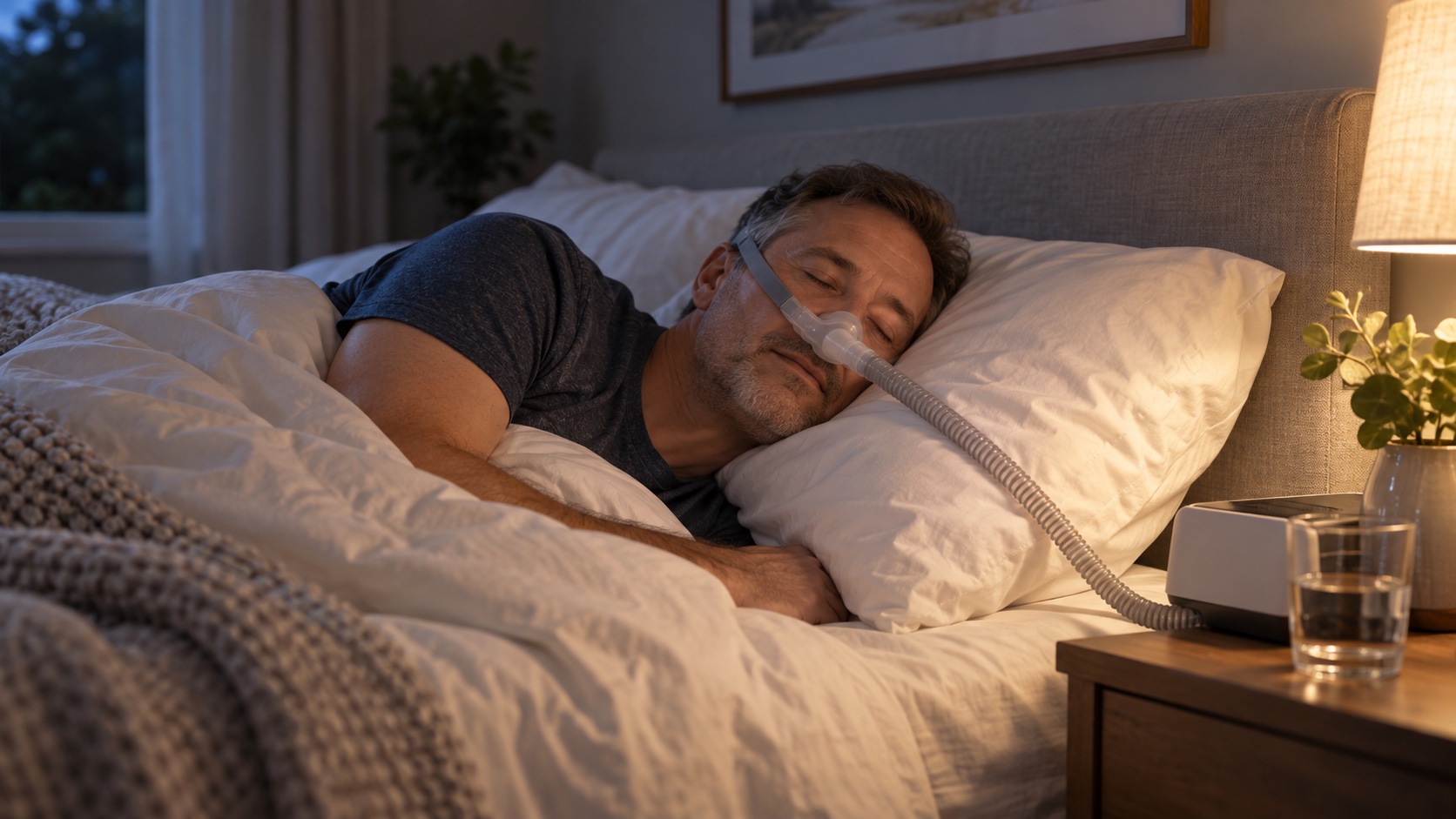
What CPAP Does, and Where It Belongs
CPAP — continuous positive airway pressure — delivers a steady stream of pressurized air through a mask, holding the upper airway open so it does not collapse during inspiration. It is prescribed after a diagnosis of obstructive sleep apnea, when the airway narrows or closes repeatedly during sleep, disrupting breathing and sleep. It is not a blood-pressure medication, and it is not bought off a shelf: a clinician works out the diagnosis, the pressure setting, and the mask fit, and a sleep team titrates it over time.
The mechanism connecting it to blood pressure is plausible and grounded: each apnea event strains breathing, drops oxygen, and triggers a burst of sympathetic activity and a brief arousal. Across a night, repeated events can raise blood pressure and blunt its normal nighttime fall. By preventing those events, CPAP appears to remove that repeated nighttime stress — which is why its blood-pressure effects are most visible where the apnea-driven stress is largest.
What the Trials Actually Show
The evidence base is large — dozens of randomized trials and multiple meta-analyses that pool them. The consistent finding is a modest average reduction in blood pressure with CPAP compared with control. Individual trials vary, but the pooled direction is stable: CPAP lowers 24-hour and clinic blood pressure by a few mmHg on average, on top of whatever else is being done. How much that matters depends on where the baseline starts — a few mmHg is more consequential at higher starting pressures.
Where averages get more interesting is the subgroups. People with daytime sleepiness, more severe apnea, higher baseline blood pressure, and resistant hypertension tend to show larger average reductions. The most cited example is the HIPARCO trial, which tested CPAP in people with obstructive sleep apnea and resistant hypertension: the group receiving CPAP showed a meaningfully greater reduction in 24-hour blood pressure than the group that did not, with the gap widening over months of use (Martínez-García et al., JAMA, 2013). This is real, high-quality evidence — but it applies, as tested, to a specific population, not to every snorer.
Adherence Is the Truth Serum
Every claim about CPAP and blood pressure comes with a quiet asterisk: the device only works while it is worn. Trials report average use measured in hours per night, and when researchers analyze hours of use against blood-pressure change, a dose-response appears — people who wear the device more consistently tend to show more benefit. A device used for two hours a night cannot be assumed to deliver the full effect any more than taking half a pill delivers a full dose.
Adherence is also where evidence meets ordinary life. Masks leak, straps chafe, pressure feels strange, and many people stop using the device within months. This is not a character flaw; it is a clinical problem with real solutions — mask refitting, humidification, ramp settings, troubleshooting with the sleep team. The answer to poor adherence is not private guilt or quietly abandoning the therapy; it is a conversation with the clinician who prescribed it.
⚠️ Do not adjust medicine because CPAP "looks good"
A favorable CPAP report is not a license to stop, split, or shift blood-pressure medication. Reductions are modest and variable, and medicines are titrated by the prescribing clinician against measured outcomes. If your clinic or home averages improve, share that with the team and let the person managing your medications decide what it means. Never improvise a dose change from a device dashboard.
Who It Helps Most, and Who It Helps Least
The most honest framing is not "does CPAP lower blood pressure?" but "for whom, and by how much?" The evidence points to larger average effects when the apnea is more severe, when the person is sleepy during the day, and when baseline blood pressure or resistance is higher. Conversely, in minimally symptomatic people with no hypertension, average blood-pressure changes can be very small — which is why trials recruit groups that matter rather than promising across-the-board reductions.
| Group | What trials suggest on average | Verdict |
|---|---|---|
| 💓 Resistant hypertension + apnea | Mean 24-h blood pressure falls more than control in a randomized trial (HIPARCO) — a real, specific finding | Meaningful |
| 😴 Severe apnea with sleepiness | Average reductions tend to be larger than in unselected groups | Larger |
| 🧍 Unselected sleep apnea | Modest average reductions, often 2–4 mmHg, with wide individual spread | Modest |
| 🙂 Minimal symptoms, no hypertension | Average blood-pressure changes are small and often nonsignificant | Small |
Beyond blood pressure, CPAP is prescribed primarily to treat the underlying sleep apnea — improved breathing, alertness, and sleep quality are the direct outcomes — not as a hypertension treatment. The blood-pressure benefit is a bonus that appears to be real but modest and variable, which is exactly the honest trade the evidence supports.
The Other Treatments in the Room
CPAP is not the sole option, and choosing among them is clinical work. Mandibular advancement devices, positional therapy, weight management, and sometimes surgery exist; a sleep physician matches the intervention to the diagnosis, anatomy, severity, preferences, and tolerance. None of these is a blood-pressure medication either. If hypertension coexists with apnea, guideline-based blood-pressure care — the territory of the medications and handoff page — runs alongside, not instead of, apnea treatment.
- 🛌 Different airways, different answers — CPAP, oral appliances, and weight change each fit different profiles; the sleep clinician decides, not a forum post.
- 💊 Medicines run on their own track — a prescription regimen is adjusted by the clinician who prescribes it, using measured outputs including (if ordered) ambulatory monitoring.
- 📐 Fit is treatment — a well-tolerated mask worn for more of the night beats a "better" therapy abandoned in week two.
- 🧭 Measure the real outcomes — symptoms, device data, sleep-study findings, and home blood-pressure averages each answer a different question; ask the team what each will show.
Bringing It to the Clinic
The practical path: if sleep apnea is diagnosed and CPAP is prescribed, use it, track symptoms and home blood pressure, and bring both to follow-up. The nocturnal blood-pressure handoff page covers the full conversation, and the home monitoring with sleep context page shows how to keep the log that makes the follow-up productive. Report leaks, discomfort, and changing symptoms rather than quietly drifting away from treatment.
It is also worth talking about what to expect in the first weeks. Masks take getting used to, and the first nights can feel odd before they feel normal. A sleep team can adjust the pressure ramp, choose a different mask style, or add humidity — all small changes that often move adherence far more than willpower does. If the device is loud, the seal is poor, or you wake with a dry mouth, those are fixable complaints, and raising them is how care actually improves.
One more expectation worth setting: the blood-pressure effect, when it appears, is usually gradual rather than overnight, and it sits alongside the larger gains in breathing, alertness, and sleep quality. Tracking home averages over weeks — not judging the first week — gives the clinician the signal they need to decide whether anything else belongs in the plan.
The Bottom Line
- The evidence is real but modest. Across trials and meta-analyses, CPAP lowers blood pressure by a few mmHg on average — consistent, not dramatic (Martínez-García et al., JAMA, 2013; Fava et al., Chest, 2014).
- Largest effects land in specific groups. Resistant hypertension, greater severity, and daytime sleepiness mark where average reductions are bigger; minimal-symptom groups may see very little.
- Adherence is the verdict. Benefits track with hours of actual use; a device worn for part of the night cannot be assumed to deliver the full effect.
- Keep medicines on their own track. CPAP is apnea treatment with a blood-pressure bonus; stopping, splitting, or shifting prescriptions because of a device report is clinician territory, not self-direction.
Related Topics
- Martínez-García M-A, et al., "Effect of continuous positive airway pressure on blood pressure in patients with obstructive sleep apnea and resistant hypertension: the HIPARCO randomized clinical trial," JAMA (2013)
- Patil SP, et al., "Treatment of adult obstructive sleep apnea with positive airway pressure: an American Academy of Sleep Medicine systematic review," Journal of Clinical Sleep Medicine (2019)
- Fava C, et al., "Effect of CPAP on blood pressure in patients with obstructive sleep apnea/hypopnea: systematic review and meta-analysis," Chest (2014)
- Bratton DJ, et al., "Effects of CPAP on blood pressure in patients with minimally symptomatic obstructive sleep apnoea," Lancet Respiratory Medicine (2014)
- Javaheri S, et al., "Sleep apnea: types, mechanisms, and clinical cardiovascular consequences," Journal of the American College of Cardiology (2017)