The eating-window dose
"16:8" sounds like a fixed protocol, but the window is a dial with a dose-response — and like most doses, the curve bends. This page walks the width from 12 hours down to 4, using the trials that actually measured each setting, and shows where benefit plateaus and where cost starts to climb.
What the evidence supports
- A 10-hour window improved weight, blood pressure, and atherogenic lipids over 12 weeks in people with metabolic syndrome (Cell Metabolism, 2020).
- Eight-hour windows produce modest weight loss (~2–3% over 8–12 weeks), mostly via a spontaneous calorie drop.
- Windows of 6 and 4 hours produced no greater weight loss than 8 hours in the direct comparison that exists (Cell Metabolism, 2020).
What remains uncertain
- Whether any single width is optimal — no large trial has randomized 10h vs 8h vs 6h against each other for outcomes.
- How much of the early-window metabolic benefit depends on the clock itself versus matching meals to circadian biology.
- Long-term adherence at each width — trial windows are short, and real-life adherence drifts.
Evidence last reviewed: August 15, 2026. Conclusions may change as new research is published.
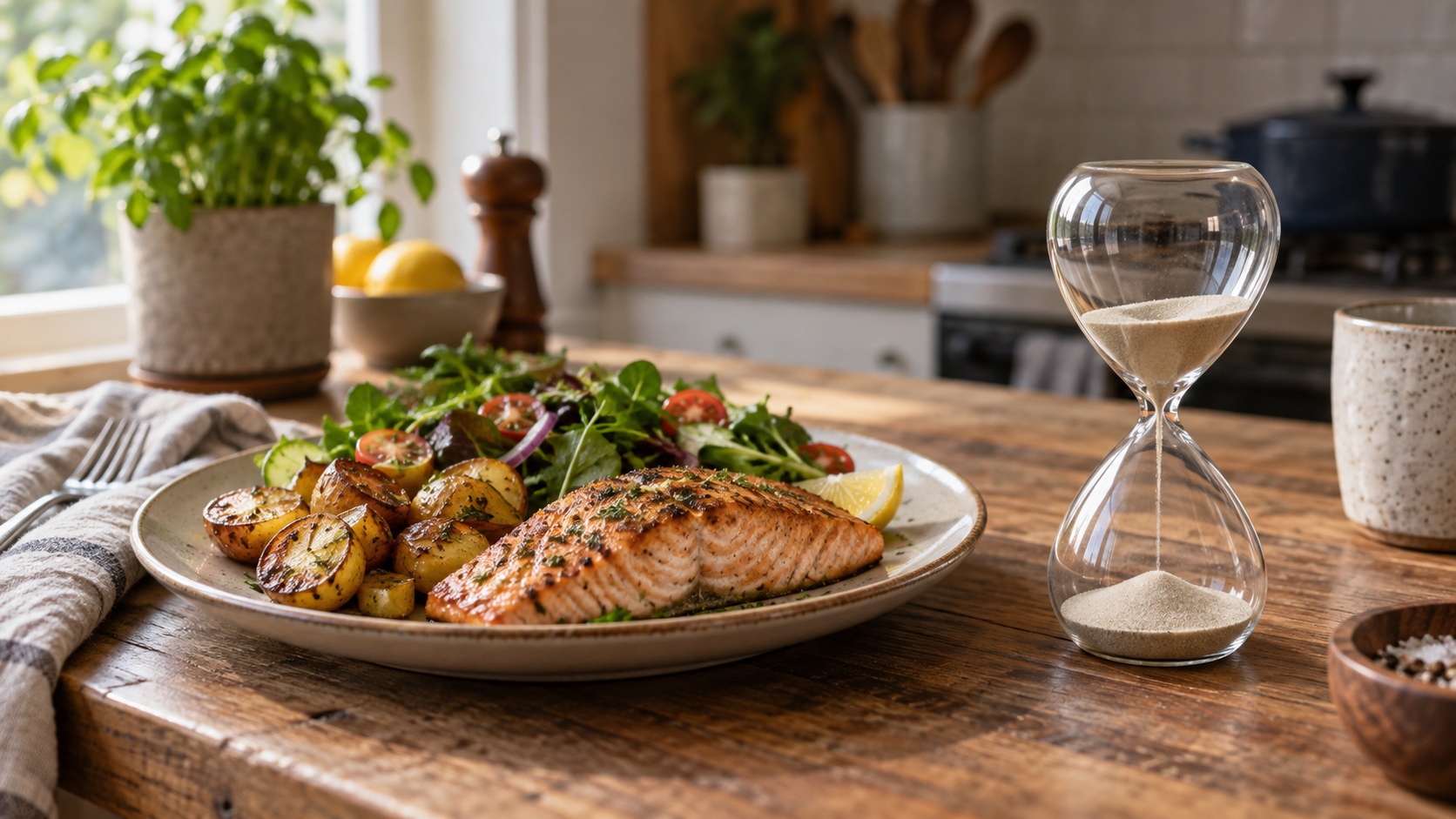
The Window Is a Dose
Every fasting discussion defaults to 16:8, as if the width were a brand rather than a variable. Treat it as a dose instead: each setting has its own evidence, its own downsides, and its own failure mode. Three patterns organize the trial literature. Wider windows (12h) are nearly free — most people already eat within them, so the intervention is deleting late-night intake. Middle windows (10h–8h) are where the measured benefits cluster. Narrow windows (6h and below) add cost faster than benefit — hunger, social friction, and lean-mass pressure with no extra weight loss to show. The rest of this page fills in each rung, then gives you a rule for choosing.
12 Hours: The Default That Works
A 12:12 schedule — food between, say, 8am and 8pm — is barely a "fast" and that is its virtue. There is no large dedicated 12-hour trial, because for most adults 12 hours is close to baseline; the intervention is trimming the tail. What the wider literature shows is that the late-evening hours are where the damage concentrates: snacks after dinner add calories without satiety and sit close to bedtime, where a full stomach can fragment deep sleep. A 12-hour window removes that tail while leaving breakfast, lunch, and dinner untouched — no protein compression, no social cost, and it aligns with the circadian meal-timing evidence that late eating is metabolically worse than early eating. This is the width the fasting protocol recommends as a starting point, and for good reason: the best dose is the one you forget you are taking.
10 Hours: The Metabolic-Syndrome Trial
The strongest dedicated window trial used 10 hours. In a 2020 Cell Metabolism study, 19 adults with metabolic syndrome — most on statins or blood-pressure medication — were coached to compress eating into a self-chosen 10-hour window (no food logging, no calorie targets) for 12 weeks. Body weight, waist circumference, blood pressure, LDL, and non-HDL cholesterol all improved, and the gains held at follow-up; participants described the schedule as easy to maintain. The design matters: the benefit appeared under realistic conditions, with the window doing the work that calorie counting was supposed to. Ten hours is also wide enough to hold three protein-containing meals — an underrated property, since lean-mass protection depends on fitting enough pulses inside the window.
8 Hours: Where Benefits Plateau
Eight hours is the most-studied width — the 16:8 of every headline — and the trial record is honestly modest. In a 12-week study of 23 adults with obesity, an 8-hour window (10am–6pm) produced weight loss of roughly 2–3% without calorie instruction, driven by a spontaneous reduction of about 340 kcal per day (Nutrition and Healthy Aging, 2018). The 2020 JAMA Internal Medicine TREAT trial found 16:8 produced no significant weight advantage over a normal schedule in 116 adults across 12 weeks. In other words: 8 hours works for some people, mostly by cutting calories, and adds nothing metabolic that wider windows lack in the trials that measured both. What 8 hours does do is start charging real costs: breakfast or dinner has to shrink, evening social eating gets squeezed, and hitting protein targets takes planning. The dose response has clearly bent by this point.
Below 8: Diminishing Returns, Rising Costs
The direct evidence on very narrow windows is thin, and what exists is deflating. A 2020 Cell Metabolism trial randomized 58 adults with obesity to a 4-hour or 6-hour window for 8 weeks: both groups lost roughly 3% of body weight, and — the part that matters — the 4-hour window produced no additional benefit, while insulin resistance and oxidative stress improved similarly in both. Nothing in the literature shows that squeezing below 8 hours buys you anything except difficulty: more hunger, compressed protein schedules, and a higher chance of one-meal-a-day patterns that undershoot protein. The honest dose-response reads: benefits cluster at 10–8 hours, and below 6 the curve is mostly cost.
| Window | Who it suits | What the trials show | Verdict |
|---|---|---|---|
| 🕛 12:12 | Most people; muscle goals; cautious starters | Few dedicated trials — near baseline; removes late-night tail | Good default |
| 🕙 10:14 | Metabolic syndrome; gradual compressors | Wilkinson 2020: weight, BP, and lipids improved at 12 weeks | Good |
| 🕗 8:16 | Weight loss; the most-studied option | ~2–3% loss over 8–12 weeks; no edge over wider windows in TREAT | Moderate trade-off |
| 🕕 6:18 | Only with a strong personal reason | No added benefit vs 8h (Cienfuegos 2020); more hunger and friction | Limited benefit |
| 🕓 4:20 | Rarely worth it | Same loss as 6h; protein compression and lean-mass risk rise | Avoid for most |
⚠️ Narrower is not better
The dose-response intuition — if some fasting is good, more is better — fails at the window dial. The trials that compared widths found the same weight loss at 4 hours as at 6, and no trial has shown a metabolic edge below 8 hours. Choose the widest window that still fixes your specific problem, not the narrowest one you can endure.
Picking Your Window: Practical Rules
- 🌅 Start at 12h and earn the rest. Two weeks at 12:12 fixes most late-snacking problems at zero cost; only compress further if there is a specific reason.
- 🩸 Metabolic concerns? 10 hours has the best direct trial (Wilkinson 2020). Match it to your glucose and lipid picture, not to a social-media default.
- ⏰ Early beats late at any width. A window that ends by early evening outperforms the same width shifted late — the timing evidence is consistent (Sutton 2018).
- 🥩 Fit the protein before you fit the window. Count the meals your protein target needs, then choose the narrowest window that holds them — usually 10h or wider. The muscle page has the arithmetic.
- 👩 Women: default gentler. Given the thinner safety data and preliminary hormonal signals, 12–14 hours is the sensible starting width; see who should avoid TRE.
Questions, Answered Briefly
- 📏 Is 16:8 the "studied" window? Eight-hour windows are well studied, but "16:8" as a brand is mostly marketing; 10-hour trials are the ones with the strongest metabolic outcomes.
- 🧮 Do I get 4 hours of extra benefit from a 4-hour window? No — the one direct comparison found no added weight loss below 6 hours.
- 🌙 Does the window have to be identical daily? No. Consistency helps habit formation, but weekend drift is normal and the trials tolerated it.
- 🪟 I feel great on 14:10 — am I missing out? On the contrary: you are inside the zone where the measured benefits live, at minimal cost. There is nothing to chase.
- Anchor the window to your day: an earlier window fits most circadian biology, but the sustainable window is the one your schedule and hunger actually allow.
The Bottom Line
- The window is a dose, and the dose-response bends. Benefits cluster at 10–8 hours; below 8 hours, cost rises faster than benefit.
- 12 hours is the free option. It removes the late-night tail with no protein or social cost.
- 10 hours owns the strongest metabolic trial — weight, blood pressure, and lipids improved in people with metabolic syndrome (Wilkinson 2020).
- Below 6 hours buys nothing extra. The 4-hour and 6-hour windows lost the same ~3% (Cienfuegos 2020) — choose the widest window that fixes your problem.
Related Topics
- Wilkinson et al., "Ten-hour time-restricted eating reduces weight, blood pressure, and atherogenic lipids in patients with metabolic syndrome," Cell Metabolism (2020)
- Cienfuegos et al., "Effects of 4- and 6-h time-restricted feeding on weight and cardiometabolic health: a randomized controlled trial in adults with obesity," Cell Metabolism (2020)
- Gabel et al., "Effects of 8-hour time restricted feeding on body weight and metabolic disease risk factors in obese adults: a pilot study," Nutrition and Healthy Aging (2018)
- Lowe et al., "Effects of time-restricted eating on weight loss and other metabolic parameters in women and men with overweight and obesity: the TREAT randomized clinical trial," JAMA Internal Medicine (2020)
- Sutton et al., "Early time-restricted feeding improves insulin sensitivity, blood pressure, and oxidative stress even without weight loss in men with prediabetes," Cell Metabolism (2018)
- Regmi & Heilbronn, "Time-restricted eating: benefits, mechanisms, and challenges in translation," iScience (2020)