Prebiotics as the Higher-Leverage Bet
Probiotics add visitors to an ecosystem that mostly rejects them. Prebiotics do something structurally different: they feed the microbes already living there, in place, for as long as you keep feeding them. This page makes the fiber-first case — the definition, the measurable effects, the doses, and the honest limits of the strategy.
What the evidence supports
- Defined prebiotics — inulin-type fructans, galacto-oligosaccharides — reliably increase Bifidobacteria and related species within weeks, at doses around 5–10 grams per day.
- The effect outlasts the supplement: the grown population persists for weeks to months after intake stops, unlike transient probiotics.
- Prebiotic fibers improve bowel regularity and, via fermentation, support butyrate production in the colon.
What remains uncertain
- Whether a higher Bifidobacteria count translates into fewer diseases is less directly demonstrated than the count itself — the long-term outcomes come from whole-diet fiber cohorts.
- Individual responses vary widely; some people are "non-responders" and others hit the gas-and-bloating ceiling quickly.
- Prebiotic powders are extracts — they lack the food matrix, and their long-term head-to-head evidence against food fiber is thin.
Evidence last reviewed: August 15, 2026. Conclusions may change as new research is published.
Product picks are generic categories, not brands. We may earn a commission on Amazon or iHerb purchases at no cost to you — this never changes our evidence conclusions. Full disclosure
Inulin-type prebiotic powder
May be a structured, optional way to increase inulin-type fructans when an article explicitly teaches a gradual, food-first trial.
⚠️ Can cause gas and bloating; avoid self-directed use with active gas-predominant IBS or a low-FODMAP elimination phase without professional guidance.
Check price on Amazon →The Definition, Sharpened
"Prebiotic" is a precise term that marketing has stretched. The consensus definition, from the International Scientific Association for Probiotics and Prebiotics: a substrate that is selectively utilized by host microorganisms conferring a health benefit (Gibson et al., Nature Reviews Gastroenterology & Hepatology, 2017). Two words do the work. Selectively — the fiber feeds specific beneficial groups rather than whatever happens to be there, which is what separates a prebiotic from bulk fiber. And conferring a health benefit — the outcome has to be shown, not assumed. By that standard, the established prebiotics are a short list: inulin and fructo-oligosaccharides (FOS), galacto-oligosaccharides (GOS), and — with growing support — partially hydrolyzed guar gum. Resistant starch and other candidate fibers sit just outside the formal definition, waiting on selective-utilization evidence. The concept itself dates to 1995, when Gibson and Roberfroid proposed feeding Bifidobacteria deliberately rather than importing new microbes — which is, in one sentence, the argument this page makes.
Tourists vs Residents
The case for fiber-first follows directly from the biology covered in Probiotics 101. Ingested probiotic strains are transients — in many people they never even establish in transit, and their effects end when the capsules do. Prebiotics invert the transaction. Instead of importing microbes into a community that practices colonization resistance, they send food to the residents that are already adapted to you, already stable, and already doing the daily work of digestion and immunity. The difference shows up in what happens when you stop. Stop a probiotic and detection of the strain typically fades within days to a couple of weeks (Kristensen et al., Genome Medicine, 2016). Stop a prebiotic and the Bifidobacteria population you grew stays elevated for weeks to months before slowly drifting back — you expanded a native population, and populations persist. That asymmetry — rent versus ownership — is the entire leverage argument.
What Prebiotics Reliably Do
The measured effects, in order of how well they are established:
- 📈 The bifidogenic effect: 5–10 g/day of inulin-type fructans raises Bifidobacteria abundance reproducibly within weeks — the most replicated finding in prebiotic research (Vandeputte et al., Gut, 2017).
- 🔥 Butyrate, indirectly: Bifidobacteria themselves produce acetate and lactate, which butyrate producers cross-feed on — prebiotics grow the supply chain for the colon's preferred fuel (see the fermentation products page).
- 🚽 Regularity: prebiotic fibers add fermentable bulk and water-holding capacity; stool frequency and softness improve on a time scale of days.
- 🦴 A niche win: in adolescents, 8 g/day of inulin-type fructans increased calcium absorption by around 20% in a controlled trial (Abrams et al., American Journal of Clinical Nutrition, 2005) — small population, but one of the few hard outcome wins in the field.
- 🛡️ The long game: disease-level outcomes — mortality, cardiovascular events, colorectal cancer — come from whole-diet fiber cohorts, not prebiotic powders; that evidence belongs to the Fiber topic and is the reason food-first is the default posture here.
The Dose and the Tolerance Curve
Prebiotics have a built-in honesty mechanism: take too much too fast, and the fermentation produces enough gas to stop you. The tolerance curve is why dose discipline matters. Start at 3–5 g/day, hold for a week, step up in 2–3 g increments — the same ramp-up logic the fiber topic's ramp-up protocol spells out — and most people land comfortably at 5–10 g/day of inulin-type fructans, which is also the dose band where the bifidogenic effect appears. Some people never adapt: those with FODMAP-sensitive guts may find even small inulin doses punishing, and for them the answer is other fiber families (psyllium, oats) rather than more willpower. The gas itself is the sound of a working ecosystem — hydrogen and carbon dioxide are normal fermentation products — but bloating pain is a signal to slow down or switch substrate, not to push through.
🌬️ The gas is the tax, not the point
New prebiotic users are often startled by the first week of flatulence and read it as failure. It is the opposite: the resident fermenters were starved, and they are waking up. The ramp-up protocol exists precisely to pay this tax in small installments. But two groups should not pay it at all: people with active IBS of the gas-predominant kind, and anyone on a low-FODMAP elimination phase — for them, prebiotic powders are a later question for a dietitian, and food-based, slower-fermenting fibers come first.
A Working Cheat Sheet
The practical prebiotic roster, with the honest evidence read on each.
| Prebiotic / fiber | Main food sources | Typical studied dose | Evidence read |
|---|---|---|---|
| 🧅 Inulin & FOS | Chicory root, Jerusalem artichoke, garlic, onion, leeks | 5–10 g/day | Well studied |
| 🥛 GOS | Legumes; supplements (derived from milk sugar) | 3–5 g/day | Well studied |
| 🫘 Resistant starch | Cooled potatoes and rice, green bananas, legumes | 15–30 g/day food-based | Candidate — promising |
| 🌱 PHGG (partially hydrolyzed guar gum) | Supplement form mostly | 5–7 g/day | Moderate |
| 🌾 Psyllium | Supplement form mostly | 5–10 g/day | Strong for laxation — not selectively fermented, so not a prebiotic by the strict definition |
| 🌽 XOS (xylo-oligosaccharides) | Supplement form mostly | 1–2 g/day | Emerging |
The Honest Limits
Fiber-first is the higher-leverage bet, not a magic one. Three limits keep it honest. First, the count is not the outcome: a reproducible rise in Bifidobacteria is a validated intermediate, but the disease-level evidence that matters for longevity comes from whole-diet fiber — food, not powder. Second, the powder is an extract: prebiotic supplements deliver one fiber family; food delivers a matrix of fibers, polyphenols, and structure that ferment together, and the food matrix has the stronger outcome record. Third, individual response varies: some guts respond dramatically, some barely, and a meaningful minority cannot tolerate fructans at all. The strategy is therefore: food first (legumes, alliums, whole grains, cooled starches), powder only as a targeted top-up, and your own tolerance curve as the dosing guide. That ordering is the same one the parent scorecard reaches from the other direction.
Questions, Answered Briefly
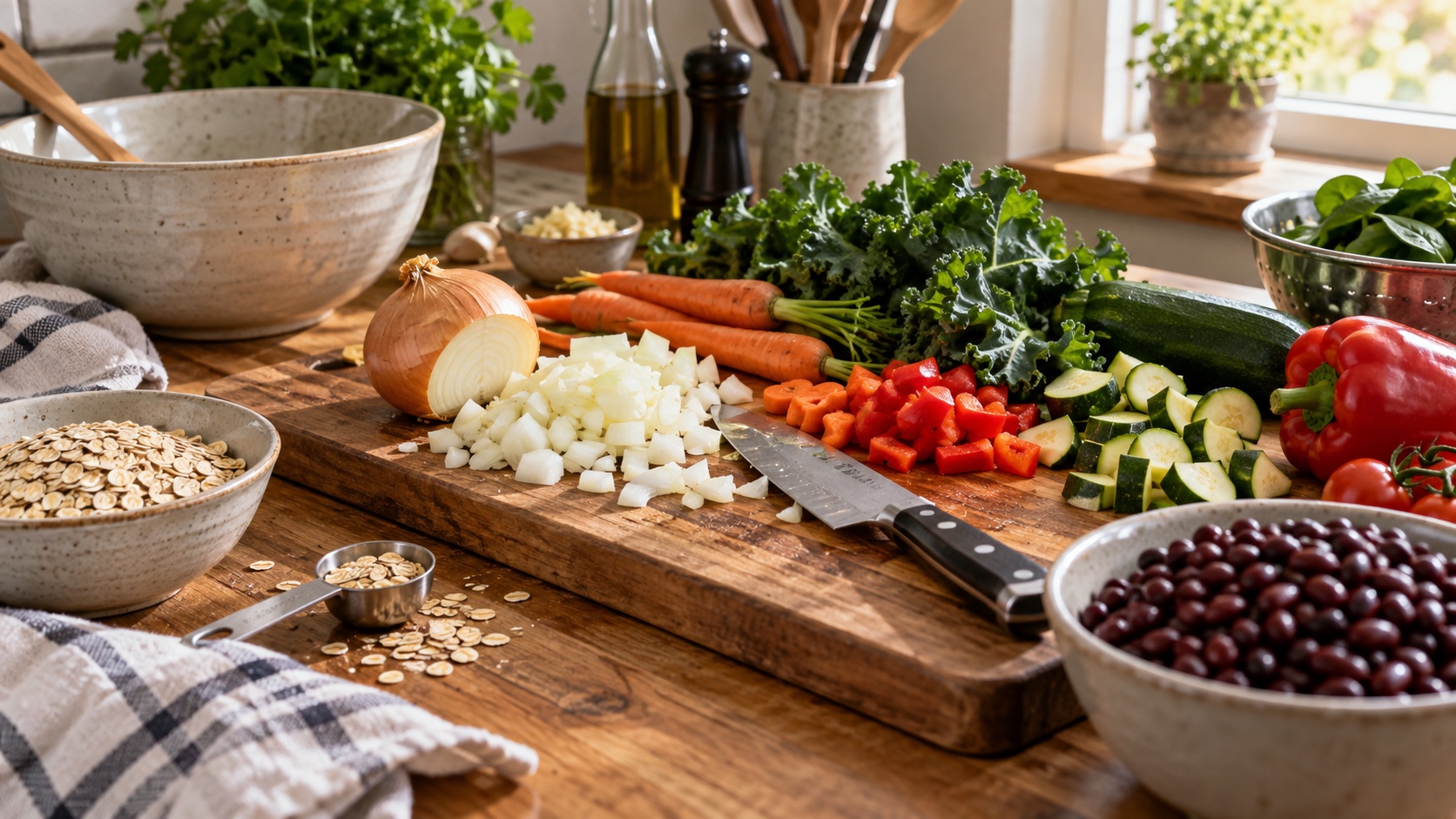
- 🌾 Can I just eat food and skip the powder? Yes — and it is the default. Garlic, onion, leeks, oats, barley, legumes, and cooled starches deliver prebiotics inside a food matrix with the stronger outcome record.
- 💊 Prebiotic or probiotic, if I had to choose one? Prebiotic, for most people. It grows native, persistent populations; the probiotic adds a transient. The exceptions are specific indications like antibiotic-associated diarrhea — see the demonstrated list.
- ⏱️ How long until I notice anything? Regularity often shifts within days; the measurable community change takes 2–4 weeks; disease-level benefits are the long game of total diet, not of any single product.
- 🤢 What if fiber wrecks my gut? Slow down and switch families — psyllium and oats ferment gently. Persistent pain or severe bloating is a clinician question, and FODMAP-sensitive guts should work with a dietitian rather than self-dose fructans.
The Bottom Line
- Prebiotics grow what you have; probiotics import what you don't — and native populations outlast imported ones, which is the structural reason fiber-first wins.
- The bifidogenic effect is real and doseable — 5–10 g/day of inulin-type fructans or 3–5 g/day of GOS, ramped up over weeks, reproducibly expands the resident Bifidobacteria.
- Food is the vehicle — alliums, legumes, whole grains, and cooled starches deliver the same chemistry inside a matrix with the stronger outcome record.
- Respect the tolerance curve — start small, step up slowly, and switch fiber families if the gas tax gets too high.
Related Topics
- Gibson & Roberfroid, "Dietary modulation of the human colonic microbiota: introducing the concept of prebiotics," The Journal of Nutrition (1995)
- Gibson et al., "Expert consensus document: The International Scientific Association for Probiotics and Prebiotics (ISAPP) consensus statement on the definition and scope of prebiotics," Nature Reviews Gastroenterology & Hepatology (2017)
- Vandeputte et al., "Prebiotic inulin-type fructans induce specific changes in the human gut microbiota," Gut (2017)
- Kristensen et al., "Alterations in fecal microbiota composition by probiotic supplementation in healthy adults: a systematic review of randomized controlled trials," Genome Medicine (2016)
- Abrams et al., "A combination of prebiotic short- and long-chain inulin-type fructans enhances calcium absorption and bone mineralization in young adolescents," The American Journal of Clinical Nutrition (2005)
- Wilson & Whelan, "Prebiotic inulin-type fructans and galacto-oligosaccharides: definition, specificity, function, and application in gastrointestinal disorders," Journal of Gastroenterology and Hepatology (2017)
- Reynolds et al., "Carbohydrate quality and human health: a series of systematic reviews and meta-analyses," The Lancet (2019)
- Slavin, "Fiber and prebiotics: mechanisms and health benefits," Nutrients (2013)