Genetics & the Ceiling
Roughly half of your starting VO₂ max is inherited, and so is part of how fast you respond to training — but neither number is a verdict. The studies that quantified the genetic ceiling also quantified how much room training leaves open, and that room exists at every age. This page separates what's fixed from what's negotiable.
What the evidence supports
- Baseline VO₂ max is substantially heritable — around 50% in twin and family studies.
- In the HERITAGE Family Study, the same 20-week program produced gains from roughly zero to over 50%, averaging about +17%.
- The age-related decline accelerates with each decade, but training attenuates it substantially at every age studied.
What remains uncertain
- Your personal genetic ceiling — it can't be measured in advance, only approached through training.
- Why some people respond little: dose, timing, and biology all contribute, and their relative shares are unresolved.
Evidence last reviewed: August 15, 2026. Conclusions may change as new research is published.
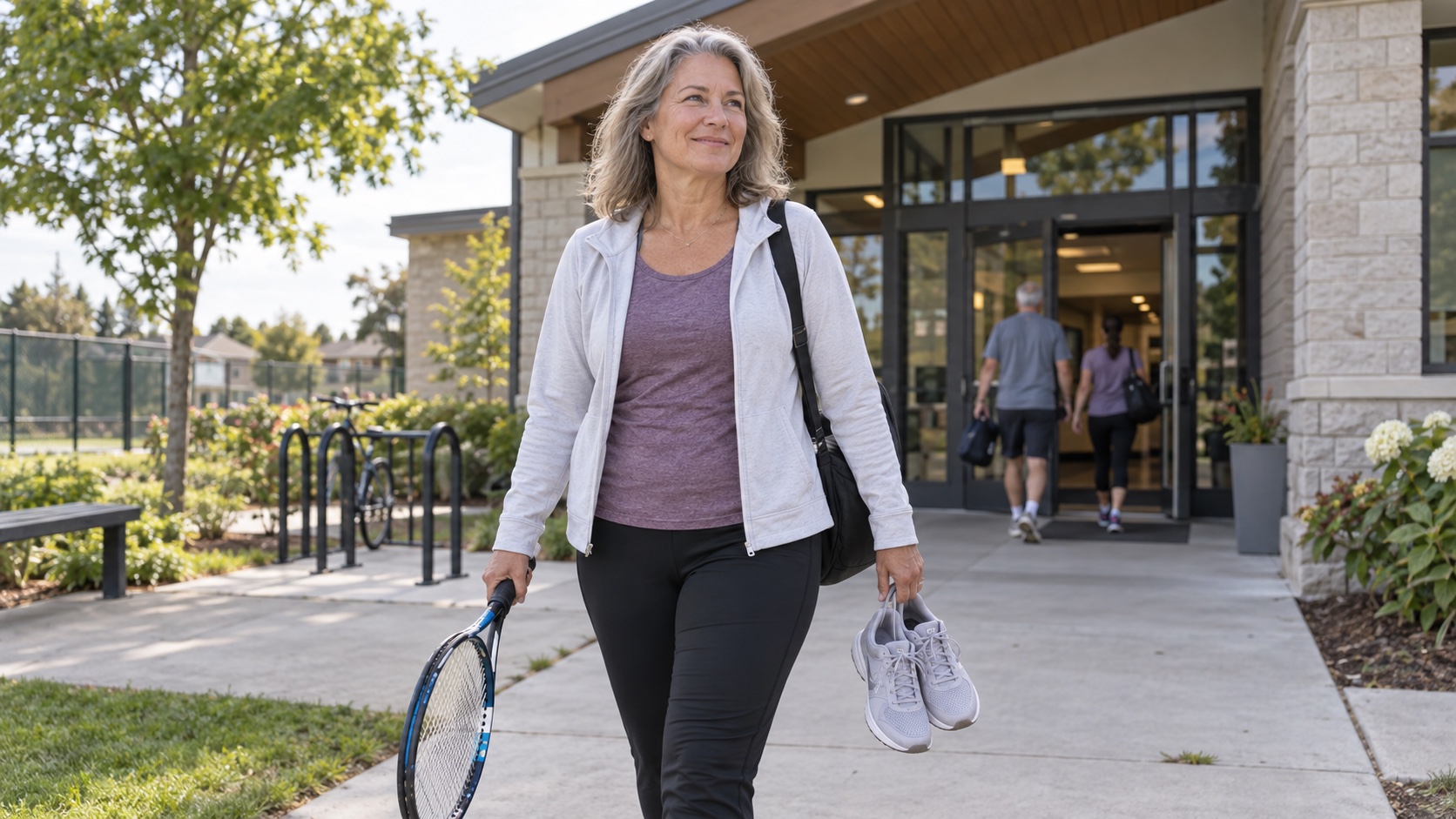
What Twin Studies Say About the Starting Point
Before anyone trains, people differ — and the family evidence says about half that difference is inherited. Fagard and colleagues' classic twin analysis (Journal of Applied Physiology, 1991) put the heritability of aerobic power, adjusted for age, sex, and body size, in that 40–50% range, and later family and twin work has landed in the same neighborhood. The practical read: if a friend strolls into a lab and posts a 45 ml/kg/min with no training history, a chunk of that is a gift. And if your baseline is a 28, a chunk of that gap was never yours to close.
But heritability is a population statistic, not a personal limit — it describes the spread between people, not what any one person can become. The same studies that found 50% heritability left the other 50% to environment: training, body weight, and the years you spend accumulating both. Half the variance is a lot of room.
Product picks are generic categories, not brands. We may earn a commission on Amazon or iHerb purchases at no cost to you — this never changes our evidence conclusions. Full disclosure
Stationary bicycle
Offers an indoor, lower-impact way to accumulate aerobic activity.
⚠️ Fit, intensity, and medical context matter; chest pain, fainting, or concerning exertional symptoms require medical evaluation.
Check price on Amazon →The HERITAGE Study: One Program, Wildly Different Answers
The single most cited dataset on training response is the HERITAGE Family Study (Bouchard et al., Journal of Applied Physiology, 1999). Around 500 previously sedentary adults, organized into families, completed the same carefully supervised 20-week program on stationary bikes. The headline results:
- 📊 The average response was strong. Mean VO₂ max rose about 17% — a meaningful, reproducible effect of a standard dose of exercise.
- 🌊 The spread was enormous. Individual gains ranged from near zero to over 50%. Same dose, different bodies, different answers.
- 👪 Response ran in families. Siblings and parent–child pairs resembled each other in how much they gained, and much more of the variance sat between families than within them — direct evidence that trainability itself is partly genetic.
- 🥀 A minority barely moved. A small fraction of participants improved under 5% at the standard dose — the origin of the "non-responder" label that now needs unpacking.
Non-Responders Are Often Just Under-Dosed
The non-responder story turns out to be partly a dosing story. Reviews of the exercise response literature — Ross et al.'s "Precision exercise medicine" (British Journal of Sports Medicine, 2019) is the reference point — make two corrections to the popular version. First, true non-response at any given dose is real but frequently converts to response when the dose goes up: longer programs, added sessions, or higher intensity resurrect most apparent non-responders. Second, some people respond to a different kind of stimulus than the one they were assigned. The honest conclusion is not that some people can't improve; it's that the standard prescription is a population average, and individual dose-finding is part of the work.
The practical rule that falls out: if 8–12 weeks of a real program moves your VO₂ max less than about 5%, change the dose — add a session, lengthen the block, raise the intensity — before you conclude genetics has you capped. That sequence matters, because the mortality data rewards leaving the bottom of the distribution, not reaching the top of it.
A second, less-discussed source of apparent non-response is time. In training studies, participants sort into early responders, whose gains arrive within the first weeks, and late responders, who show little until the final weeks of a block. Judging your genetics from a four-week retest is like judging a marathon at mile five — some of the fastest finishers start slowest.
The Age Decline Curve, in Real Numbers
Age is the other ceiling people invoke, and the best longitudinal data on it come from the Baltimore Longitudinal Study of Aging, analyzed by Fleg and colleagues (Circulation, 2005). Following healthy adults over years of repeated treadmill testing, they found the decline in VO₂ max is not linear — it accelerates. Roughly 3–6% per decade in the twenties and thirties, more in middle age, and over 20% per decade in the seventies and beyond, even among people who stayed active. Part of that is unavoidable biology: maximal heart rate falls with age, and the heart's maximal pumping capacity follows.
Two things keep this curve from being a death sentence for the number. First, the decline is a rate multiplied by time — a trained 70-year-old is falling from a higher perch, so they arrive at 80 with the aerobic capacity of an untrained person decades younger. Second, the decline is partly optional: the "accelerated" losses in Fleg's analysis were driven in part by what people did — or stopped doing — as they aged, and training studies in seventysomethings still show gains of 10–25% within months of starting. Age lowers the ceiling; it doesn't remove the ladder. The parent topic covers the trained-versus-untrained comparison in chart form.
Realistic Targets From Where You Start
Ceiling talk is mostly abstract; targets are what you actually steer by. The literature and the parent page's timeline converge on start-point-dependent expectations over a first 3–6 month block:
| Starting point | Realistic 3–6 month gain | Notes |
|---|---|---|
| 🐢 Bottom quintile, untrained | +15–25% | The fastest gains in the literature — and the biggest mortality payoff |
| 🚶 Mid-pack, somewhat active | +10–15% | Standard dose-response; stalls if the dose never progresses |
| 🏃 Well-trained | +5–10% | Requires periodization and patience; year-over-year, not month-over-month |
| 🏔️ Near your ceiling | Flat | Maintenance plus new goals; the number becomes a guardian, not a project |
Note the diminishing returns built into that table: every gain makes the next one harder. The curve flattens by design, and flattening is how you know you're approaching your ceiling — it is not a sign the training stopped working.
Why does the starting point dominate the target? Because improvements are roughly proportional to the distance from your current ceiling — the untrained body sits far from it, so the first block harvests the easiest gains, and each subsequent block works against a smaller gap. It's the same curve as any biological adaptation: steep at first, then asymptotic. None of that means the later gains aren't worth collecting; it means the expectations should look like a curve, not a line.
🧬 Your ceiling is a hypothesis, not a verdict
No baseline test, genetic panel, or family history can tell you where your ceiling sits. The way to find it is to train well for a year and watch the curve flatten — and most people who believe they've hit it haven't, because they never escalated the dose. Treat "I've peaked" as a claim that needs two flat retests and an honest training log before it's believed.
How to Know You're Near Your Ceiling
The operational definition: two consecutive 12-week blocks, honestly executed and progressively loaded, with flat retests on a standardized field test (see Testing without a lab). When that happens, three things change. First, chasing the number further has poor returns — most additional training time is better spent on strength, mobility, or simply maintaining. Second, maintenance is cheaper than building: the dose that holds a VO₂ max is smaller than the dose that raised it. Third, and most underrated, the denominator is still negotiable — losing fat raises the per-kilogram number without any cardiovascular change at all, which is why body composition belongs in every ceiling conversation.
Questions, Answered Briefly
- 🧪 Will a consumer DNA test tell me my ceiling? No. Genetic panels can flag a handful of variants associated with fitness response in aggregate, but they cannot predict your individual ceiling or your response to a specific program. The honest test of your ceiling is training.
- 👨👩👧 Is my child stuck with my low baseline? Partly shared, partly not: heritability means relatives resemble each other, not that they're identical. Half the variance is environmental — training history, body weight, and activity matter as much as the family tree.
- ♀️ Do women hit the ceiling earlier than men? On average women start with lower absolute values — smaller hearts, lower hemoglobin — but percentage gains from training are comparable, and the age-decline and trainability patterns are similar in the studies.
- ⏳ If my sixties have started, is it too late to matter? The opposite — late-start training studies show the largest relative gains, and because the mortality gradient is steepest at the bottom of the distribution, a 60-something leaving the bottom quintile buys more risk reduction than a 40-something polishing an already decent number.
- ♨️ What about altitude or sauna as ceiling lifters? The evidence for altitude and heat exposure moving VO₂ max is modest and contested — consistent training and progressive dose dwarf both. The hormetic stress pillar owns the sauna evidence.
The Bottom Line
- About half your starting VO₂ max is inherited — and the other half is environment, which means it's yours to move.
- Training response is also partly genetic, but "non-response" at a standard dose often means under-dosed, not doomed.
- The age decline is real and accelerates — yet training blunts it at every age studied, and late starters gain fast.
- Realistic targets: +15–25% if untrained, +5–10% if trained. The longevity payoff comes from leaving the bottom, not reaching the top.
Related Topics
- Fagard et al., "Heritability of aerobic power and anaerobic energy generation during exercise," Journal of Applied Physiology (1991)
- Bouchard et al., "Familial aggregation of VO2max response to exercise training: results from the HERITAGE Family Study," Journal of Applied Physiology (1999)
- Fleg et al., "Accelerated longitudinal decline of aerobic capacity in healthy older adults," Circulation (2005)
- Ross et al., "Precision exercise medicine: understanding exercise response variability," British Journal of Sports Medicine (2019)
- Joyner & Lundby, "Concepts about VO2max and trainability that are context-dependent," Cell Metabolism (2018)