The daily 10-minute mobility routine
The parent topic promised ten minutes a day and showed the menu; this page is the actual sequence — minute by minute, with the cues that make it work and the regressions that make it fit everyone.
What the evidence supports
- Total weekly practice time, not session length, predicts range-of-motion gains (Thomas et al., International Journal of Sports Medicine, 2018).
- Its balance component has direct trial support: 3+ hours a week of balance-challenging exercise cut fall rates 42% (Sherrington et al., Cochrane, 2019).
- Range of motion responds to strength training through full range as well as to stretching (Afonso et al., Sports Medicine, 2021).
What remains uncertain
- The specific ten-minute sequence has never been tested as a package in a trial.
- The optimal dose per joint per week is not established.
- Whether routine mobility practice prevents injuries in healthy adults is unproven.
Evidence last reviewed: August 15, 2026. Conclusions may change as new research is published.
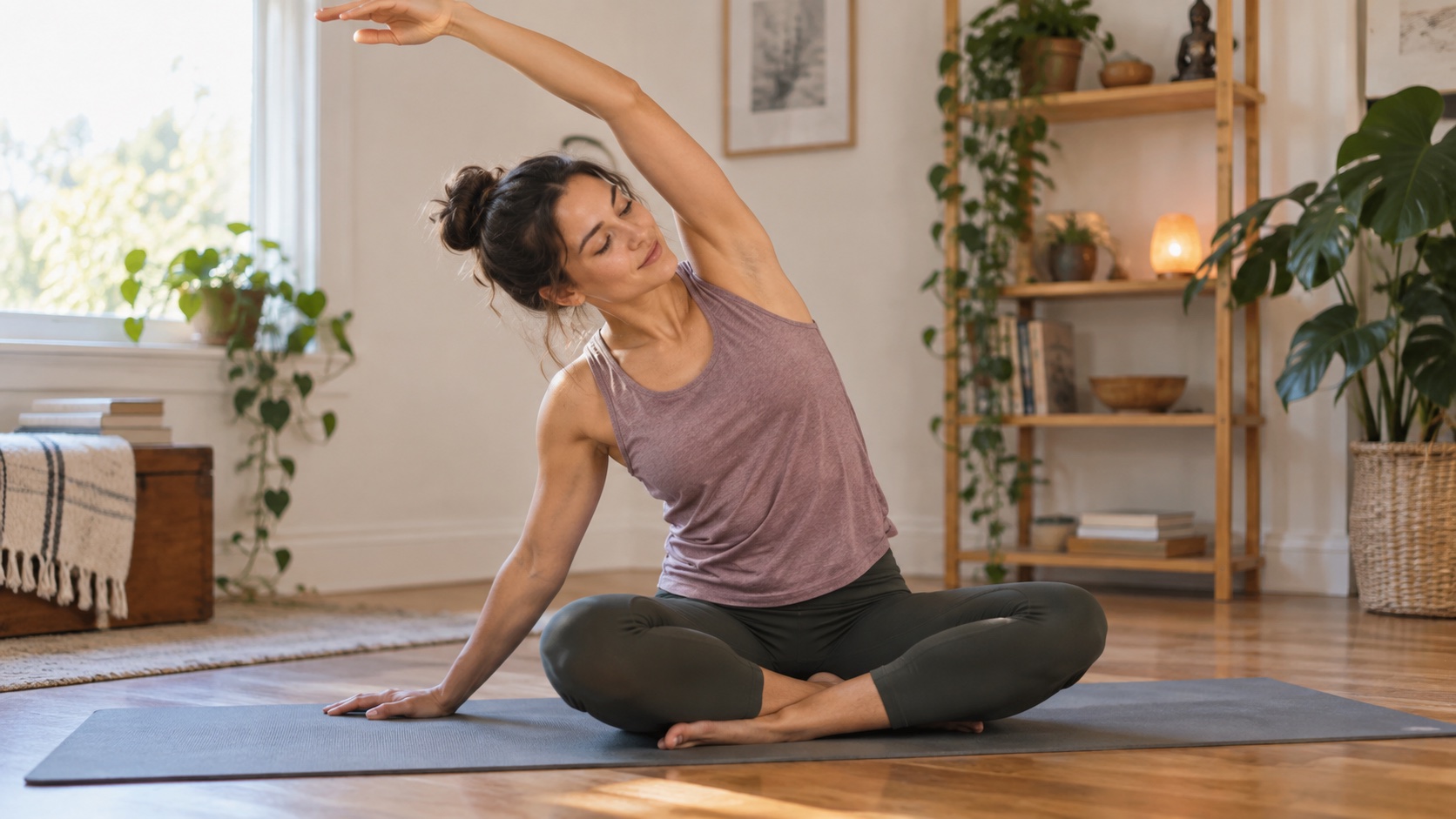
Why Ten Minutes Daily, Not an Hour on Sunday
Joint range behaves like a habit: it adapts to what it meets most often, not to what it meets most intensely. The physiology points the same direction — connective tissue stiffens between exposures, and each dose of movement re-establishes the range before the next day's stiffness has a chance to set. The dose literature agrees in its broad outline: what predicts range-of-motion gains is total weekly practice time, not the length of any single session (Thomas et al., 2018). Ten minutes a day is seventy minutes a week — the same total as a single yoga class, delivered in the format the tissue actually notices. If a day collapses to five minutes, take the five; the two-day rule is the pattern, not the workout.
The Routine, Minute by Minute
| Time | Move | Dose | What it's for |
|---|---|---|---|
| 0:00–2:00 | Ankle circles and calf raises, wrist and neck circles | 10 each direction, slow | The joints that stiffen first; a full-loop warm-up of every joint from the ground up |
| 2:00–4:00 | Standing hip circles, then slow knee lifts with a pause | 8–10 each direction, each leg | Hip range in all three planes — the joint chairs punish most |
| 4:00–6:00 | Cat-cow, then seated or standing thoracic rotations | 10 each | Spine mobility without loaded flexion; the "look over your shoulder" skill |
| 6:00–8:00 | Deep squat hold, then knee-to-wall ankle drill | 3 × 20-second holds; 10 rocks per side | The ankle and hip range that the knee depends on |
| 8:00–9:30 | World's-greatest-stretch lunge sequence | 5 per side | Hip, hamstring, and thoracic mobility in one flowing move |
| 9:30–10:00 | One balance task from the ladder | 30 seconds, 2–3 holds | The stability half of the equation — end every session with control |
The order is deliberate: joints first (minutes 0–6), then loaded positions (6–9:30), then balance (9:30–10:00). The balance slot finishes the session while you're still warmed up but not fatigued — and it's the part with the strongest trial record, so it never gets cut. If you do nothing else on a chaotic day, do the last two minutes and the squat holds.
Why These Six Moves
The menu isn't random — it was built from the joint-by-joint map. Each move targets a "mobile" joint that modern life stiffens, in the order that stiffness cascades: ankles and wrists first (the smallest joints, which stiffen fastest), then hips (the sitting tax), then the thoracic spine (the screen tax), then the loaded positions — squat and hinge — that integrate several joints into one functional pattern, and finally balance, because range without control is exactly the flexibility nobody needs. The routine deliberately skips long static holds: the myths page explains why movement practice and strength do that job better.
The Six Cues That Make It Work
- 🐢 Slow into the end range, and only there. The adaptation happens at the edge of your current range, not in the middle. Move deliberately to that edge each rep; never bounce.
- 🫁 Exhale into the last degrees. A long exhale quiets the guarding reflex that holds joints back — the single most effective technique cue in mobility work.
- 🎛️ Control, not momentum. Swinging through a range proves nothing. If you can pause at the end range, you own it; if you can't, that's the boundary to train at.
- 🏋️ Pair every move with its strength twin. Range without load slips back. The squat hold pairs with squats, the hinge with deadlift patterns — this is why strength training builds flexibility as well as stretching does.
- 🛑 Sharp pain is the stop signal. Stretch, tension, and mild ache are expected; sharp, shooting, or electric pain means modify or skip and reassess.
- 📏 Progress by range, not time. The routine stays ten minutes forever. What changes is the depth of each squat hold, the height of each knee lift, the eyes-open to eyes-closed balance transition.
Regressions and Progressions
| Move | Regression (starting point) | Progression (when the cue feels easy) |
|---|---|---|
| Deep squat hold | Half-depth squat holding a door frame, heels on a rolled towel | Full-depth, heels down, then a small weight held in front |
| Hip circles | Circles while holding a counter, small radius | Hands free, larger radius, slower tempo |
| Thoracic rotation | Seated rotation, arms crossed, small range | Standing, one arm reaching, then rotation with a light press |
| Knee-to-wall | Toes close to the wall, knee only partway over | Toes further back, then add a calf raise at the end position |
| Balance task | Two-finger support on a wall | Arms free, then soft surface, then eyes closed near a wall |
Stacking It Into a Real Day
The sequence survives or dies on attachment. Three attachment points have worked in practice: after brushing teeth (the bathroom routine is already daily), while coffee brews, or as the cool-down after a walk. On strength days, the routine doubles as a warm-up — same ten minutes, borrowed for the workout. The balance minute can migrate to any spare moment: while on hold on the phone, waiting for the kettle, watching the news. The balance ladder page supplies the progression for that minute; the routine supplies the consistency.
And when life genuinely breaks the pattern — travel, illness, a newborn — the routine has a two-minute minimum viable version: ankle circles, one squat hold, one thoracic rotation, one balance hold. It preserves the habit wire even when it can't preserve the full dose. The difference between a week of two-minute versions and a week of nothing is the difference between resuming in a day and restarting from scratch.
A note on setting: this routine was designed to work in a kitchen or hotel room, in normal clothes. Nothing needs a mat, a rack, or a change of shoes — removing every friction point is part of the design, because the session that requires preparation is the session that stops happening in week six.
⚠️ When the routine isn't the answer
Persistent joint pain that doesn't improve over two weeks, or any numbness, tingling, or radiating pain, is clinician territory — a physical therapist can diagnose what a routine can't. The same caution applies to osteoporosis: loaded end-range positions are generally good for bone, but after a fracture or with very low bone density, the routine should be reviewed with a professional first.
What to Expect, Week by Week
Honest expectations prevent the routine's main failure mode — quitting at week two because nothing dramatic happened. The realistic arc: week one, you learn the sequence and find your attachment point; weeks two to four, the moves stop feeling like choreography and start feeling like maintenance, with the first changes usually showing up as less morning stiffness; months one to three, the measurable shifts — a deeper squat hold, a longer balance time, a knee-to-wall distance that has crept forward. Joint range is slow tissue; it repays quarters, not days. The quarterly audit is the natural check-in point: re-test the screens, adjust the progressions, and let the trend line — not any single session — be the evidence.
Questions, Answered Briefly
- 🌅 Morning or evening? Either — but morning wins by default because it happens before the day negotiates. If mornings are chaos, the post-walk cool-down is a strong second attachment point.
- 😅 Should it feel hard? No. Effort stays at two or three out of ten. Discomfort lives at the end range only, and the balance minute is the only part that should demand real focus.
- 🏃 Does this count as exercise? It's maintenance, not training — the cardio and strength work elsewhere on the site carry the conditioning load. The routine is what keeps those programs injury-free and keeps you moving between sessions.
- 🧒 Who else should do it? It scales both ways — kids lose these movements to desks, and fit adults use the routine as injury insurance for the training load elsewhere in the week.
The Bottom Line
- Ten minutes daily is the whole program — joints first, then loaded positions, then one balance task, in that order.
- Frequency is the mechanism — total weekly practice predicts range gains, and daily exposure beats the weekly class for the same minutes.
- Own the range, don't just visit it — slow into the end range, exhale, pause, and pair every move with its strength twin.
- Stack it, regress it, keep it — attach it to an existing daily habit, take the regressions when needed, and let the quarterly screens measure the trend.
Related Topics
- Thomas et al., "The relation between stretching typology and stretching duration: the effects on range of motion," International Journal of Sports Medicine (2018)
- Sherrington et al., "Exercise for preventing falls in older people living in the community," Cochrane Database of Systematic Reviews (2019)
- Afonso et al., "Strength training versus stretching for improving range of motion: a systematic review and meta-analysis," Sports Medicine (2021)
- Garber et al., "American College of Sports Medicine position stand: quantity and quality of exercise for developing and maintaining cardiorespiratory, musculoskeletal, and neuromotor fitness," Medicine & Science in Sports & Exercise (2011)
- World Health Organization, Guidelines on Physical Activity and Sedentary Behaviour (2020)