Body Metrics: Waist, Grip & Balance
Three numbers, zero needles, ten minutes: waist at the navel, grip on a dynamometer, and how long you can stand on one leg. Each is a cheap, trainable, predictive vital sign — and each has a measurement protocol that separates real signal from wishful breathing.
What the evidence supports
- Grip strength inversely tracks all-cause mortality in large international cohorts (PURE, ~140,000 adults; UK Biobank, ~500,000).
- Failing a 10-second one-leg stand predicted higher ~7-year mortality in 1,702 middle-aged and older adults.
- Waist-to-height below 0.5 is a simple, validated early-risk marker that outperforms BMI in several analyses.
What remains uncertain
- The associations are observational — whether quarterly measuring of these three changes outcomes is untested.
- Age reference tables are population averages, not pass/fail lines; your own trend matters more.
- One-quarter movement in any of the three is mostly measurement noise; two-quarter patterns are the real signal.
Evidence last reviewed: August 13, 2026. Conclusions may change as new research is published.
Waist: The Tape That Outranks the Scale
The scale reports total mass. The tape reports where the risk lives — the visceral fat around the organs. The waist-to-height ratio is the free, monthly, home-owned number that the Metabolic pillar's case for visceral fat builds on.
- 📐 The method — tape around the bare waist, crossing the navel, level all the way around. Stand relaxed, breathe out gently — and no sucking in; the tape measures the body you have, not the body you can perform for two seconds.
- 🤏 The tension — snug but not compressing: the tape should rest against the skin without denting it. Pull it tight and you gift yourself a phantom centimeter.
- 🔁 Three passes — measure three times, average them. If the three differ by more than a centimeter, the method is drifting, not your waist.
- ➗ The ratio — waist ÷ height, in the same units. Target: below 0.5. A 178 cm person's target waist is under 89 cm; the "half your height" rule works in inches or centimeters alike.
- 🎯 Why not BMI — two people with the same BMI can carry entirely different risk depending on where the mass sits. The waist captures the deposit that matters — the pillar topic owns the full argument.
Grip: The Handshake Metric That Predicts
Grip strength sounds like a party trick, but it tracks total-body muscle and nervous-system function well enough that large cohorts show a clear mortality gradient across it — the PURE study followed ~140,000 adults and found every 5 kg of grip loss associated with higher all-cause and cardiovascular mortality. The full science lives in Hidden Vital Signs; here is the protocol that makes your numbers comparable quarter to quarter.
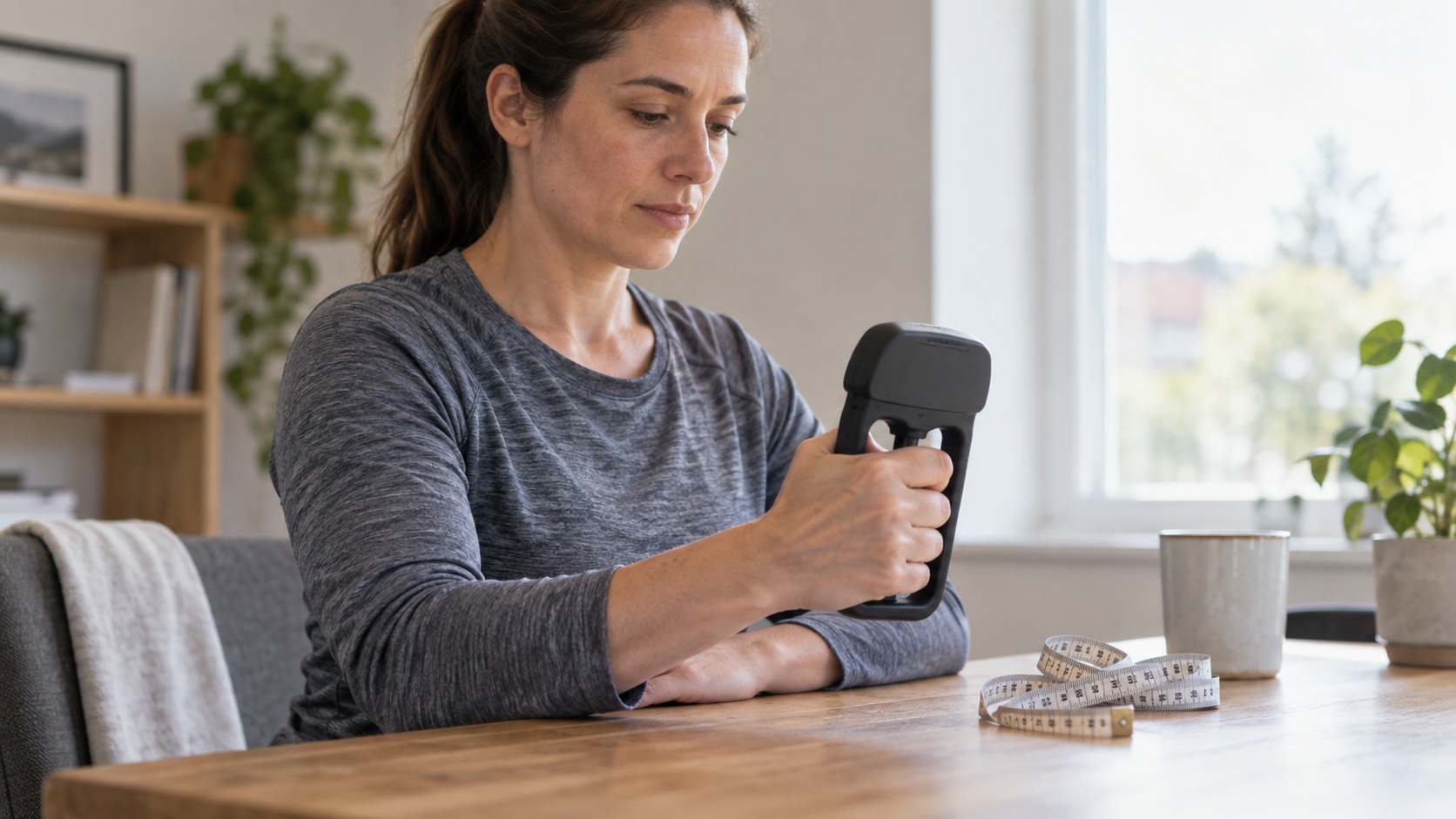
- 🤲 The setup — standing, elbow at the side bent to 90°, forearm neutral, wrist straight. Squeeze the dynamometer as hard as you can for 2–3 seconds, exhaling — no swinging the arm, no bracing on the thigh.
- 🏆 Best of three — three attempts per hand, 30–60 seconds of rest between. Record the best of the three per hand; the maximum, not the average, is the score.
- 🤝 Same hand, same setting — a dynamometer has adjustable grip positions; find the handle setting that fits and use it every quarter. Switching settings changes the number without changing you.
- ⏰ Same time of day, not after training — grip fatigues. Measure in the morning before workouts, same conditions as last quarter.
| Group | Typical range (kg) | Where to pay attention |
|---|---|---|
| Men, 30s–40s | ~45–55 | Below ~40 is worth investigating strength habits |
| Men, 50s | ~38–48 (approximate) | Below ~35 is worth investigating |
| Men, 60s–70s | ~32–42 | Below ~28–30 approaches frailty-adjacent territory |
| Women, 30s–40s | ~28–33 | Below ~24 is worth investigating |
| Women, 50s | ~24–29 (approximate) | Below ~21 is worth investigating |
| Women, 60s–70s | ~20–26 | Below ~18 approaches frailty-adjacent territory |
Population averages, not pass/fail lines — the 50s rows are interpolations between published decades and carry wider error. The metric that matters is your own trend: grip declining year over year is the signal, wherever you sit against this table.
Product picks are generic categories, not brands. We may earn a commission on Amazon or iHerb purchases at no cost to you — this never changes our evidence conclusions. Full disclosure
Flexible body-measurement tape
Can help track waist circumference when a person and clinician choose to monitor it.
⚠️ Can encourage unhelpful body checking for some people; a measurement is a risk marker, not a diagnosis or a worth score.
Check price on Amazon →The One-Leg Stand: Thirty Seconds That Matter
Standing on one leg aggregates vision, inner ear, proprioception, and strength into a single timed sample. In a study of 1,702 adults aged 51–75, people who couldn't hold the position for ten seconds had markedly higher mortality over roughly seven years — and balance is the system that decides whether a slip becomes a fall.
- 🦩 The protocol — eyes open, hands at your sides, gaze fixed on a point at eye level. Lift one foot so the raised ankle rests near the standing calf — no hooking the foot behind the knee.
- ⏱️ The timing — start the clock the moment the foot leaves the floor; stop when the foot touches down, the hands leave the sides, the standing foot hops, or you grab anything. One practice attempt per leg, then one scored attempt per leg.
- 🎯 The target — 30+ seconds on each leg. Ten seconds is the studied floor; below it in middle age or beyond is a real signal, and the full science sits in Hidden Vital Signs.
- 🛡️ Why it matters — falls cascade: a fracture in later life can start a decline that nothing else fully reverses. Balance is the cheapest fall insurance available, and it improves fastest of all the audit's markers.
- 🧯 Safety note — stand near a wall or counter, and do the eyes-closed version only with a spotter or solid support. The audit measures the eyes-open test.
The Targets, at a Glance
| Measure | Target | Frequency | Equipment |
|---|---|---|---|
| 📏 Waist-to-height | <0.5 (waist under half your height) | Quarterly — monthly if you're working on it | A soft tape measure, a few dollars |
| ✋ Grip | Above your age-decade median, trending up or stable | Quarterly | Hand dynamometer, ~$25–40 |
| 🦩 One-leg stand | 30+ seconds each leg | Quarterly | Nothing — a wall nearby for safety |
The same honest caveat as every target on this site: these are orientation, not judgment. Age, sex, injury history, and training state shift all three. The audit compares you to your own last quarter — the ranges only flag when a closer look is due.
All Three in Ten Minutes
- 📋 The order — waist first (unaffected by fatigue), then grip (rested hands), then balance (fatigue barely touches a 30-second stand, but keep the order identical anyway).
- 🌅 The time — morning, before training, fasted or not — just pick one state and repeat it every quarter. Conditions are part of the measurement.
- 🗂️ The output — six numbers (waist, ratio, grip both hands, balance both legs) into the four-column sheet from Part 5, next to last quarter's row.
Hand-grip dynamometer
Can track grip-strength performance over time when measured consistently.
⚠️ Readings can be affected by pain, arthritis, technique, and device variation; a result is not a diagnosis.
Check price on Amazon →What One Quarter of Movement Means
The hardest discipline in self-tracking is not reacting to noise. Here is the honest calibration for each measure:
| Measure | Quarter-to-quarter noise | What counts as real change |
|---|---|---|
| 📏 Waist | ±2 cm — food, hydration, tape tension, time of day | ≥3 cm sustained across two quarters |
| ✋ Grip | ±3–4 kg — fatigue, sleep, handle setting, motivation | ≥5 kg sustained across two quarters |
| 🦩 One-leg stand | Large — practice effect, footwear, focus | Collapse from 30+ to under 10 seconds, two quarters running — or any fall |
These are practical decision rules, not validated thresholds. The principle behind them is validated: single-quarter movement in all three is dominated by measurement noise, so the audit only ever acts on two-quarter patterns — or on a single genuinely alarming reading like a fall or a balance collapse.
Where the Evidence Lives
The science behind all three measures lives in the pillars — this page is the protocol that collects the numbers:
- ✋ Grip and balance science — the Hidden Vital Signs topic owns the cohort data, the four-test battery, and what each marker predicts.
- 🥓 Why waist carries the risk — the Visceral Fat topic owns the case that the tape, not the scale, is the metabolic number.
- ⚖️ What the scale adds — the Body Composition topic owns weight and lean-mass ranges; the audit reads them alongside.
- 🏋️ The fix for weak numbers — the Resistance Training Protocol is the response when grip trends down; balance practice lives in the stability routines behind Hidden Vital Signs.
- 📋 Where the numbers land — Part 5 of this series, Tracking Sheets, owns the four-column log these six values feed.
What to Do When It Goes Wrong
Five situations that actually happen, with the response that has worked:
- 🚩 Grip dropped more than 5 kg in one quarter — check conditions first: measured after training, different handle setting, poor sleep, low motivation all fake a drop. Re-test under clean conditions; if it holds, that's the trend the strength protocol exists to reverse.
- 🚩 The one-leg stand collapsed from 40 seconds to 8 — footwear, a recent ankle tweak, or testing in a rush explain most single-quarter collapses. Re-test calmly; two collapses in a row, or any actual fall, is the real signal — and a clinician conversation about fall risk.
- 🚩 Waist is up 3 cm but the scale hasn't moved — that's the exact scenario the waist exists to catch: distribution shifted while weight held. It's the early warning the scale can't give, and the deficit is the standard first response.
- 🚩 Tape readings disagree by more than a centimeter — the method is drifting, not the waist: breathing, tension, or placement. Re-measure with the navel rule, relaxed exhale, three passes, and trust the average.
- 🚩 Balance test is trivially easy — 60 seconds both legs, every quarter — you've hit the ceiling of the eyes-open test, and that's a good report. Raise the bar with the eyes-closed version near a wall, or a single-leg stand on a foam pad — carefully, and only as a practice, not as the scored audit.
Questions, Answered Briefly
- ❓ Navel or narrowest point — where does the tape go? — The navel, every time. The "narrowest point" moves as you change shape, which breaks comparability; the navel is a fixed landmark, and the waist-to-height evidence was built on it.
- ❓ Which dynamometer should I buy? — Any reputable hand dynamometer in the $25–40 range with an adjustable handle. The absolute brand matters less than using the same device, same setting, same conditions every quarter.
- ❓ One leg holds 45 seconds and the other holds 18 — is that a problem? — Big asymmetries are worth noting: they often trace to an old ankle or knee injury, and they raise fall risk on that side. Log both legs separately, and let a clinician know if the gap keeps widening.
- ❓ My waist-to-height is 0.53 — how worried should I be? — Worried is the wrong verb. It's an orientation number: above 0.5 means the visceral risk story is worth a conversation and the waist is a sensible target for the next four quarters. It's a starting point, not a sentence.
📏 These numbers are trainable
Unlike a lab value you wait on, all three of these respond within weeks to ordinary training: balance improves fastest, grip follows a strength routine, and the waist follows the deficit. The point of measuring is to find the leak early — not to document it forever.
The Bottom Line
- Tape at the navel, relaxed, no sucking in — waist under half your height, three passes averaged.
- Grip is best of three — same dynamometer, same setting, same time of day, morning and rested.
- One-leg stand, eyes open, 30+ seconds — below ten in middle age or beyond is a real signal.
- Act only on two-quarter patterns — single-quarter movement is mostly measurement noise.
This Page in One Workflow
- Set up — tape, dynamometer, timer, and the four-column sheet, on audit morning.
- Waist — navel, relaxed exhale, three passes, divide by height.
- Grip — best of three per hand, 30–60 seconds between attempts.
- Balance — practice once, then one scored attempt per leg, wall nearby.
- Record — six numbers into the sheet, compare against last quarter, and flag any two-quarter pattern for action.
The Daily Checklist
- One-leg stand each leg while brushing teeth — 30 seconds a day, eyes open
- Carry the groceries by hand, not the cart — incidental grip work
- Dead hang or a doorframe hold when passing a bar — grip maintenance
- Sit-to-stands ×10 after long sitting — the balance system likes daily traffic
- Anything unusual logged — illness, travel, poor sleep, a tweaked ankle
- Audit kit kept in one place — tape, dynamometer, timer where you'll find them
The Weekly Checklist
- One dry run of the ten-minute trio — the method stays honest
- One grip session — hangs, farmer's carries, or a pull day
- One balance practice — single-leg stands, tandem walking, or the stability routine
- Practice numbers jotted into the sheet so the next audit has context
- Audit date confirmed on the calendar for this quarter
Go Deeper: Body Metrics
These five companion pages turn the topic into smaller, testable practices.
- 🔗 The waist-to-height rule
- 🔗 The grip measurement
- 🔗 The 10-second balance test
- 🔗 The scale & the trend line
- 🔗 The photo standard
Related Topics
- Leong et al., "Prognostic value of grip strength: findings from the Prospective Urban Rural Epidemiology (PURE) study," The Lancet (2015)
- Celis-Morales et al., "Associations of grip strength with cardiovascular, respiratory, and cancer outcomes and all cause mortality: prospective cohort study of half a million UK Biobank participants," BMJ (2018)
- Araújo et al., "Successful 10-second one-legged stance performance predicts survival in middle-aged and older individuals," British Journal of Sports Medicine (2022)
- Ashwell & Gibson, "Waist-to-height ratio as an indicator of 'early health risk': simpler and more predictive than using a 'matrix' based on BMI and waist circumference," BMJ Open (2016)
- Roberts et al., "A review of the measurement of grip strength in clinical and epidemiological studies," Age and Ageing (2011)
- Bohannon, "Grip strength: an indispensable biomarker for older adults," Clinical Interventions in Aging (2019)