The Phone-in-the-Bedroom Rule
If you change exactly one thing about your relationship with the phone, this is the one: it charges outside the bedroom. The rule is not about discipline — it is about removing the device from the one room where it intersects three physiological transitions in a row: the evening descent, sleep onset, and the waking rise. Here is the evidence for why that specific change outranks the others, and the mechanics of making it hold.
What the evidence supports
- Bedtime media-device access or use is associated with inadequate sleep quantity, poor sleep quality, and daytime sleepiness in a meta-analysis of 20 studies (Carter et al., 2016).
- Adult surveys find the same direction: bedtime phone use predicts longer time to fall asleep and worse sleep quality (Exelmans & Van den Bulck, 2016).
- Restricting bedroom smartphone use improved reported wellbeing in a small intervention study (Hughes & Burke, 2018).
What remains uncertain
- The meta-analytic evidence is strongest for children and adolescents; adult data are thinner and mostly observational.
- Device use and poor sleep could share causes (anxiety, schedule chaos) — the association is not proof that the phone alone does the damage.
- No large trial has tested "phone out of the bedroom" as an isolated intervention against hard outcomes.
Evidence last reviewed: August 15, 2026. Conclusions may change as new research is published.
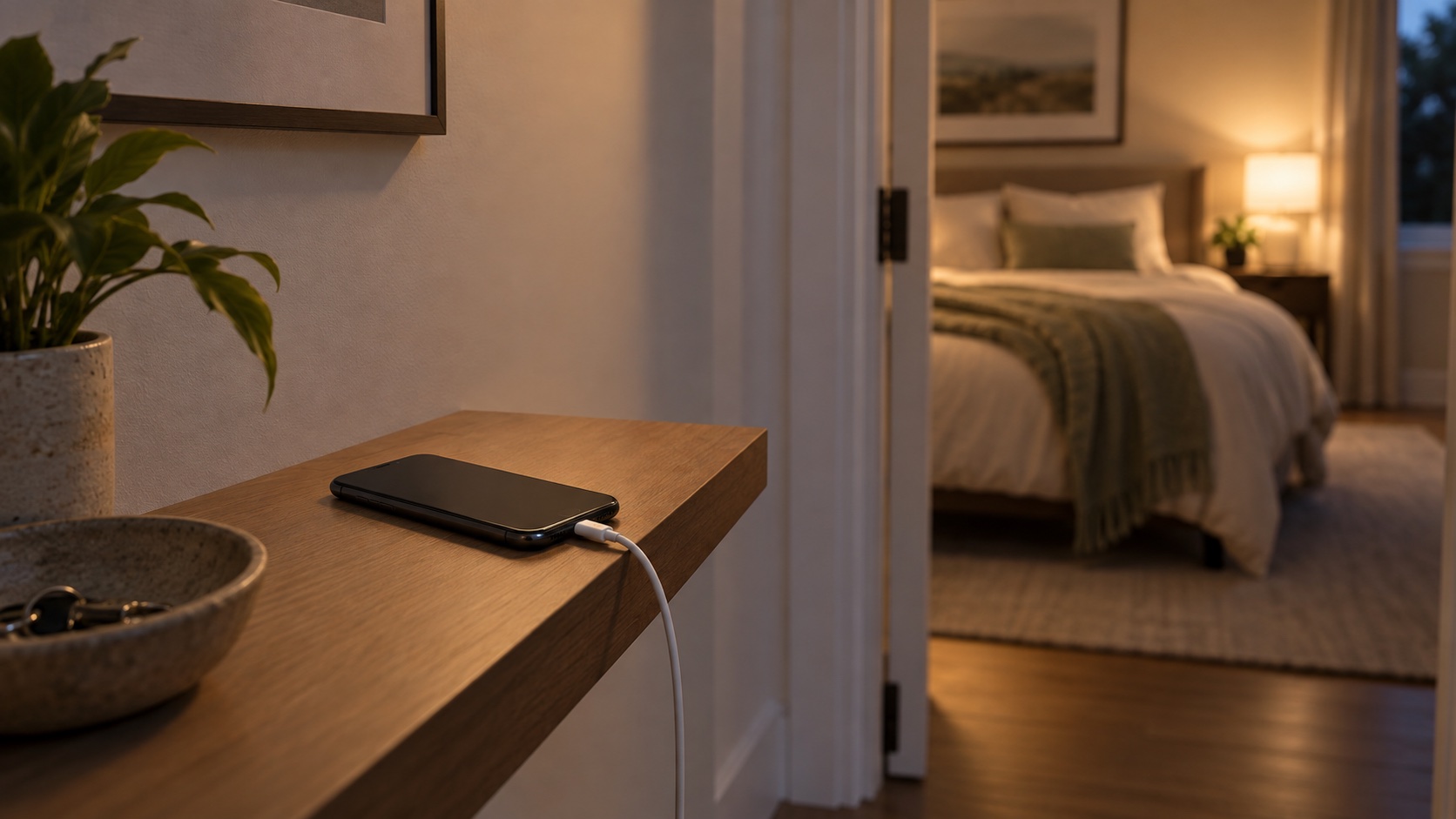
Why the Bedroom Is Different
The same phone that costs a little attention on your desk at 2pm costs something more expensive on the nightstand at 10pm. The bedroom is where the device sits inside three consecutive physiological windows. The first is the evening descent — the cortisol fall that lets the system shift out of daytime mode, the curve the cortisol topic maps in detail; a notification or a final scroll at this hour is an arousal landing exactly where the descent is trying to happen. The second is sleep onset, the transition the device delays both by keeping you engaged and by the light and content questions the Sleep pillar's saboteurs topic owns. The third is the waking rise — the first minutes of the morning, when the cortisol surge is doing its job of booting the system and the phone, checked from bed, hijacks the boot sequence before you have decided anything. A phone in the living room interrupts tasks; a phone in the bedroom interrupts recovery. That is the entire leverage argument.
Product picks are generic categories, not brands. We may earn a commission on Amazon or iHerb purchases at no cost to you — this never changes our evidence conclusions. Full disclosure
Book or skill-learning workbook
Can support sustained reading or structured skill practice.
⚠️ None expected; a product cannot prevent dementia or replace assessment of new cognitive symptoms.
Check price on Amazon →The Bedtime-Device Evidence
The reference dataset is a systematic review and meta-analysis of 20 studies covering 125,198 children and adolescents (Carter et al., JAMA Pediatrics, 2016). Compared with no bedtime media device, having a screen-based device at or in bed was associated with elevated odds of three sleep problems — most sharply for daytime sleepiness, the outcome that best predicts how the following day actually feels. The honest caveat is the usual one for this literature: these are cross-sectional associations in young people, and households where phones live in bedrooms differ in other ways too. Adult data point the same direction without the meta-analytic weight: in a survey of Belgian adults, bedtime phone use predicted longer sleep onset latency and poorer sleep quality (Exelmans & Van den Bulck, 2016), and the few intervention studies — asking people to restrict bedroom phone use — reported improved wellbeing (Hughes & Burke, 2018).
The mechanism is not mysterious. Part of it is light and content at the wrong hour — reading on a light-emitting screen in the evening delayed melatonin onset and cut next-morning alertness in a controlled comparison (Chang et al., 2015), and the sleep topic documents why total light dose and content matter more than the color of the glass. Part of it is simpler still: the phone makes sleep optional. When a device is at arm's reach, a 2am wake-up has a second act — checking, scrolling, re-arousing. The bedroom rule addresses both parts at once, by removing the device rather than negotiating with it.
Presence, Not Just Use
The rule would be worth it even if you never touched the phone after 9pm, because the phone in the bedroom is an ambient cue. The mere-presence finding — a silent, face-down phone measurably reduces available cognitive capacity — was demonstrated on desks (Ward et al., 2017), but the bedroom version is behavioral: about two-thirds of American cell phone owners reported sleeping with the phone on or right next to the bed (Pew Research Center, 2010), and students who sleep with their devices describe interrupted nights — waking to the sound of a notification and answering it (Dowdell & Clayton, 2019). The negotiation never ends: every wakeful moment contains the option to check, and the option itself is vigilance. Moving the charger out of the room ends the negotiation. There is nothing left to decide at midnight.
🚪 If the phone must stay, take the half-dose
Some lives genuinely need a phone at night — on-call work, caregiving, emergencies. The harm-reduction version, in order of value: the phone charges across the room rather than at arm's reach; it stays face-down and silent with Do Not Disturb scheduled; notifications are reduced to calls only (the curfew page has the setup); and grayscale mode kills the visual pull for the nights you slip. Be honest about what this is: a partial dose of a rule whose evidence comes from the device being in bed or at hand. Distance is the active ingredient — arm's reach to across-the-room is a real step, and out-of-room remains the reference version.
The Rule, Precisely Stated
- 🔌 The phone charges outside the bedroom. Every night, starting tonight. Not "mostly," not "unless I'm tired" — the rule's entire power is that it never requires a decision at bedtime.
- ⏰ An alarm clock takes the wake-up job. The "it's my alarm" excuse is the most common failure point; a separate alarm costs less than one dinner and removes the phone's last legitimate role in the room.
- 📞 Calls stay reachable. The rule bans the optional stream, not the essential one — leave ringer access for the people who might genuinely need you at night, the same carve-out the parent topic uses.
- 📖 A paper book or e-reader is the sanctioned substitute. Content matters more than glass: a dedicated reader without feeds and notifications is a different exposure than a phone — the sleep topic explains the light side.
- 🔄 No one-night exceptions. Each exception re-installs the cue; consistency is the mechanism (the Habit Formation protocol owns the cue design).
| Intervention | What it changes | Verdict | Effort to install |
|---|---|---|---|
| 🛏️ Phone charges outside the bedroom | Protects evening descent, sleep onset, and the waking rise in one move | Good | One-time environment change |
| 🔕 Notifications off, calls through | Removes the daytime interruption stream | Good | One settings pass |
| ⏳ Feed timers | Caps passive scrolling, but relies on in-app limits you can override | Moderate | Medium |
| 🌙 Night mode or blue-light glasses | Alters light spectrum — leaves content and interruption untouched | Mixed | Low |
| 🕊️ Weekly digital Sabbath | Deep reset once a week; social pressure makes it the hardest to hold | Moderate | High |
The table's point is not that other tools are useless — the curfew and the notification settings are the rest of this series. It is that the bedroom rule has the rare profile of a high-value intervention: the evidence sits in the strongest tier available, the effort is a one-time environment change, and it needs no ongoing willpower.
The Objections, Answered Briefly
- 🚨 "I need it for emergencies." Then the calls carve-out applies — reachability survives; the optional stream does not. The two are different things, and conflating them is how the phone keeps its bedroom residency.
- ⏰ "It's my alarm clock." The cheapest fix on the site: a separate alarm removes the excuse entirely. If the phone were not also a slot machine, nobody would fight for it as an alarm.
- 📚 "I read myself to sleep on it." Then swap the device, not the ritual: a paper book or a feed-free e-reader preserves the wind-down and drops the notification layer. The ritual survives; the tax does not.
- 👥 "My partner scrolls in bed." Household rules need a household agreement — the coordination tactics in the Sleep pillar's household page apply, and the couple that moves both chargers moves the argument.
- 🔁 "I tried it and relapsed." Normal. The rule is architecture, not virtue — re-install the charger location and read Detox That Sticks for why relapse is a design problem, not a character one.
Installing the Rule: The First Week
- 🌙 Night 1: Move the charger. Borrow or set any separate alarm. Announce the change to whoever will notice — declared intentions hold better (the implementation-intentions page explains why).
- 👋 Nights 2–3: Expect the phantom reach — the hand searching the nightstand. It is the old cue firing without its reward, and for most people it quiets within days.
- 🌆 Nights 4–7: Pair the rule with the evening curfew so the hour before bed does not end in a last-minute scroll burst — a common way the rule gets sabotaged.
- 📓 Week 2: One line each morning in a notes app: time to sleep, night wakings, morning state. Crude, but it turns "I think it helped" into data.
- 🗓️ Month 1: Success looks boring — the rule should feel neutral by now, the way a settled environment change does. If the charger keeps migrating back, the friction diagnosis on the final page is the next stop.
The Bottom Line
- The bedroom rule is the highest-leverage change because the bedroom is where the phone intersects three physiological transitions: the evening descent, sleep onset, and the waking rise.
- The evidence is the strongest tier available in this topic — a 20-study meta-analysis puts bedtime device access alongside sleepiness (OR 2.72), short sleep (2.17), and poor quality (1.46), mostly in young people.
- The rule is environment change, not discipline — charger relocation plus an alarm clock, with calls preserved for real emergencies.
- If the phone must stay, take the half-dose — across the room, silent, calls-only — and treat distance as the active ingredient.
Related Topics
- Carter, Forrest & Kaida, "Association Between Portable Screen-Based Media Device Access or Use and Sleep Outcomes: A Systematic Review and Meta-analysis," JAMA Pediatrics (2016)
- Exelmans & Van den Bulck, "Bedtime mobile phone use and sleep in adults," Social Science & Medicine (2016)
- Hughes & Burke, "Sleeping with the frenemy: How restricting 'bedroom use' of smartphones impacts happiness and wellbeing," Computers in Human Behavior (2018)
- Dowdell & Clayton, "Interrupted sleep: College students sleeping with technology," Journal of American College Health (2019)
- Chang, Aeschbach, Duffy & Czeisler, "Evening use of light-emitting eReaders negatively affects sleep, circadian timing, and next-morning alertness," PNAS (2015)
- Ward, Duke, Gneezy & Bos, "Brain drain: The mere presence of one's own smartphone reduces available cognitive capacity," Journal of the Association for Consumer Research (2017)
- Pew Research Center, "The Rise of Apps Culture" (2010)