Midlife: The Silent Squeeze
Between roughly 40 and 60, sleep does not usually fail in one dramatic event — it gets squeezed, from both ends, by the most legitimate demands of a lifetime: peak career load, children still at home, parents who suddenly need care, a hormonal transition that fragments nights, and a rising risk of sleep apnea that almost nobody is screened for. This page maps each source of pressure, which ones medicine can help with, and the parts of your sleep that still respond to behavior.
What the evidence supports
- Sleep continuity measurably declines across midlife in large cohorts — more awakenings, lighter architecture, less slow-wave sleep — even before any disease appears.
- Weight gain raises the odds of sleep-disordered breathing sharply: in the Wisconsin Sleep Cohort, a 10% weight gain came with roughly a sixfold increase in the odds of developing sleep apnea (JAMA, 2000).
- Sleep complaints rise across the menopausal transition, tracking vasomotor symptoms more than age itself.
- Anchoring wake time and managing the evening cascade remain effective at any age — the fundamentals do not expire in your 40s.
What remains uncertain
- How much midlife sleep loss is intrinsic aging versus reversible circumstance — the two are tangled in every cohort.
- Whether treating fragmentation in midlife changes long-term cognitive or cardiovascular outcomes is inferred, not trial-proven.
- Career- and caregiving-driven sleep loss has almost no randomized trial literature; recommendations there are reasoned, not tested.
Evidence last reviewed: September 28, 2026. Conclusions may change as new research is published.
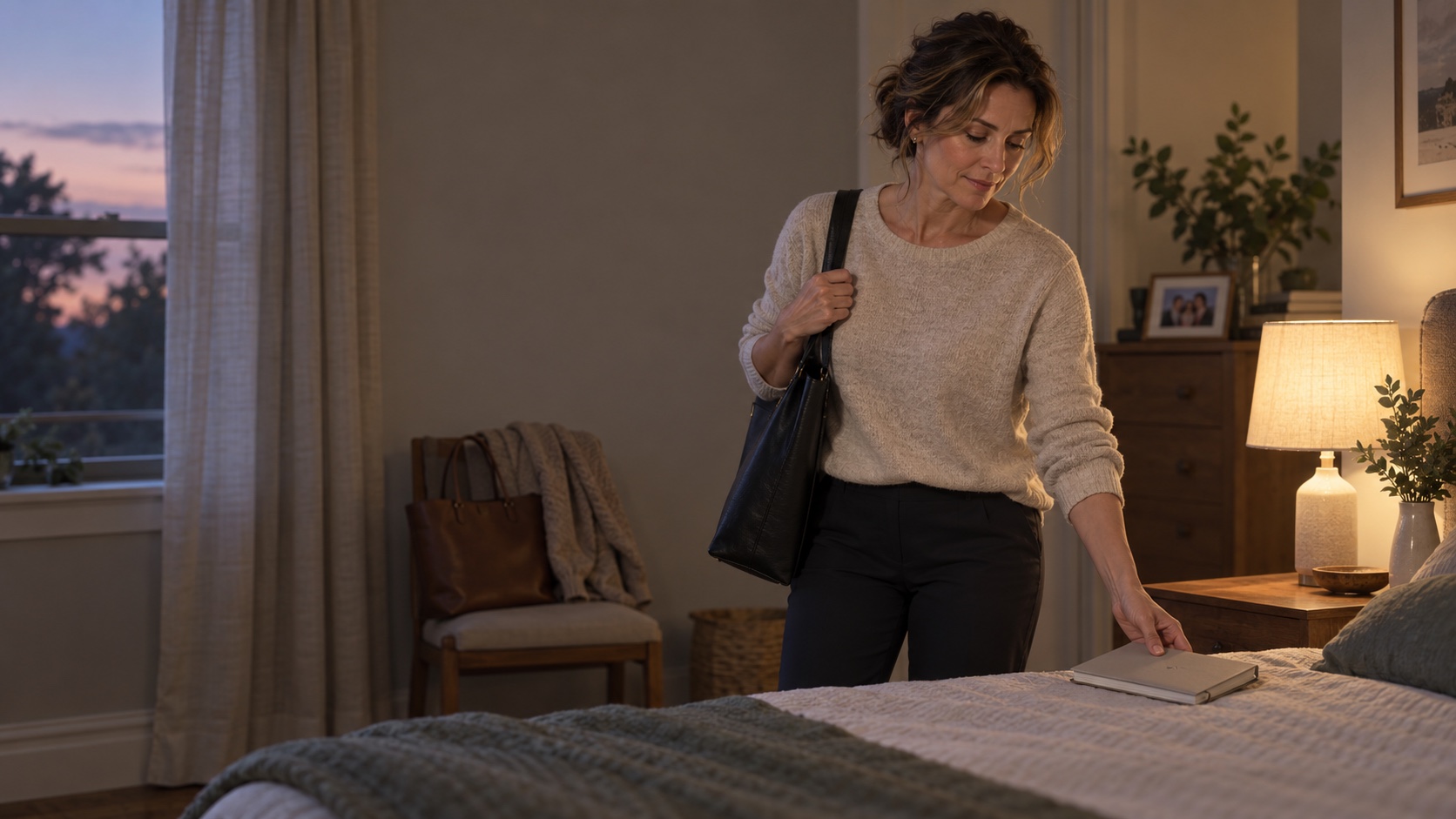
The Squeeze Is Structural, Not Personal
The honest starting point: midlife sleep loss is mostly not a discipline failure. It is arithmetic. This is the decade where three time-intensive roles overlap — peak job responsibility, children still at home, and parents crossing into their 70s and 80s. Each role alone is manageable; stacked, they compress both edges of the night. Late obligations push bedtime later while early alarms and caregiving duties hold the wake end fixed.
- 💼 Career load: the 40s and 50s concentrate responsibility — travel, late calls across time zones, and the "one more email" drift that converts recovery hours into work hours.
- 🧒 Children: teens need late pickups and early shuttles; younger children bring illness and night wakings — parental sleep fragments around the household's schedule, not the parent's biology.
- 🧓 Aging parents: health crises arrive unpredictably, and the midlife adult is the first responder — the same person whose alarm rings earliest. The strain is logistical and relational, which is why the network resilience page treats caregiving load as something to distribute, not absorb alone.
- 🧠 The temperament trap: the same conscientiousness that runs the career and the household makes "I'll sleep when things calm down" feel responsible. Things do not calm down; sleep has to be defended inside the squeeze.
Where the Minutes Go
No single driver takes much alone. The damage is additive — a later bedtime from work, a night waking from a child or a hot flash, an early alarm — and the composition is individual. The chart below is an illustrative attribution, not measured data: your own ledger will weight the drivers differently, and writing it down for two weeks is the honest way to see which bar is widest for you.
Women: The Perimenopause Spike
For women, midlife sleep has a specific inflection: the menopausal transition. Population studies consistently find sleep complaints climb through perimenopause — trouble falling asleep, 3 a.m. wakings, and unrefreshing nights — and that the rise tracks vasomotor symptoms — hot flashes and night sweats — more closely than chronological age. A hot flash triggers arousal, throws off bedding, and fragments the night into shallow segments the sleeper remembers only as a morning that arrived exhausted; breathing-stability and mood changes add pressure on top.
The detail belongs elsewhere: the sleep-and-mood transition page owns the full treatment — what actually helps, what hormone therapy can and cannot be expected to do, and where clinician conversations start. What this page adds is sequencing: perimenopausal insomnia responds to the same anchor-and-cascade structure as any insomnia, and starting the behavioral layers early builds a floor under the rougher months.
Men, Weight, and the Snore Nobody Flags
For men — and for women post-transition — the quieter midlife threat is mechanical. Weight creeps up through the 40s and 50s, and fat deposited around the neck and airway narrows the passage that must stay open all night. The Wisconsin Sleep Cohort put a number on the exchange: a 10% weight gain came with roughly a sixfold rise in the odds of developing sleep-disordered breathing (JAMA, 2000). The first symptom is rarely dramatic — a louder snore, a dry mouth on waking, afternoon sleepiness blamed on the job.
- 😴 Snoring gets normalized: "he's always snored" and "I snore when I'm tired" are the sentences that keep a real airway problem undiagnosed for years. Loud, habitual snoring is a symptom, not a personality trait.
- ⚖️ Weight moves both directions: cohort data suggest modest weight loss improves breathing during sleep — one of the few midlife sleep levers with longitudinal evidence, detailed on the sleep apnea page.
- 🧪 Nobody screens: routine midlife checkups rarely ask about sleep. The epidemiology has been clear for decades; primary-care screening never caught up, which makes the patient the usual first detector.
The Decade Apnea Compounds Silently
Untreated sleep apnea at 45 is not the same disease as at 70 — it has more years to compound. Each fragmented night raises average blood pressure a little, worsens insulin sensitivity a little, and leaves the cardiovascular system running at a higher idle. The landmark 1993 New England Journal of Medicine cohort put prevalence at about 4% of middle-aged men and 2% of women with the full syndrome — figures that understate today's pool, since average weight has risen since and an estimated eight or nine of every ten cases were never diagnosed. Midlife is when the divergence happens: the person who gets evaluated and treated pulls apnea out of their trajectory; the person who doesn't carries it into the decades where resilience is thinner. The mechanics — and when treatment is worth pursuing — live on the apnea page; what this page insists on is the timing.
⚠️ New loud snoring is a screening conversation
If snoring has become loud and habitual in your 40s or 50s, or a partner has seen you stop breathing during sleep, that is a reason to raise screening with a clinician, not buy a different pillow. Witnessed pauses, gasping awake, waking with headaches, or daytime sleepiness despite adequate time in bed all point the same direction. Nothing here diagnoses anything; it tells you which conversations to start.
What Still Works: The Anchor Defense
The good news of the decade: the sleep you have left is highly defensible, and the tools are unchanged from younger adulthood. The core is the anchor — a wake time held within about thirty minutes, seven days a week. In midlife the anchor does double duty: it stabilizes the circadian clock that menopause is jostling, and it puts a hard boundary on the morning end of the squeeze, so late nights cannot drift into a shifted schedule. Around the anchor the standard structure holds — a wind-down started before you are desperate, a cool dark bedroom, and caffeine with a curfew. The full system lives in the sleep protocol; the two moves below matter most under squeeze conditions.
- ⏰ Defend the wake end first: bedtime is the least controllable edge of a midlife night — work, children, and parents all attack it. The wake end you own. Fixing wake time lets bedtime flex a little without the whole rhythm dissolving.
- 🧩 Ration recovery, don't chase it: protect sleep opportunity the way meetings are protected — scheduled, not hoped for — rather than by weekend oversleeping, which repays depth with Monday-morning drift.
The Evening Cascade, Rebuilt for a Squeezed Life
The cascade — light, caffeine, alcohol, temperature, wind-down, in that order — was designed for a person with control of their evenings. Midlife requires the same sequence with less cooperation from circumstances, and the honest version accepts partial compliance: dimmer light after the children's bedtime, a caffeine cutoff at noon that survives travel, and alcohol counted as a sleep cost rather than a sleep aid — it sedates the evening, then fragments the night's second half. The table below compresses each driver into what it takes and what gives it back.
| Driver | What it takes | What gives it back |
|---|---|---|
| 💼 Career & commute | Bedtime drift, travel time-zone chaos, late screens | A hard lights-out cue, travel anchors, calendar-defended sleep blocks |
| 🧒🧓 Caregiving | Unpredictable wakings, early duty, vigilance that follows you to bed | Shared rotations, delegation, a wind-down that discharges the day's load |
| 🔥 Menopause symptoms | Night wakings, heat-driven arousals, lighter architecture | Cooling the room and bedding, layered covers, clinician conversation about options |
| 😮💨 Apnea risk | Fragmentation without waking memory, daytime sleepiness, cardiovascular load | Screening when signals appear, modest weight management, treatment if diagnosed |
Questions, Answered Briefly
- 🛌 "Isn't some sleep loss just what 50 looks like?" Architecture does lighten with age — the decade map traces that baseline — but exhaustion is not. Most midlife sleep complaints are circumstantial or treatable, not verdicts.
- 💊 "Do I need a sleep study?" Loud habitual snoring, witnessed pauses, gasping, or significant daytime sleepiness make the conversation worthwhile; your clinician decides whether a study follows.
- 🌡️ "Hot flashes are waking me — is that insomnia?" It is symptom-driven fragmentation; behavioral layers still help, and the transition page details what medical options exist for the flashes themselves.
- 📈 "Is it too late for habits to matter?" Anchor, cascade, and screening all remain worthwhile in the 40s–60s — the decade they buy the most future decades.
The Bottom Line
- The squeeze is structural — career, children, and aging parents compress the night from both ends; treat it as arithmetic to manage, not a willpower problem to regret.
- Women get a second, hormonal squeeze — perimenopausal fragmentation is real, common, and partially manageable; the transition page owns the medical detail.
- Weight raises apnea odds steeply — a 10% gain roughly sextupled the odds in cohort data, and most cases go undiagnosed; new loud snoring or witnessed pauses are a screening conversation, not a pillow purchase.
- The defense is unchanged — anchor the wake time, run the evening cascade at whatever fidelity life allows, and spend clinician visits on the symptoms behavior cannot reach.
Related Topics
- Young T., Palta M., Dempsey J., et al., "The occurrence of sleep-disordered breathing among middle-aged adults," New England Journal of Medicine (1993)
- Peppard P.E., Young T., Palta M., et al., "Longitudinal study of moderate weight change and sleep-disordered breathing," JAMA (2000)
- Young T., Evans L., Finn L., Palta M., "Estimation of the clinically diagnosed proportion of sleep apnea syndrome in middle-aged men and women," Sleep (1997)
- Kravitz H.M., Ganz P.A., Bromberger J., et al., "Sleep difficulty in women at midlife: a community survey of menopause and vasomotor symptoms," Sleep (2003)
- Ohayon M.M., "Epidemiology of insomnia: what we know and what we still need to learn," Sleep Medicine Reviews (2002)