Intergenerational Service
Most service flows one way; intergenerational service is the form where both directions are measured. Mentored children and mentored elders turn out to be the same intervention from opposite sides, and the evidence is unusually good for this corner of the parent topic: a randomized mentoring evaluation, a randomized school-volunteering trial in older adults, and a cohort finding on caregiving grandparents. This page walks all three — and what each side actually gets.
What the evidence supports
- In a randomized evaluation, mentoring measurably reduced truancy and early substance use in the young.
- Experience Corps, the one intergenerational program with a randomized trial, improved executive function in at-risk older volunteers and slowed brain-volume loss in one analysis.
- Grandparents providing regular childcare had materially lower mortality in the Berlin Aging Study.
What remains uncertain
- The trials are small to modest in size, and follow-up is shorter than the cohort studies behind the mortality claims.
- Whether the child-side gains persist into adulthood is largely unmeasured.
- Which ingredient — mentoring, physical activity, social contact — carries the effect is unresolved.
Evidence last reviewed: August 15, 2026. Conclusions may change as new research is published.
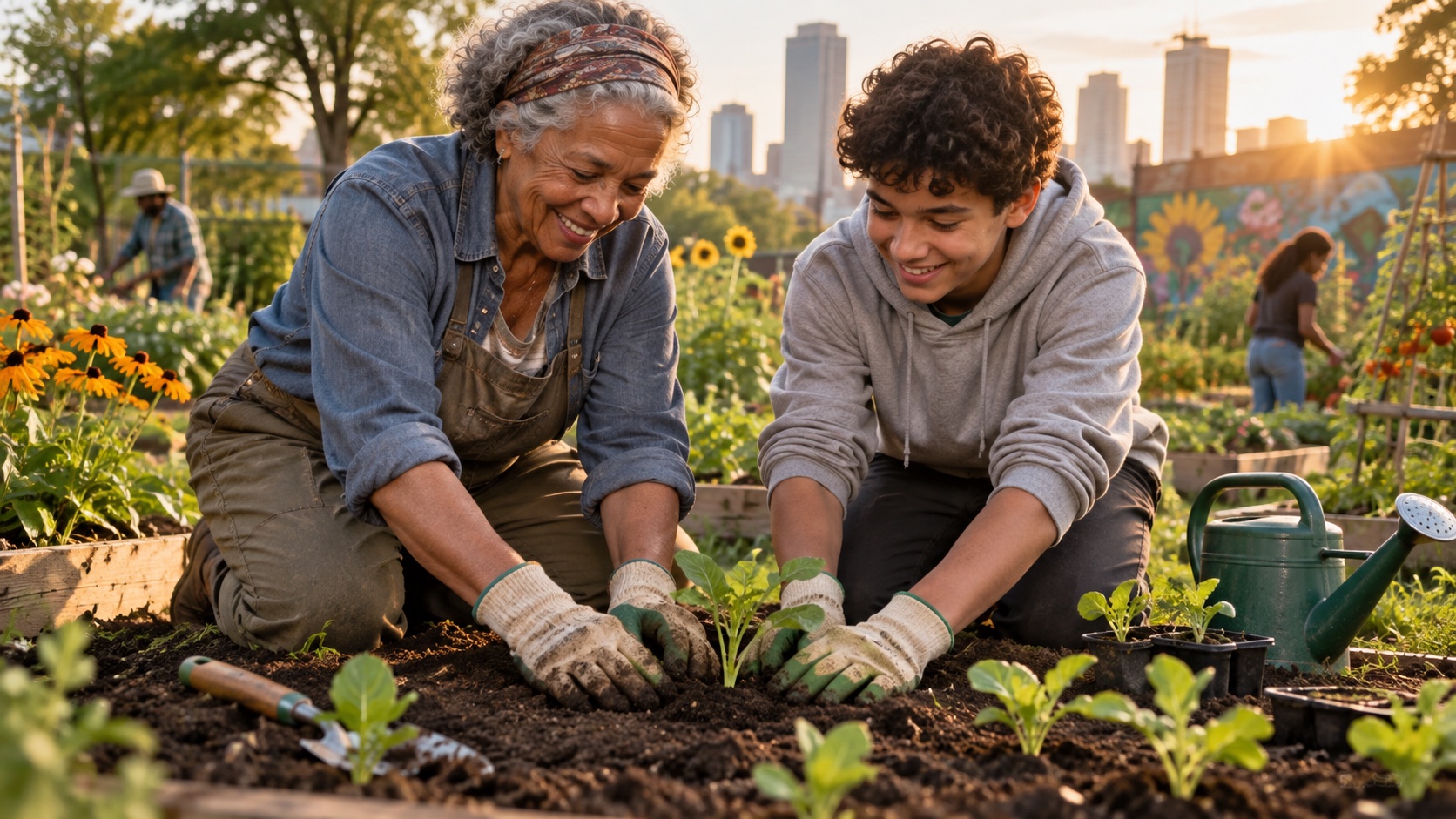
Two Generations, One Transaction
Intergenerational service is the one form of volunteering in which the giver's benefit and the recipient's development are the same event. Psychology has a name for the older side of it: generativity, Erikson's term for the mid- and late-life drive to create, nurture, and pass something on to the next generation — a drive that is measurable, and that tracks well-being independently of other purpose measures (McAdams & de St. Aubin, Journal of Personality and Social Psychology, 1992). The younger side is harder to label and easier to measure: skills, attendance, behavior. When the two are paired, neither is performing charity — each is meeting a developmental need the other happens to supply, which is the entire reason this arrangement outlasts more one-directional forms of giving. Generativity, worth noting, is measured not as a feeling but as behavior and narrative: what you create, what you offer, and what you expect to leave behind — which is why a role that produces visible help for a young person scores higher on it than an abstract sense of being useful.
The Kids' Side: What Mentoring Does
The reference study here is the Big Brothers Big Sisters evaluation: a randomized design that assigned roughly 950 young people aged 10 to 16 to a mentor or to a waiting list and measured outcomes eighteen months later. The mentored group missed less school, started fewer habits with long tails, and fought less — the four headline reductions are charted below (Grossman & Tierney, Evaluation Review, 1998). The honest gloss: these are short-horizon behavioral outcomes, and the study's strengths — randomization, real-world program delivery — came with modest sample sizes and attrition. The direction, though, is consistent with the wider mentoring literature.
The honest boundaries of the kids' side are as important as the numbers. Mentoring changed behavior; it did not transform family circumstances, and the evaluation's effects were modest to moderate, not dramatic. A mentor is also not a therapist, a tutor, or a parent — programs that train mentors set these limits explicitly, and the training exists because untrained help has a way of drifting into roles it cannot sustain. For the longevity reader, the point is not the child-outcome details so much as the design: a randomized trial in which a form of service measurably changed lives is the rarest evidence in this entire series, and it lives on this side of the exchange.
The Elders' Side: Experience Corps
The strongest older-adult evidence comes from Experience Corps, a program that places adults over 55 in elementary-school classrooms for roughly 15 hours a week — reading, tutoring, organizing — and was designed from the start as a health intervention disguised as a school program (Fried et al., Journal of Urban Health, 2004). The Baltimore trial randomized older adults into the program or a control condition, and the findings accumulated in a direction this site's other pillars would recognize:
- 🏃 Activity went up first. Volunteers moved meaningfully more than controls — walking to, around, and with children (Tan et al., Journal of Urban Health, 2006).
- 🧠 Executive function followed. At-risk older volunteers — those with some baseline cognitive vulnerability — improved on executive-function measures relative to controls (Carlson et al., Journals of Gerontology Series A, 2009).
- 🗺️ Brain structure moved, modestly. A follow-up analysis found attenuated age-related volume loss in cortex and hippocampus among participants, concentrated in men in that analysis (Carlson et al., Alzheimer's & Dementia, 2015).
- 🌱 Generativity itself rose. Participation increased measured generativity — the wish to share knowledge and care for the young (Gruenewald et al., Journals of Gerontology Series B, 2016).
The honest counterweight is what did not move. Effects were not uniform: several cognitive and physical measures showed no difference between groups, and the benefits concentrated in participants who entered with the most room to improve — the at-risk pattern that repeats across the program's papers. Intergenerational service appears to work where there is need to be met, which is the opposite of a universal tonic and exactly what you would expect of an intervention whose active ingredient is being needed.
The honest size of all of this: modest. These were small-to-moderate effects in modest samples over a couple of years, strongest in the people with the most room to improve. What distinguishes this program is not the size of the effects but the design — it remains the cleanest demonstration that volunteering's benefits can survive randomization, the exact test the evidence page says the field is missing.
The Grandparent Analogue
The same two-directional pattern shows up outside formal programs. In the Berlin Aging Study, a long-running cohort of older Berliners, people who provided regular care for grandchildren or for other non-relatives had materially lower mortality over roughly two decades than non-caregivers and non-caregiving grandparents — a finding the authors summarized as about one-third lower mortality risk (Hilbrand et al., Evolution and Human Behavior, 2017). It is observational, and the selection problem applies in full: people who can care for a grandchild are healthier to begin with. But the result survives the usual adjustments and sits comfortably inside the wider volunteering-mortality pattern. One boundary belongs in the same paragraph: intensive, full-time custodial grandparenting is a different and often stressful situation, and the burnout page's rules apply there with force — care that displaces a caregiver's own life is not the arrangement this finding describes.
If You Have No Grandchildren (or None Nearby)
Most readers of this page are not grandparents, and the programs this evidence runs through were built precisely to route around that. The formal versions pair unrelated generations on purpose — the "foster grandparent" model has run in the United States since the 1960s, and school-based volunteering and mentoring programs reproduce the grandparent structure without the family tree. The table maps the main ways in.
| Path | What it takes | What the evidence says | Verdict |
|---|---|---|---|
| Formal mentoring | Recurring one-on-one time, screening, and supervision | Reduced truancy and early substance use in the randomized Big Brothers Big Sisters evaluation | Trial-tested |
| School-based volunteering | Classroom hours — the Experience Corps model, ~15 h/week | Increased activity and executive function in at-risk older adults, in a randomized trial | Trial-tested |
| Foster-grandparent-style care roles | Structured placement, often stipended in US programs | Long program history; outcomes less formally evaluated | Promising |
| Informal grandparental childcare | Family relationship; boundary discipline required | Lower mortality in the Berlin Aging Study — observational | Observational |
The practical path is shorter than the table suggests. Schools and libraries near you already run the entry-level versions — reading partners, homework rooms, after-school programs — and they are the natural first rung: one hour a week, no family tie required, and the scheduling usually already exists. From there, the escalation is by appetite and fit: a formal mentoring match if you want one-to-one depth, a classroom role if you want the Experience Corps structure, and a foster-grandparent placement if you want the closest formal analogue to grandparenting itself. The fit page's two-question screen applies here as anywhere: would you show up unthanked, and does it use a strength you enjoy.
🤝 The exchange that is not a transaction
Mentoring works in part because it is ongoing and unpaid — reframing it as a tit-for-tat would dissolve the thing being measured. The two directions of benefit are real, but each side only gets them by attending to the other side's needs. Children gain skills because an adult shows up reliably; elders gain role and function because a child actually needs them. Attend to the child, and the elder's physiology follows — that ordering is not rhetorical; it is the design of every program this page cites.
What Both Sides Risk
The two-directional structure has a two-directional failure mode. Children risk dependence on a relationship that ends — mentoring programs plan explicitly for closure, and good ones treat the ending as part of the intervention. Elders risk over-identification with a role that cannot meet all their needs, and boundary erosion when care expectations expand past what was agreed — the burnout page owns the corrective. The mature version of intergenerational service holds both: the commitment that makes it work, and the boundaries that let it keep working. That pairing — reliable presence, protected limits — is also, not coincidentally, the ikigai formula for a role that lasts.
The Bottom Line
- Intergenerational service is the best-tested form of volunteering: a randomized mentoring evaluation and a randomized program trial in older adults both show measurable, modest benefit.
- Children gain behavior and skills — mentored youth missed less school and started fewer harmful habits.
- Elders gain function, role, and generativity — more activity, better executive function in at-risk volunteers, and lower mortality among caregiving grandparents.
- Neither side needs a family tie: mentoring and classroom programs pair unrelated generations by design — show up reliably, and protect the boundaries.
Related Topics
- Grossman & Tierney, "Does mentoring work? An impact study of the Big Brothers Big Sisters program," Evaluation Review (1998)
- Fried et al., "A social model for health promotion for an aging population: initial evidence on the Experience Corps model," Journal of Urban Health (2004)
- Tan et al., "Volunteering: a physical activity intervention for older adults — the Experience Corps program in Baltimore," Journal of Urban Health (2006)
- Carlson et al., "Evidence for neurocognitive plasticity in at-risk older adults: the Experience Corps program," Journals of Gerontology Series A (2009)
- Carlson et al., "Impact of the Baltimore Experience Corps trial on cortical and hippocampal volumes," Alzheimer's & Dementia (2015)
- Gruenewald et al., "The Baltimore Experience Corps Trial: enhancing generativity via intergenerational activity engagement in later life," Journals of Gerontology Series B (2016)
- Hilbrand et al., "Caregiving within and beyond the family is associated with lower mortality for the caregiver: a prospective study," Evolution and Human Behavior (2017)
- McAdams & de St. Aubin, "A theory of generativity and its assessment through self-report, behavioral acts, and narrative themes in autobiography," Journal of Personality and Social Psychology (1992)