The Three Equipment Tiers
The same five patterns run on any budget. Bodyweight needs nothing, resistance bands cost about the price of a dinner out, and a gym subscription buys the finest load control available. This page maps the three tiers — what each genuinely provides, where each runs out of road, and how to move between them without restarting the program.
What the evidence supports
- Untrained adults build similar strength and muscle with low-load work — push-ups, light bands — as with heavier loading over short trials (Kikuchi & Nakazato 2017).
- A meta-analysis of elastic-resistance training found strength gains broadly comparable to conventional weights, within small, short studies (Lopes 2019).
- Muscle activation in prime movers tends to run lower with bands than with barbells on the same exercises, which caps the top end of loading (Iversen 2017).
What remains uncertain
- Long-term comparisons of a bodyweight program versus a gym program are essentially absent; most trials run 8–12 weeks in untrained participants.
- Whether one tier produces better long-term adherence — the variable that probably decides results — has not been tested head-to-head.
Evidence last reviewed: August 21, 2026. Conclusions may change as new research is published.
The Three Tiers, on One Map
The tiers are not different programs — they are different load ladders for the same five patterns. The table is the honest overview.
| Tier | Start-up cost | How load progresses | Real limits | Best role |
|---|---|---|---|---|
| 🏠 Bodyweight | Nothing | Harder variations: leverage, tempo, single-limb | Coarse steps; legs outgrow it first | Start here |
| 🧪 Bands | Low | Thicker bands, then band + bodyweight | Finite resistance range; activation lower | Portable upgrade |
| 🏋️ Gym | Membership | Plates in 2.5 kg steps | Cost, travel, and scheduling | Load ceiling |
Read the "best role" column as a starting recommendation, not a caste system: many people mix tiers within a single week, and the protocol has no opinion on which one you must choose.
The tier choice rarely changes the program's skeleton — the sets, rep ranges, and rest periods survive the move between tiers untouched. What changes is the load ladder under the pattern, and that is the entire point of the map: switching tiers later is a swap of tools, not a restart of the plan.
Product picks are generic categories, not brands. We may earn a commission on Amazon or iHerb purchases at no cost to you — this never changes our evidence conclusions. Full disclosure
Adjustable dumbbells
Allows progressive loading at home across common strength movements.
⚠️ Poor technique or rapid load increases raise injury risk; not required to begin moving more.
Check price on Amazon →Tier 1: Bodyweight
The floor is genuinely free — no membership, no setup, no drive. A patch of floor, a chair, and a doorway are the entire inventory.
- 🪜 Progression by variation — leverage, tempo, and single-limb versions replace added plates: incline push-up to floor push-up to slow push-up; split squat to rear-foot-elevated split squat.
- 🔬 The evidence is real but short — a trial in untrained men found push-up training produced similar hypertrophy and strength gains to barbell bench press over the study period (Kikuchi & Nakazato 2017).
- 📏 What it cannot do — loading is capped by your own mass. The squat and carry patterns are the easiest to outgrow; the push-up is the hardest to keep progressing without adding load.
- ⏱️ Time is the real cost — bodyweight sets are short, so sessions can drift long; set a 45-minute cap and progress the variation when sets get easy.
Tier 2: Bands and Adjustable Dumbbells
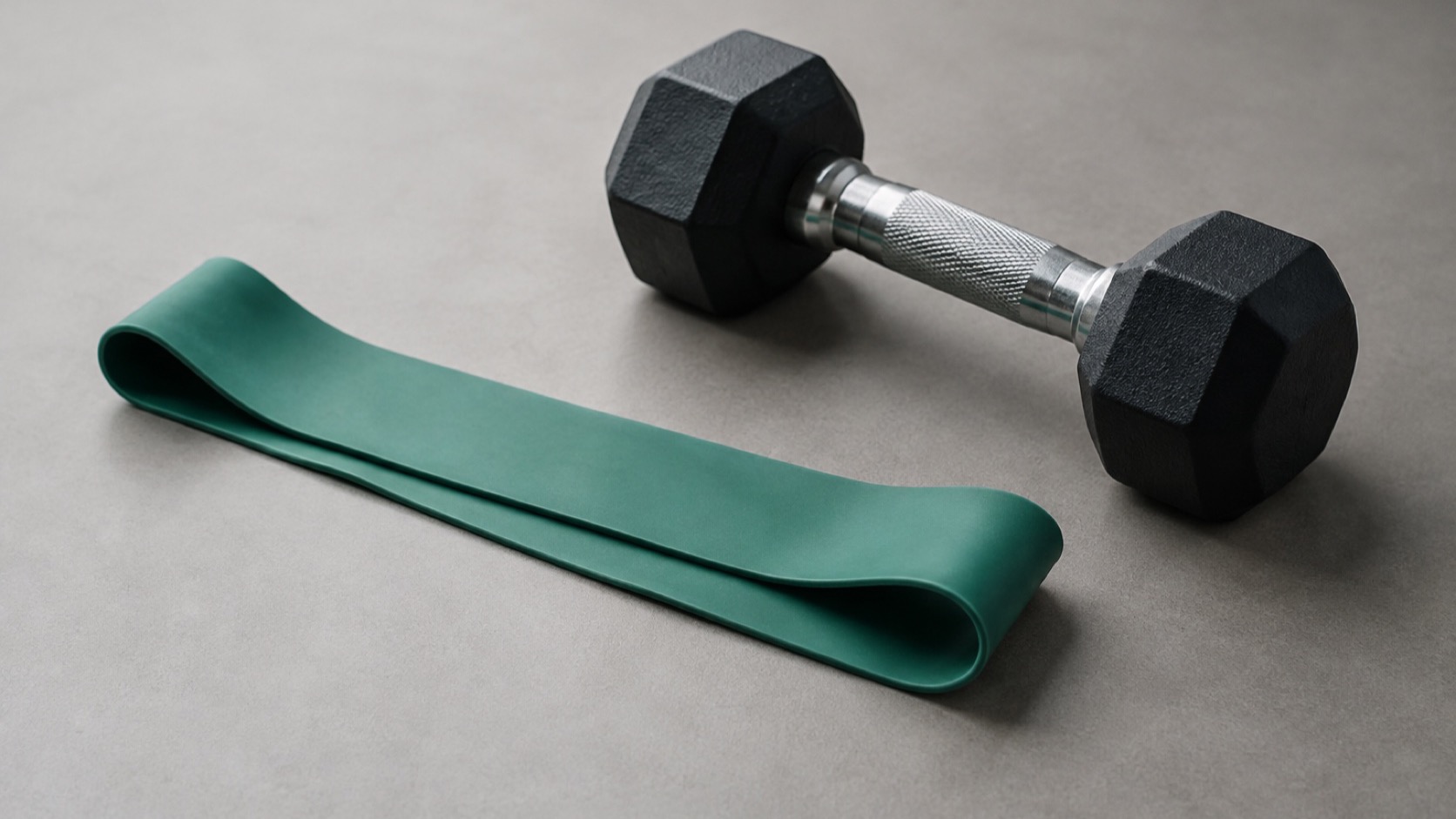
The middle tier splits into two very different tools. Bands are cheap and portable; adjustable dumbbells are the closest thing to a home gym in a box.
- 🧪 What the band evidence says — a meta-analysis of elastic-resistance training found strength gains comparable to conventional weights, with the honest caveat that the trials are small and short (Lopes 2019).
- 🎛️ The band caveat — muscle activation in the prime movers runs lower with bands than with barbells on the same exercises (Iversen 2017), so bands are a loading tool with a ceiling, not a substitute for everything.
- 🔩 Dumbbells are the load ladder — adjustable dumbbells step in 2.5 kg increments and cover every pattern; the parent protocol's minimal buy is adjustable dumbbells first and a pull-up bar second.
- 🧳 Portability — bands pack flat, which makes travel weeks and hotel rooms productive instead of lost.
Tier 3: The Gym
The gym's advantage is not mystique — it is granularity. Barbells plus small plates deliver the smallest planned load steps, which is exactly what progressive overload runs on.
- 🏋️ Load control — 2.5 kg jumps on a barbell are the standard smallest step, and racks, benches, and pulleys let all five patterns express many variations without rebuying anything.
- 🧱 Serious approximations — the barbell squat, deadlift, and press are the reference versions of their patterns; if you want to know what heavy feels like, this is where it lives.
- 💸 The honest costs — membership and travel time. The tier pays off only if the sessions actually happen; a distant gym is a marginally cheaper excuse than no equipment.
- 🛡️ Machines are here too — as entry points and accessories; the pattern view from the Five-Pattern Philosophy page applies inside the gym building as much as outside it.
Doorway pull-up bar or suspension trainer
Can expand upper-body pulling options in a small home space.
⚠️ Incorrect installation or using an unsuitable door frame can cause falls; shoulder pain requires modification or assessment.
Check price on Amazon →Progressing Within a Tier
The tiers differ most in how finely they can add load. That granularity decides how smoothly double progression runs — the widths below are qualitative, and the ordering is the point.
The practical consequence: on the gym tier, double progression rarely needs improvisation — hit the top of the rep range, add 2.5 kg, rebuild. On the bodyweight tier, the same rule runs on variation swaps: master the current version, move to the harder one, rebuild the rep count. Bands sit between the two, with thickness steps as the coarse dial.
The band ladder has a mechanical quirk worth knowing: resistance grows as the band stretches, so the last inches of a rep are hardest. That makes bands forgiving on joints at the start of a rep and demanding at the finish — useful for the pull and carry patterns, and a reason to keep hinge and squat loading honest with dumbbells or a barbell when the goal is heavy.
Mixing Tiers Without Guilt
- 🏠 A home base plus a gym pass — gym for heavy squat and hinge days, bands at home for pull and carry on the light day; the patterns stay identical.
- 🧳 Travel weeks — bands and bodyweight variations keep all five patterns in play; the session structure never changes, only the tools.
- 🏃 The other days belong to zone 2 — the Zone 2 Training topic owns the aerobic side of the week; strength tiers and cardio are complements, not competitors.
- 🩺 Injury is a tier decision — if chronic pain or a recent injury is why you are choosing a tier, that is a clinician or physio conversation, not a shopping decision; no tier here is a treatment.
The First Month on Any Tier
- 📋 The session stays the same shape — warm-up, all five patterns, 2–3 sets each, done in 45–60 minutes; only the tools differ between tiers.
- 🪜 Find the variation that talks back — in month one, pick the version of each pattern that is hard enough to notice and easy enough to control; the log tells you when to step up.
- 📓 Log the tool, not just the load — "band × heavy" or "push-up, slow tempo" is data; the variation ladder is the tier's progression table, and the notebook is where it lives.
- 🩹 Equipment is not a pain reliever — a joint that hurts on one variation usually hurts on its cousins; drop load, change the variation, and take persistent pain to a clinician or physio.
💪 Consistency picks the tier
Every tier can build the strength that matters, and no tier builds it by being owned. The sessions that happen twice a week for a year beat the perfect setup that happens twice a month. Pick the tier you will actually run, and let the evidence about equipment differences stay in its place: real, but small next to adherence.
Resistance bands
A low-space way to begin or supplement resistance training.
⚠️ Bands can snap and unstable anchoring can cause injury; stop movements that provoke pain.
Check price on Amazon →Questions, Answered Briefly
- ❓ Can bands really build muscle? — Over short trials, yes, and plausibly longer for untrained lifters; the honest expectation is a lower ceiling than heavy barbells, not a zero ceiling.
- ❓ Is bodyweight enough forever? — For years, with hard variations; most people eventually want the squat and hinge loaded heavier than their own mass allows, and that is when the dumbbell or the gym earns its keep.
- ❓ Do I need a gym for the hinge pattern? — No: glute bridge to single-leg hinge to dumbbell Romanian deadlift covers the whole ladder at home.
- ❓ What about the machines at the gym? — Entry points and accessories — fine, and sometimes the safest option after injury; the five patterns still anchor the session.
- ❓ Cheapest complete setup? — Bands plus adjustable dumbbells plus a pull-up bar: the parent protocol's minimal buy, and it covers all five patterns at home.
- ❓ How long before I need a heavier tier? — When the hardest variation of a pattern is no longer hard at the top of the rep range — usually months, sometimes years, and never a reason to rush the technique month.
The Bottom Line
- Three tiers, one program. The patterns never change; only the load ladder does.
- Bodyweight and bands are honest starting points. The evidence for them is short-term and real, with honest ceilings.
- The gym buys load control and variation, not better biology — adherence still decides the outcome.
- Buy one tier and run it twice a week for a year before upgrading; consistency picks the tier.
Related Topics
- Kikuchi & Nakazato, "Low-load bench press and push-up induce similar muscle hypertrophy and strength gain," Journal of Exercise Science & Fitness (2017)
- Lopes et al., "Effects of training with elastic resistance versus conventional resistance on muscular strength: a systematic review and meta-analysis," SAGE Open Medicine (2019)
- Iversen et al., "Multiple-joint exercises using elastic resistance bands vs. conventional resistance-training equipment: a cross-over study," European Journal of Sport Science (2017)
- Schoenfeld et al., "Strength and hypertrophy adaptations between low- vs. high-load resistance training: a systematic review and meta-analysis," Journal of Strength and Conditioning Research (2017)
- Fragala et al., "Resistance training for older adults: position statement from the National Strength and Conditioning Association," Journal of Strength and Conditioning Research (2019)