Whey, casein & the supplement question
Protein powder is the world's most scrutinized food product, and the honest verdict on it is smaller than the marketing: a convenient, precise dose of milk protein that matters mainly when whole food is awkward. The science is real but narrow — whey spikes, casein drips, and both beat nothing. What they beat food at is mostly logistics. This page separates the two claims.
What the evidence supports
- Whey protein digests fast and spikes blood amino acids within about an hour; casein digests slowly and sustains a milder elevation for hours (PNAS, 1997).
- Whey stimulates muscle protein synthesis more than casein or soy at matched doses (Journal of Applied Physiology, 2009).
- Protein supplementation augments training gains — with the effect shrinking as baseline food protein rises (American Journal of Clinical Nutrition, 2012).
What remains uncertain
- Whether pre-sleep casein's overnight benefit translates into meaningful long-term muscle gains for everyone, or mainly for older adults.
- How much of powders' training benefit is protein per se versus simply making the daily total easier to hit.
- Long-term health comparisons between whole-food and supplemented protein patterns are essentially absent.
Evidence last reviewed: August 15, 2026. Conclusions may change as new research is published.
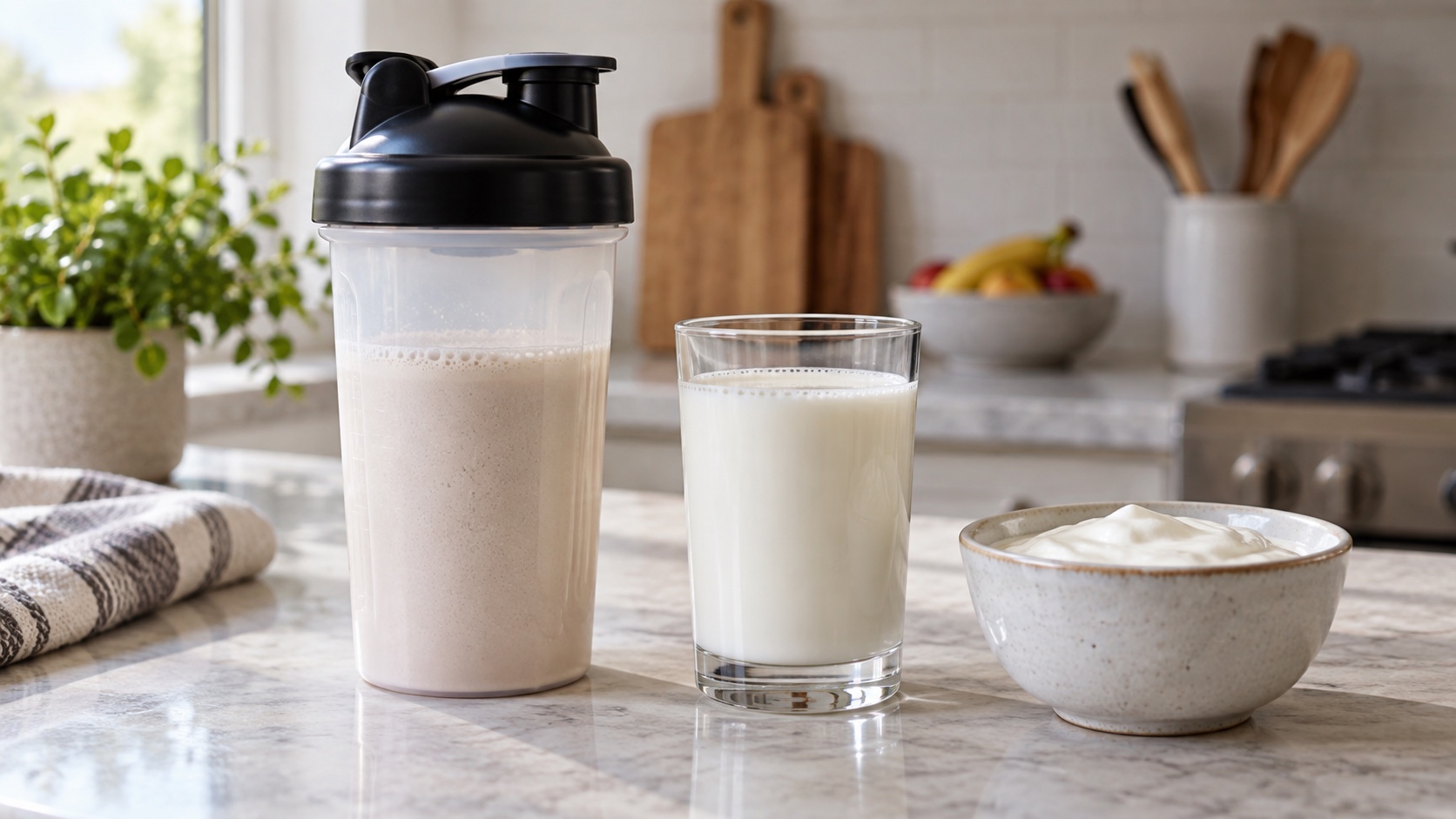
What Powders Are: Milk, Broken Apart
Most protein powder is not a laboratory product — it is cow's milk with the fat, lactose, and water removed, leaving its two protein families. Milk protein is roughly 80% casein and 20% whey. Casein coagulates in the stomach and releases amino acids over hours; whey passes through quickly. "Isolate" means further processing to strip almost all lactose and fat; "concentrate" retains a bit more of both. Neither is more "natural" in a way that matters to your muscle — the difference is digestion speed, lactose content, and price. One practical caution before the science: powders sit in a loosely regulated category, so choosing brands with third-party batch testing (NSF or Informed Choice, for example) is a reasonable quality floor, not paranoia.
The Speed Difference That Matters
The landmark experiment fed people whey or casein through tubes and tracked blood amino acids and whole-body protein balance for seven hours (PNAS, 1997). Whey produced a sharp leucine peak within an hour and a quick fall; casein produced a smaller, sustained elevation that outlasted the study's tracking. The functional reading: whey is a switch — it fires muscle protein synthesis hard and briefly — while casein is a drip that suppresses protein breakdown over time. Later dose-matched work confirmed whey stimulates synthesis more than casein or soy, at rest and after lifting, in young men (Journal of Applied Physiology, 2009) and that whey outperforms casein for post-meal muscle protein accretion in older men too (American Journal of Clinical Nutrition, 2011). None of this makes one protein "better" in the abstract; it makes them better at different jobs — which the timing section below turns into a schedule.
What Powders Actually Add Over Food
The honest head-to-head answer is that powders rarely beat whole food on anything except precision, speed, and convenience. The training literature shows why: protein supplementation reliably augments lean-mass and strength gains — but meta-analytic estimates find the benefit shrinking as participants' baseline food protein rises, becoming negligible around 1.6 g/kg (American Journal of Clinical Nutrition, 2012). A scoop, in other words, is mostly a delivery vehicle for hitting totals you have not yet hit with food. What food offers back: the co-nutrients powders lack — zinc and iron and B12 in meat, calcium and bioactive peptides in dairy, fiber and polyphenols in plants. Powder is not "better protein"; it is protein with the food stripped off, and the food part is not worthless.
The Casein-at-Night Idea
The one timing effect with repeated support uses casein's slow drip. Thirty to 40 grams of casein before sleep improved overnight muscle protein synthesis after evening exercise (Medicine & Science in Sports & Exercise, 2012), and twelve weeks of pre-sleep casein during training produced greater muscle and strength gains than placebo (Journal of Nutrition, 2015). Effect sizes are modest, and the people most likely to benefit are those who struggle to hit daytime totals or whose anabolic resistance makes every pulse count — which describes many older adults. Cottage cheese, Greek yogurt, or milk deliver the same slow protein as casein powder; the powder is just the most concentrated version. If you already spread protein well across the day (see the distribution page), pre-sleep casein is a refinement, not a requirement.
Dose, Timing, and the Post-Workout Window
Gym folklore once claimed protein had to be consumed within 30 minutes of training or the session was lost. The evidence says the "anabolic window" is hours wide, not minutes. A meta-analysis of protein-timing trials found that the apparent benefit of immediate post-workout protein was largely explained by people simply eating more total protein in the timing arms — total intake dominated the outcome (Journal of the International Society of Sports Nutrition, 2013). The practical translation: a 20–40 g dose within roughly two to three hours after training is a reasonable habit with no urgency attached, and your per-meal threshold (25–40 g) matters more than your stopwatch. Where powders do earn their keep: early mornings when a cooked protein breakfast is unrealistic, travel, and the final 25 g of a day that came up short. That is it. They are gap-fillers, not a food group.
| Feature | Whey | Casein | Plant blend | Whole food |
|---|---|---|---|---|
| ⚡ Digestion speed | Fast (~1h peak) | Slow (4–7h) | Medium | Varies by food |
| 🧪 Leucine per ~25g protein | ~2.7 g | ~2.2 g | ~2.0–2.3 g | Varies |
| 🥦 Co-nutrients | Minimal | Minimal | Minimal (blends) | Rich — zinc, iron, B12, calcium |
| ⏱️ Convenience | Very high | Very high | High | Low |
| 🏆 Overall verdict | Good | Good | Moderate | Good |
🥛 The honest verdict on powders
Use them to close a gap: 25–40 g when a meal is impractical, a plant blend when breakfast needs leucine, casein before bed if your daytime distribution is thin. Do not use them to replace meals, and do not expect what food-plus-powder cannot do — powder adds protein, not a protocol. And note the clinical caveat: anyone with kidney disease or on a protein-restricted diet should count powder grams like any other protein and follow their clinician's limits (the kidney and liver page owns that territory).
Choosing a Powder Without the Hype
- 🥛 Whey concentrate vs isolate. Isolate if lactose bothers you; concentrate otherwise — the difference is digestion comfort and price, not results.
- 🌙 Casein or slow dairy before bed. Only if daytime totals are hard for you; cottage cheese works and costs less.
- 🌱 Plant blends over single-source. Pea-rice blends close the lysine gap and approach whey's leucine density (see the plant vs animal page).
- 🚫 Skip BCAAs. Whole protein delivers the same leucine plus everything else; the branch-chain trio alone is an expensive, partial signal.
- 💪 If you want one training supplement, creatine. Monohydrate has stronger, broader evidence for strength and muscle than any protein powder ever will — the Big Five topic scores it. Protein powders are conveniences; creatine is an intervention.
Questions, Answered Briefly
- 🏭 Isn't powder ultra-processed food? It is processed, certainly — but the concern with ultra-processed foods is their calories, salt, fat, and appetite effects; a whey isolate is mostly one ingredient. The better critique is that it displaces nutrient-dense food, which is a reason to cap it, not fear it.
- 🥩 I eat meat at every meal — do I need powder? Almost certainly not. If you hit your band from food (see the band page), powder adds nothing but convenience.
- 📏 How much is too much? There is no magic ceiling — but every scoop beyond your daily target is food budget spent on protein you cannot store. One or two scoops a day, as gap-filling, is the sensible envelope.
- 🐄 I'm allergic to milk. Are there options? Yes — pea-rice blends and soy isolate work for plant-based needs, and egg-white protein exists for those who tolerate eggs. Match the dose to the leucine guidance on the plant page.
The Bottom Line
- Whey fires fast, casein drips slow. The speed difference is real and studied for decades (PNAS, 1997) — whey suits post-workout and breakfast, casein suits pre-sleep.
- Powders beat nothing, not food. Supplementation helps most when baseline food protein is low and fades around 1.6 g/kg (AJCN, 2012); food's co-nutrients are not optional decoration.
- The post-workout window is hours wide. Total daily protein dominates timing; a 20–40 g dose within a few hours of training is a habit, not an emergency.
- Buy for the gap, not the promise. Third-party-tested whey or a pea-rice blend, one to two scoops where food is awkward — and creatine if you want a supplement with intervention-grade evidence.
Related Topics
- Boirie et al., "Slow and fast dietary proteins differently modulate postprandial protein accretion," Proceedings of the National Academy of Sciences (1997)
- Tang et al., "Ingestion of whey hydrolysate, casein, or soy protein isolate: effects on mixed muscle protein synthesis at rest and following resistance exercise in young men," Journal of Applied Physiology (2009)
- Pennings et al., "Whey protein stimulates postprandial muscle protein accretion more effectively than do casein and casein hydrolysate in older men," American Journal of Clinical Nutrition (2011)
- Cermak et al., "Protein supplementation augments the adaptive response of skeletal muscle to resistance-type exercise training: a meta-analysis," American Journal of Clinical Nutrition (2012)
- Res et al., "Protein ingestion before sleep improves postexercise overnight recovery," Medicine & Science in Sports & Exercise (2012)
- Snijders et al., "Protein ingestion before sleep increases muscle mass and strength gains during prolonged resistance-type exercise training in healthy young men," The Journal of Nutrition (2015)
- Schoenfeld, Aragon & Krieger, "The effect of protein timing on muscle strength and hypertrophy: a meta-analysis," Journal of the International Society of Sports Nutrition (2013)