Post-Meal Movement
Ten to fifteen minutes of easy walking after a meal measurably lowers that meal's glucose curve — and the timing turns out to be the whole trick: moving after meals beats moving before them, and several short bouts beat one long one. No gym, no gear, no cost. This page covers the muscle biology that makes it work, the head-to-head trials that proved the timing, and how to bolt the habit onto meals you already eat.
What the evidence supports
- Light post-meal activity lowers the glucose and insulin curve of that meal — the finding is consistent across trials and pooled analyses.
- Timing matters: movement after a meal outperforms the same movement before it, and brief post-meal bouts outperform a single longer session.
- The mechanism is contraction-driven glucose uptake — working muscle pulls glucose from the blood largely without needing insulin.
What remains uncertain
- Trials measure hours and days, not years — whether shaving post-meal curves changes long-term outcomes in healthy people is inferred, not proven.
- Most controlled studies enrolled people with diabetes or impaired glucose tolerance; healthy people get a smaller absolute effect.
- The minimal effective dose — how short a walk still counts — has no clean threshold, though breaks as brief as a few minutes moved markers in pooled analyses.
Evidence last reviewed: August 15, 2026. Conclusions may change as new research is published.
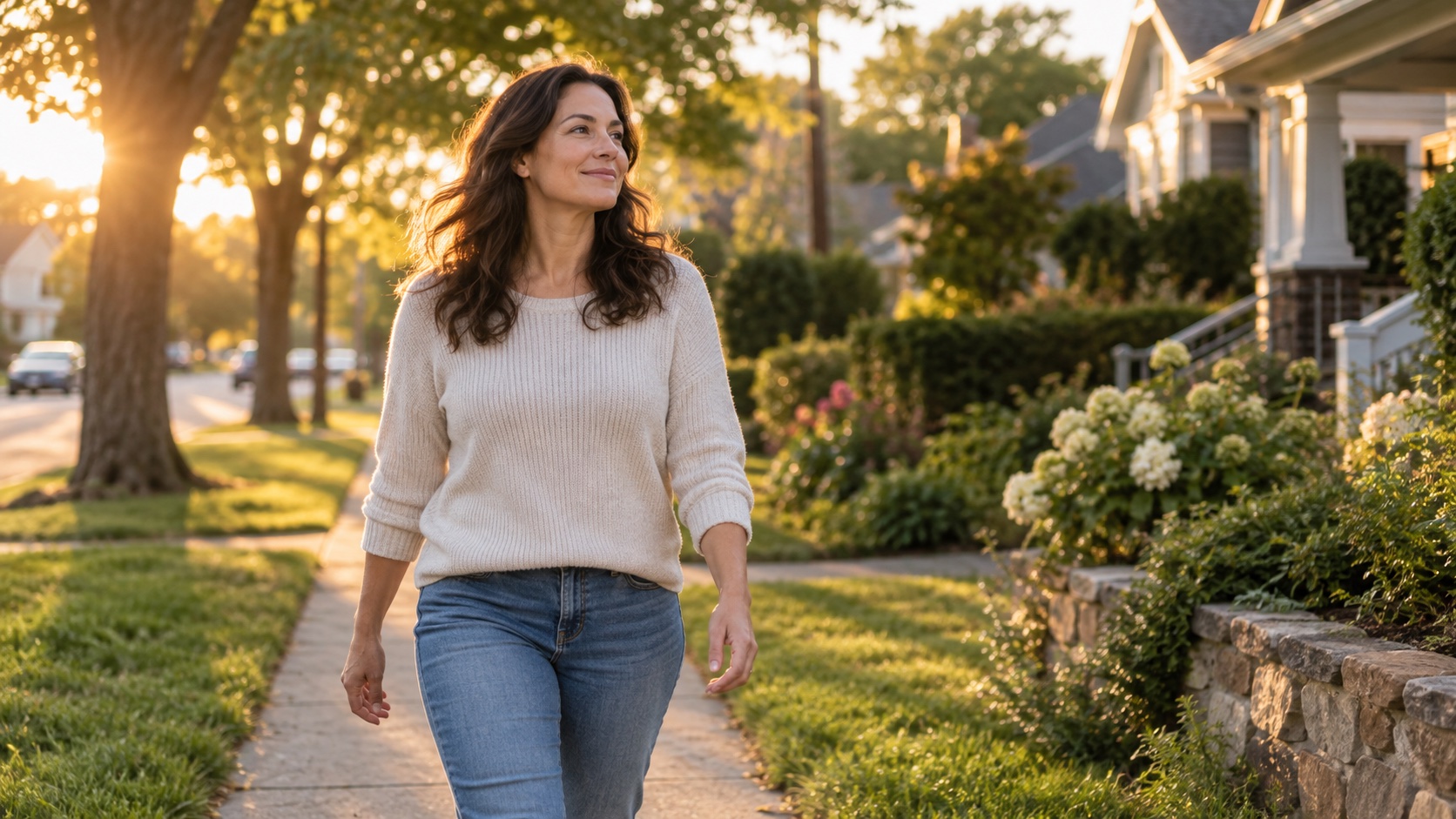
The Muscle Drain, Timed Right
The biology underneath this page is one of the cleaner stories in metabolism. When a muscle contracts, it pulls glucose out of the blood through transporter proteins — GLUT4 — that move to the cell surface in response to the contraction itself, largely without insulin's help (Richter & Hargreaves, Physiological Reviews, 2013). That is why the timing works: the glucose from your meal arrives in the bloodstream, and the moving muscle meets it at the door with open transporters. The effect is local and immediate — no training adaptation required, which is why even a casual walk after dinner measurably lowers that dinner's curve. The parent glucose topic introduced the muscle drain; this page owns its timing, dose, and habit engineering.
Product picks are generic categories, not brands. We may earn a commission on Amazon or iHerb purchases at no cost to you — this never changes our evidence conclusions. Full disclosure
Comfortable walking shoes
May improve comfort and consistency for walking-based activity.
⚠️ Footwear cannot correct every pain problem; persistent foot, knee, or hip pain warrants appropriate evaluation.
Check price on Amazon →The Head-to-Heads
Three studies settle the timing question, and their designs are worth knowing because they explain the pattern. The landmark trial gave older adults at risk for impaired glucose tolerance either one 45-minute walk or three 15-minute walks timed after meals — the post-meal schedule produced better 24-hour glucose control, with the dinner bout doing the most work (DiPietro et al., Diabetes Care, 2013). A smaller crossover in people with type 2 diabetes compared the same 20 minutes before versus after dinner: post-dinner walking lowered the evening glucose curve, pre-dinner exercise did not (Colberg et al., JAMDA, 2009). And a randomized crossover tested the advice itself — patients told to walk after meals had lower two-hour post-meal glucose than patients given the same step goal without timing instructions (Reynolds et al., Diabetologia, 2016). Same movement, different clock position, different result.
| Study | Design | Finding | Read |
|---|---|---|---|
| DiPietro et al., 2013 (Diabetes Care) | Randomized crossover, older adults at risk | Three 15-min post-meal walks beat one 45-min walk for 24-h glucose control | Strong |
| Colberg et al., 2009 (JAMDA) | Crossover, type 2 diabetes | Post-dinner walking lowered the dinner curve; the same walk before dinner did not | Strong |
| Reynolds et al., 2016 (Diabetologia) | Randomized crossover, type 2 diabetes | Advice specifying after-meal walking lowered 2-h glucose vs generic walking advice | Strong |
| Buffey et al., 2022 (Sports Medicine) | Systematic review & meta-analysis of acute trials | Interrupting prolonged sitting with light walking improved postprandial glucose and insulin | Strong |
The honest frame on all four rows: these trials measured the meal curve and the day's glucose, not heart attacks or lifespan. The leap from "this walk flattens tonight's curve" to "this walk extends your life" is reasonable but not directly demonstrated — it rests on the mortality-curve logic of the third page in this series, where flatter average glucose sits on the flat part of the risk curve.
Dose: How Much, How Soon
- 🕰️ Start the clock at the end of the meal. Glucose peaks roughly 30–60 minutes after eating, so the useful window is the first hour after the last bite. A walk begun 30 minutes after finishing lands exactly on the rising slope — the timing used in the landmark trial.
- 🚶 Ten to fifteen minutes is the tested dose. The DiPietro bouts were 15 minutes at an easy pace. There is no magic in the number — it is simply enough time for the muscle drain to meet the glucose wave.
- 🐜 Even breaks count. Pooled analyses of sitting-interruption trials found light walking breaks of a few minutes lowered postprandial glucose and insulin relative to staying seated (Buffey et al., 2022) — the dose curve is friendly at the low end.
- 🚴 Intensity is not the point. The effect is contraction-driven and works at easy paces. Hard exercise has its own glucose story — brief rises from muscle glycogen release — and its own place in the week, which the Zone 2 and 3-2-1 formula topics cover.
- 🍽️ Target the biggest meal. The dinner bout did the most work in the landmark trial, because dinner is typically the largest glucose load and the one followed by the most sitting.
⚠️ If you take glucose-lowering medication
Exercise lowers glucose — which is the point of this page and the risk of this footnote. On insulin or medications that promote insulin release (sulfonylureas and similar), adding movement after meals can overshoot into hypoglycemia, especially if the walk is new or longer than usual. The trials above were conducted under clinical supervision for that reason. If your treatment includes those medications, the post-meal walk is a clinician conversation, not a self-experiment.
The Habit Engineering
The physiology is free; the hard part is remembering to use it. The pattern that survives contact with real life: attach the walk to a trigger you already obey. The kitchen is the best anchor — the moment the plate goes in the dishwasher, the walk starts. A loop around the block takes the ten minutes; pacing the house while tidying works too, because the dose curve is friendly at the low end. For desk lunches, the two-minute version — a lap of the floor, a flight of stairs — is a real intervention, not a consolation prize, per the sitting-interruption evidence. The walking habit page and the NEAT page in the Exercise pillar own the broader habit machinery; the Habit Formation protocol covers anchor-and-reward design generally. Here the rule is simply: meals you already eat are the trigger you already have.
One Desk-Worker's Day, Worked
A realistic Tuesday. Breakfast at the desk: a two-minute lap to the printer and back after the last bite — trivial, but it interrupts the morning sit. Lunch at 12:30: ten minutes of walking back from the café the long way, timed to start right after eating, not before. Dinner at 19:00: the dishwasher switch — plates in, shoes on, one block loop. Total added: about twenty-two minutes, none of it "exercise" in the scheduled sense, all of it landing in the three windows where muscle meets glucose. The desk worker who instead does a single heroic weekend workout has the same weekly minutes and misses every window. Same movement, different clock position, different result — the whole page in one sentence.
Questions, Answered Briefly
- 🐜 Does pacing the kitchen count? Yes — light activity is what the trials used, and pooled analyses show even brief walking breaks move postprandial glucose. Ten intentional minutes beats ten anxious ones, but any contraction counts.
- ⏰ Before or after — does the order really matter? Yes, and it's the headline finding: the same walk after dinner lowered the meal curve where the same walk before dinner did not (Colberg et al., 2009).
- 🕐 How soon after eating? The tested schedule starts about 30 minutes after the last bite, landing on the rising slope. Starting immediately also works — the key is covering the first hour, when glucose peaks.
- 🏃 Does a hard workout after eating help more? Not for this purpose — intensity isn't the mechanism, contraction is. Hard efforts can briefly raise glucose from muscle glycogen, and very hard efforts on a full stomach are their own discomfort.
- 📉 Will I see it on a sensor? Often, yes — dinner one night seated, the next night walked, is one of the cleaner before/after comparisons, run with the log-before-you-look rule from the sensor page.
The Bottom Line
- Timing is the intervention — the same walk after a meal outperforms the same walk before it, and short post-meal bouts beat one long session.
- The dose is friendly — ten to fifteen easy minutes after the biggest meal does the documented work; brief breaks do real work too.
- The mechanism is contraction, not training — working muscle clears glucose without needing insulin, which is why it works the first time you try it.
- Bolt it to the dishwasher — meals you already eat are the trigger; no new schedule required.
Related Topics
- DiPietro et al., "Three 15-min bouts of moderate postmeal walking significantly improves 24-h glycemic control in older people at risk for impaired glucose tolerance," Diabetes Care (2013)
- Colberg et al., "Postprandial walking is better for lowering the glycemic effect of dinner than pre-dinner exercise in individuals with type 2 diabetes," Journal of the American Medical Directors Association (2009)
- Reynolds et al., "Advice to walk after meals is more effective for lowering postprandial glycaemia in type 2 diabetes mellitus than advice that does not specify timing: a randomised crossover study," Diabetologia (2016)
- Buffey et al., "The Acute Effects of Interrupting Prolonged Sitting Time in Adults with Standing and Light-Intensity Walking on Biomarkers of Cardiometabolic Health in Adults: A Systematic Review and Meta-analysis," Sports Medicine (2022)
- Richter & Hargreaves, "Exercise, GLUT4, and skeletal muscle glucose uptake," Physiological Reviews (2013)