Cacao & Dark Chocolate
Chocolate enjoys one of the strongest reputations in nutrition, built on a famous cohort meta-analysis and, since 2022, an actual randomized trial with 21,442 participants. The two tell different stories. This page separates what the COSMOS trial showed from what the chocolate aisle implies.
What the evidence supports
- Cocoa flavanols improve blood-vessel function and lower blood pressure modestly in short trials.
- The COSMOS trial found a 27% reduction in cardiovascular death with daily cocoa flavanol capsules in a secondary analysis.
- Observational meta-analyses associate chocolate consumption with lower cardiovascular risk.
What remains uncertain
- COSMOS missed its primary endpoint — total cardiovascular events were 10% lower but not statistically significant.
- Candy-bar doses of flavanols are far below the trial dose; the trial tested an extract, not chocolate.
- Chocolate carries sugar, calories, and in some products cadmium and lead — the dark side of the cacao story.
Evidence last reviewed: August 15, 2026. Conclusions may change as new research is published.
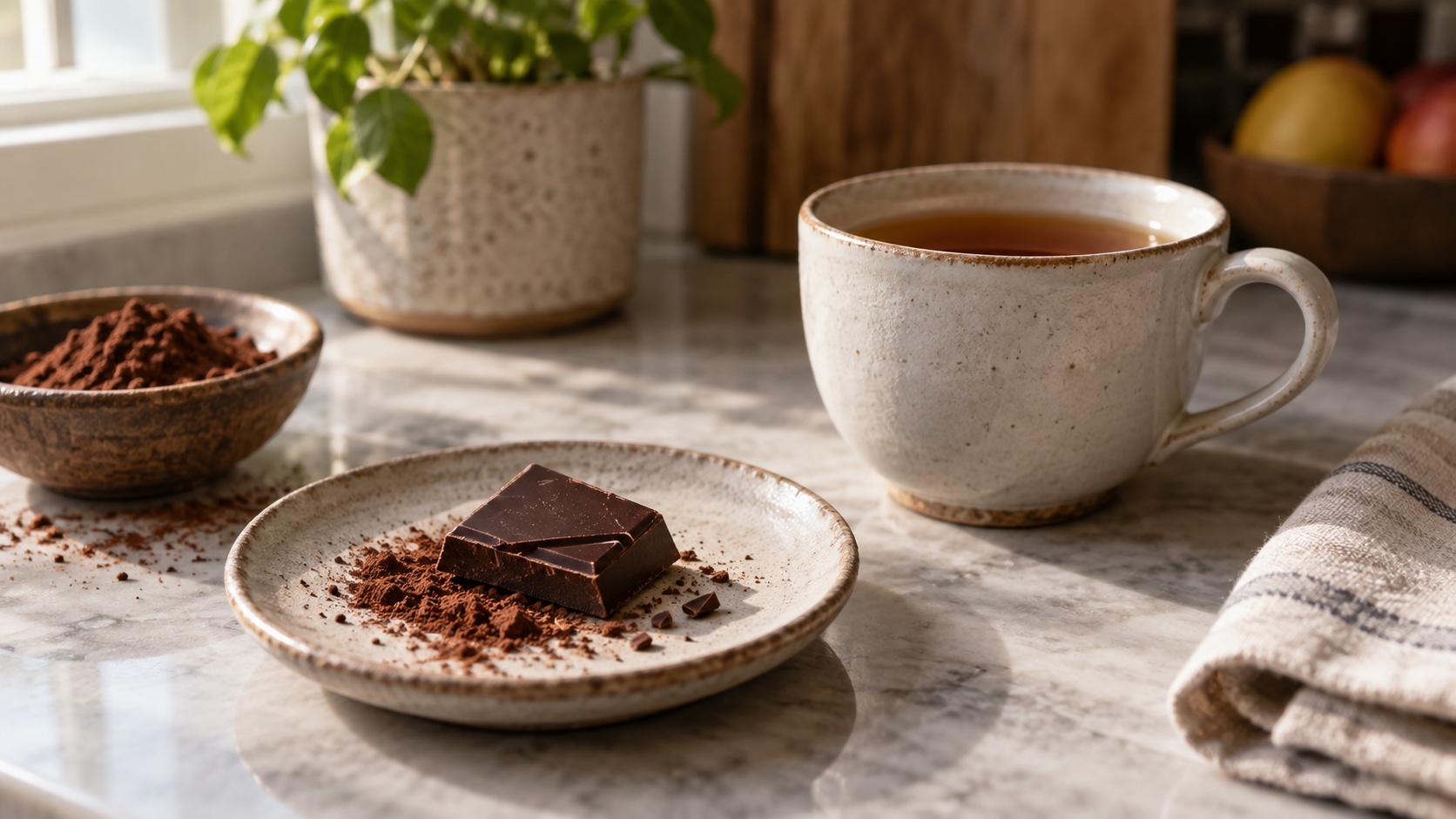
Flavanols: The Active Thread
The candidate molecule in cacao is (-)-epicatechin, the most abundant flavanol in cocoa, and the mechanism story is unusually clean for nutrition. In a classic experiment, volunteers drank either a flavanol-rich or flavanol-poor cocoa, and only the rich drink improved flow-mediated dilation — a direct measure of how well blood vessels relax. When the same volunteers later consumed pure (-)-epicatechin, the improvement matched, effectively isolating the molecule (Schroeter et al., PNAS, 2006). The pathway runs through nitric oxide, the signal that widens vessels — which is why flavanols behave like a mild cardiovascular hormetin rather than a dessert ingredient. The catch, repeated throughout this Matcha & Hormetic Drinks series: dose. What a trial delivers and what a candy bar delivers are separated by an order of magnitude, and that gap is where most chocolate claims quietly fail.
Product picks are generic categories, not brands. We may earn a commission on Amazon or iHerb purchases at no cost to you — this never changes our evidence conclusions. Full disclosure
Matcha powder
Makes an unsweetened matcha routine convenient for people who enjoy and tolerate caffeine.
⚠️ Caffeine can worsen insomnia, anxiety, palpitations, reflux, or medication-related concerns; timing and total intake matter.
Check price on Amazon →COSMOS: The Trial Everyone Quotes
The COcoa Supplement and Multivitamin Outcomes Study randomized 21,442 older adults to daily capsules containing 500 mg of cocoa flavanols (including 80 mg of epicatechin) or placebo, for a median of 3.6 years (Sesso et al., American Journal of Clinical Nutrition, 2022). The headline result is two-sided, and both sides matter. Total cardiovascular events — heart attack, stroke, cardiovascular death — were about 10% lower in the flavanol arm, but the result missed statistical significance. The pre-specified secondary analysis of cardiovascular death showed a 27% reduction that was significant. A companion cognition trial (COSMOS-Mind, 2023) found no overall cognitive benefit. This is the honest shape of the evidence: a real RCT, a plausible but unconfirmed primary result, a strong signal on the hardest endpoint, and no free lunch for the brain.
How COSMOS Sits Next to the Cohorts
Before COSMOS, the chocolate reputation rested on observational analyses. The famous one pooled seven studies and found that the people eating the most chocolate had a 37% lower risk of any cardiovascular disease than those eating the least (Buitrago-Lopez et al., BMJ, 2011). The chart puts that number next to the trial's. The lesson is not that either number is wrong — it is the standard gap between observational enthusiasm and randomized reality, the same gap the Big Five Supplements topic documents for pills. Cohorts overstate; trials deflate; the truth sits between them, closer to the trial.
70%+ dark chocolate
An occasional food option only where an article specifically gives a modest whole-food chocolate practice.
⚠️ Contains calories, sugar, caffeine/theobromine, and potentially relevant heavy-metal exposure; portion matters.
Check price on Amazon →The Blood-Pressure Record
The most replicated short-term finding is blood pressure. A Cochrane systematic review of controlled trials found that flavanol-rich cocoa lowered systolic blood pressure by roughly 2 mmHg on average, with bigger effects in trials of flavanol-rich products than in trials of chocolate itself (Ried et al., Cochrane Database of Systematic Reviews, 2017). Two mmHg is small — far below a medication — but it is the kind of population-level effect that shows up in cohort statistics without being feelable in any individual. The honest framing: cacao's vascular effects are real and modest, they fade within hours to days after intake stops, and they require flavanol doses closer to COSMOS capsules than to a square of chocolate. The coffee page tells a parallel story: polyphenol drinks move physiology measurably, and the dose-response decides whether it matters.
Chocolate vs the Capsule
| Source | Typical flavanol delivery | The trade-off | Read |
|---|---|---|---|
| 💊 COSMOS capsule | 500 mg cocoa flavanols daily, including 80 mg epicatechin | Zero sugar, zero calories — the trial's dose | Reference |
| 🍫 Dark chocolate (70%+), 1 oz | A fraction of the capsule — order-of-magnitude lower | ~150–170 kcal, some sugar; heavy-metal risk varies by origin | Moderate |
| 🥛 Milk chocolate, 1 oz | Minimal flavanols — diluted and heavily processed | Mostly sugar and fat; no meaningful flavanol dose | Weak |
| 🧪 Dutch-processed cocoa | Flavanols largely destroyed by alkalization | Looks like cocoa, delivers far less | Limited |
| 🌱 Natural cocoa powder, 1 tbsp | The cheapest flavanol-dense food source | Bitter — needs to land in oats, yogurt, or a smoothie | Good |
⚠️ Supplement-grade is not candy-grade
The COSMOS dose — 500 mg of cocoa flavanols a day — would require hundreds of grams of dark chocolate, on the order of a thousand calories daily. Nobody eats their way to the trial. The practical translation is therefore negative and positive at once: do not expect chocolate to deliver the cardiovascular signal, and do not take cocoa flavanol capsules as a substitute for food-based patterns with actual outcome data. If a flavanol supplement ever interests you — with your medical history in the picture — that is a clinician conversation, not a checkout decision.
The Heavy-Metal Footnote
Cacao plants concentrate cadmium from soil, and lead can enter during processing. Independent testing by Consumer Reports (2022) found concerning cadmium or lead levels in a large share of the chocolate products it tested, including many dark chocolates — the very products marketed for health. The risk scales with intake and matters most for children and during pregnancy. The response is not to abandon dark chocolate; it is to treat it as an occasional food, choose brands that disclose testing, and keep portions at the ounce scale rather than the bar scale. This is the same logic the matcha page applies to soil lead in tea: concentrated plants deserve tested sources.
Questions, Answered Briefly
- 🍫 What percent cacao should I buy? Seventy percent and up is a reasonable line for flavanol density, but processing matters as much as the number — a Dutch-processed 85% bar can deliver less than a natural 70% one.
- 💊 Should I take cocoa flavanol capsules? The trial signal rests on one RCT with a missed primary endpoint — below the bar the supplements topic sets for a pill worth taking.
- ❤️ Will chocolate lower my blood pressure? A couple of mmHg in pooled short trials at flavanol-rich doses — real, small, and gone when you stop. It is not a treatment, and it is not a reason to skip anything your clinician prescribed.
- 🍼 Is chocolate fine for kids? Portion and testing matter most. The cadmium and lead column in the table above is a children's issue first, because smaller bodies accumulate more per gram.
- 🌙 Can I eat it at night? A square carries roughly 10–25 mg of caffeine. For caffeine-sensitive sleepers, dessert chocolate is an evening caffeine source — the same reasoning as a late espresso.
Natural cocoa powder
A low-sugar culinary cocoa option where an article specifically calls for non-Dutch-processed cocoa.
⚠️ Caffeine and theobromine can matter; heavy-metal testing and portion context are relevant, especially in pregnancy or for children.
Check price on Amazon →Practical Rules
- 🍫 Keep it dark and small. A square or two of 70%+ chocolate a few times a week sits in the cohort range without the sugar bill; an ounce is a treat-sized flavanol dose, not a supplement.
- 🌱 Cocoa powder is the efficient route. A tablespoon of natural (not Dutch-processed) cocoa in oats or yogurt delivers meaningful flavanols for pennies and near-zero sugar.
- ☕ Count the caffeine. Dark chocolate carries roughly 10–25 mg of caffeine per ounce — small, but part of the daily total the caffeine ceiling page tallies.
- ⏰ Evening chocolate is evening caffeine — for people whose sleep is caffeine-sensitive, the habits of great sleepers treat dessert chocolate like a late espresso shot.
- 🧪 Skip the flavanol capsules for now. One large trial with a missed primary endpoint is not a buying signal; the supplements topic explains the evidence bar a pill has to clear.
The Bottom Line
- COSMOS is the strongest cacao data that exists — 21,442 randomized adults, a significant 27% reduction in cardiovascular death as a secondary endpoint, and a missed primary endpoint for total events.
- Chocolate is not the trial — candy doses of flavanols are an order of magnitude below the capsule dose, so eating chocolate is not "taking COSMOS."
- The short-term vascular effects are real but modest — roughly 2 mmHg of systolic blood pressure in pooled trials, gone within days of stopping.
- Enjoy it as food, with eyes open — dark, small, tested for heavy metals, counted in the daily caffeine total, and never mistaken for medicine.
Related Topics
- Sesso et al., "Effect of cocoa flavanol supplementation for the prevention of cardiovascular disease events: the COcoa Supplement and Multivitamin Outcomes Study (COSMOS) randomized clinical trial," American Journal of Clinical Nutrition (2022)
- Buitrago-Lopez et al., "Chocolate consumption and cardiometabolic disorders: systematic review and meta-analysis," BMJ (2011)
- Ried et al., "Effect of cocoa on blood pressure," Cochrane Database of Systematic Reviews (2017)
- Schroeter et al., "(-)-Epicatechin mediates beneficial effects of flavanol-rich cocoa on vascular function in humans," PNAS (2006)
- Baker et al., "Effects of cocoa extract and a multivitamin on cognitive function: COSMOS-Mind," Alzheimer's & Dementia (2023)
- Consumer Reports, "Lead and cadmium could be in your dark chocolate" (2022)