The Skill-Acquisition Science at Any Age
"You can't teach an old dog new tricks" is folk wisdom with a research literature squarely against it. The adult brain keeps its capacity to rewire well past 50 — what changes is how learning works best, not whether it works. This page opens up the science of skill acquisition: the deliberate-practice engine, the honest limits of age, and the design rules that let an older learner get more from each hour than a younger one gets from three.
What the evidence supports
- Older adults learn genuinely new skills — the performance gap vs younger learners shrinks sharply when practice is matched and the task is familiar in structure.
- Deliberate practice — effortful, feedback-rich work just beyond current ability — beats passive repetition at every age studied.
- Sustained demanding learning (not socializing alone) produced measurable memory gains in older adults in the Synapse Project.
What remains uncertain
- Whether skill learning slows dementia itself remains unproven; the intervention evidence shows cognitive gains, and the dementia question is a separate, thinner literature.
- How much of the age gap comes from biology vs accumulated practice habits is hard to separate — the two travel together.
- Which mechanism (myelin, synapses, blood flow) carries the benefit in humans is largely inference from animal work.
Evidence last reviewed: August 15, 2026. Conclusions may change as new research is published.
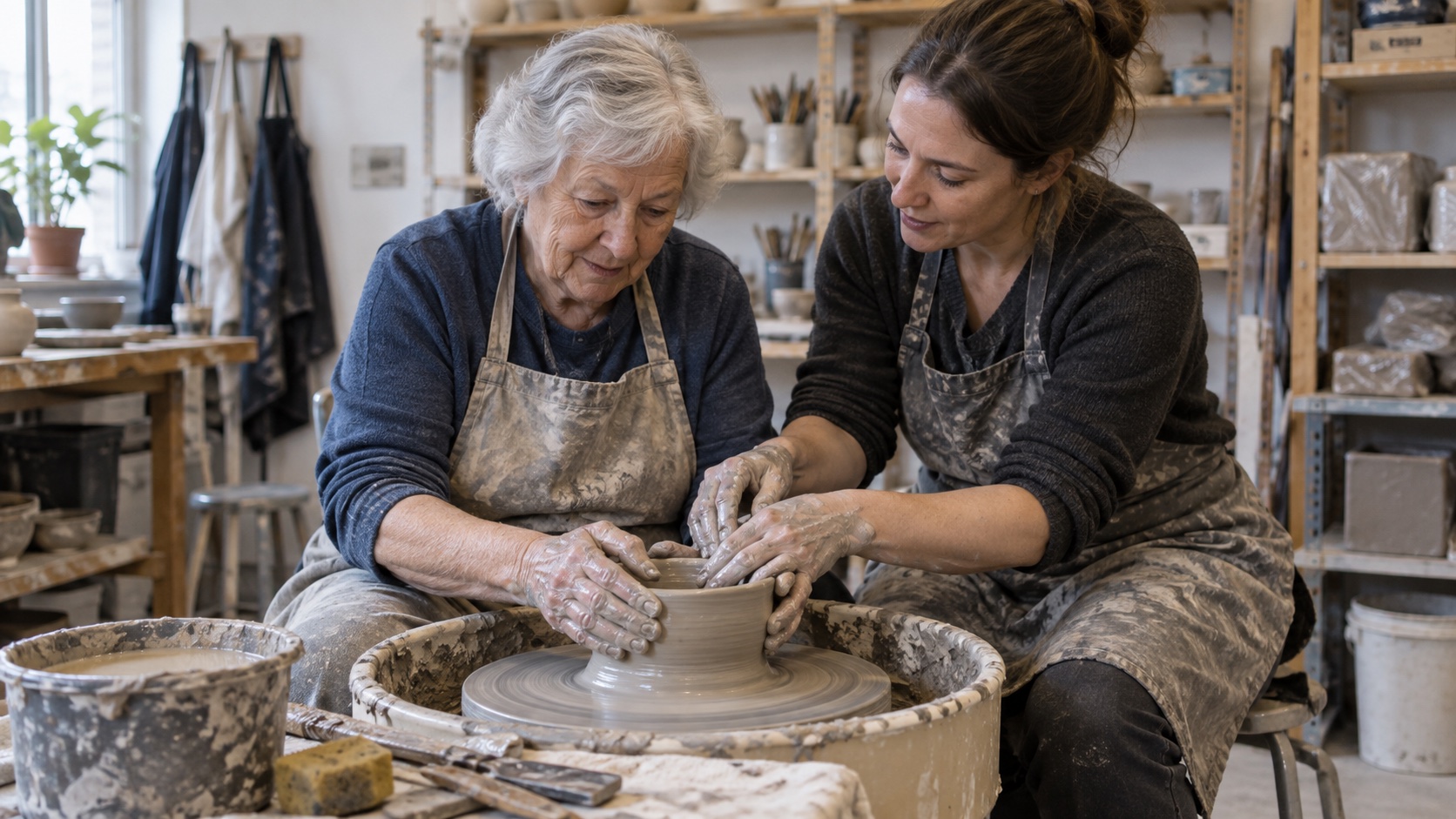
The Deliberate Practice Engine
The foundational paper in this field is famous for a reason. Anders Ericsson and colleagues studied violinists in Berlin and found that what separated the best students from the good ones was not talent but thousands of hours of a specific kind of work: deliberate practice — activity designed by a teacher (or a well-designed program) to improve a specific weak point, performed with full attention and immediate feedback (Ericsson et al., Psychological Review, 1993). What matters is the shape of the work:
- 🎯 It targets a gap. Practice stays just beyond current ability — not where you're already fluent, and not so far out that nothing sticks.
- 👁️ It includes feedback. A teacher, a recording of yourself, a failed rep you can feel — the loop of attempt → error → correction is the engine.
- 🧱 It builds representations. Over time the brain compresses the skill into richer mental structures, which is why experts "see" patterns novices can't.
- 😅 It feels effortful. If practice is comfortable, it's probably not deliberate. The discomfort is the signal, not a bug.
The honest counterweight: a large meta-analysis of 88 studies found deliberate practice explains only part of expert performance — roughly a quarter of the variance in chess and music, less in education and professions (Macnamara et al., Psychological Science, 2014). Practice is necessary but not sufficient; age of starting, working-memory capacity, and coaching all matter. The practical reading is not "practice doesn't work" — it's "practice is the lever you control."
Product picks are generic categories, not brands. We may earn a commission on Amazon or iHerb purchases at no cost to you — this never changes our evidence conclusions. Full disclosure
Book or skill-learning workbook
Can support sustained reading or structured skill practice.
⚠️ None expected; a product cannot prevent dementia or replace assessment of new cognitive symptoms.
Check price on Amazon →What Age Actually Changes
Aging does real things to the learning apparatus — no honest account skips them. Processing speed drifts down from midlife, working memory holds a little less, and learning a brand-new motor pattern takes more repetitions. The How the Brain Ages topic owns the biology; the skill-acquisition translation is narrower and more useful:
- 🐢 Slower early reps. The first hours of a novel skill feel stickier; errors repeat more before they disappear.
- 📦 Less raw working-memory bandwidth. Holding five new pieces of a task at once is harder, which is why breaking skills into pieces pays more at 60 than at 20.
- 🔁 More interference between new and old habits. Established routines compete harder with fresh ones; old wiring doesn't just fade.
- ⏳ Slower consolidation without sleep. New skills need sleep to stick at every age, and the Sleep pillar shows why the margin matters more when the margin for error is thinner.
What Age Doesn't Take
The encouraging half of the literature is just as consistent. Krampe and Ericsson studied expert pianists across the age span and found that skill-level differences tracked practice amount, not age: older pianists who kept up deliberate daily practice maintained performance on the most difficult repertoire, while decline appeared mainly in those who had cut practice (Krampe & Ericsson, Journal of Experimental Psychology: General, 1996). The same pattern repeats in chess, typing, and sports. Three assets actually grow with age:
- 🗺️ Schemas to hang things on. A new skill that resembles anything you've done before arrives with pre-built scaffolding — the single largest offset to slower raw speed.
- 🪞 Metacognition. Decades of self-observation mean older learners are often better at knowing what they don't know, and better at picking practice that targets it.
- 🧭 Motivation that survives plateaus. Adults learning by choice (not curriculum) show persistence patterns younger students often lack — the exact predictor the deliberate-practice literature says matters.
The "testing-the-limits" research program (Baltes and colleagues, 1980s–90s) made the point experimentally: with extended practice and supportive conditions, healthy older adults reached performance levels in a trained memory skill that matched untrained young adults — proof that the ceiling is farther away than baseline tests suggest. The Neuroplasticity topic covers the machinery underneath that finding.
The Synapse Project: Demanding Learning vs. Socializing
The study that moved this from theory to public-health practice is the Synapse Project (Park et al., Psychological Science, 2014). Healthy adults aged 60–90 were randomly assigned to 15 hours a week for three months of one of several conditions: learning digital photography, learning quilting, or — the critical comparisons — a social group that did fun activities together (cooking, watching movies, field trips) and a "placebo intellectual" group doing easy word games at home. The result, stated carefully: only the two demanding learning conditions produced gains in episodic memory, and the photography group — the most novel and difficult skill — showed the largest improvements, including in participants in their 80s. The social group enjoyed themselves and gained nothing measurable. The lesson is not "socializing is useless" (the social-glue page shows why groups still matter); it's that cognitive demand is the active ingredient.
The Mechanisms Underneath
What is the brain doing during those 15 weekly hours? Three mechanisms have the strongest support, mostly from animal work echoed in human imaging:
- 🔌 Synaptic remodeling. Intense skill learning builds and prunes connections in the relevant circuits — the literal meaning of "rewiring."
- 🛣️ Myelination and white-matter change. London taxi drivers studying for "the Knowledge" showed measurable hippocampal growth (Maguire et al., PNAS, 2000) — structural change from navigation learning in adults.
- 🧴 Neurotrophin release. Novel demanding learning elevates BDNF, a growth factor that supports plasticity — one of the ways exercise and learning share a currency.
Design Rules That Fall Out of the Science
Translate the literature into practice and a short set of rules appears. The 15-minutes-daily page turns these into a schedule; here is the evidence table:
| Rule | What it looks like in practice | Evidence |
|---|---|---|
| 🧱 Demand, don't coast | Practice the part you can't do yet, not the part you can; add difficulty as soon as a step feels automatic | Strong |
| 📅 Distribute, don't cram | Short daily sessions beat weekly marathons for retention at every age studied | Strong |
| 🔁 Retrieve, don't reread | Close the book and try to reproduce; self-testing outperforms re-studying | Robust |
| 🛏️ Sleep on it | New skills consolidate during sleep; late-night cramming trades today's reps for tomorrow's retention | Strong |
| 🏋️ Expect the plateau | Progress is stepwise, not linear; plateaus precede breakthroughs, and switching method (not quitting) is the tested response | Moderate |
The Honest Limits
Three cautions keep this literature in proportion. First, the Synapse findings are one randomized comparison with modest sample size — promising, not settled. Second, no trial has yet shown that skill learning reduces dementia incidence; the jump from "memory improves" to "disease risk falls" is exactly the jump the Lancet risk-factors page handles with stricter standards. Third, motivation is the rate limiter: the benefits in every study above belong to people who actually did the hours. The science of skill acquisition supports the learner who shows up; it does not drag anyone to the chair.
⚠️ Skill learning is a cognitive investment, not a dementia vaccine
The honest position: demanding new learning is among the best-supported ways to improve measured cognition in later life, and its dementia-prevention claim remains unproven in trials. Treat it as compounding interest on brain function — worth collecting regardless of what the disease-prevention studies eventually conclude. And if you notice memory or function changes that feel beyond "rusty," that's a clinician conversation, not a curriculum problem.
The Bottom Line
- The engine is deliberate practice — effortful, feedback-rich work just beyond current ability; age doesn't disable it, it changes the optimal design.
- Age costs speed, not capacity — older learners start slower but compensate with scaffolding, metacognition, and persistence, and maintain expert skill with continued practice.
- Demand is the active ingredient — in the Synapse Project, demanding learning moved memory in 60–90-year-olds while pleasant socializing alone did not.
- Design beats volume — distributed, retrieval-heavy, sleep-supported practice at the edge of ability beats more hours of comfortable repetition, at any age.
Related Topics
- Ericsson, Krampe & Tesch-Römer, "The role of deliberate practice in the acquisition of expert performance," Psychological Review (1993)
- Macnamara, Hambrick & Oswald, "Deliberate practice and performance in music, games, sports, education, and professions: a meta-analysis," Psychological Science (2014)
- Krampe & Ericsson, "Maintaining excellence: deliberate practice and elite performance in young and older pianists," Journal of Experimental Psychology: General (1996)
- Park et al., "The impact of sustained engagement on cognitive function in older adults: the Synapse Project," Psychological Science (2014)
- Maguire et al., "Navigation-related structural change in the hippocampi of taxi drivers," PNAS (2000)
- Lövdén, Bäckman, Lindenberger, Schaefer & Schmiedek, "A theoretical framework for the study of adult cognitive plasticity," Psychological Bulletin (2010)