Cardio vs Strength: What Actually Matters More
The internet argues about cardio versus strength like a sports rivalry; the research literature does not contain the match. No trial randomizes people to one mode and waits for them to die. What exists is consistent cohort evidence that each mode carries its own associations with living longer — and a practical question: with limited hours, what should win?
What the evidence supports
- Muscle-strengthening activity is associated with a 10–17% lower risk of death and major disease, independent of aerobic activity, across 16 pooled cohorts (Momma et al., 2022).
- In pooled cohorts of 370,256 participants, resistance training alone tracked with 21% lower all-cause mortality, and combined aerobic-plus-resistance with 40% lower (Saeidifard et al., 2019).
- Concurrent training does not meaningfully compromise maximal strength or muscle size in pooled trial data; explosive power takes a modest hit (Schumann et al., 2022).
What remains uncertain
- Which mode is "better" — never tested head-to-head in a randomized trial; the cohorts cannot settle order-of-addition.
- Mode-specific mortality figures rest on observational designs, self-reported activity, and healthy-user confounding.
- Interference in trained lifters is conditional and modest; its long-run importance for health, as opposed to performance, is not well studied (Petré et al., 2021).
Evidence last reviewed: October 7, 2026. Conclusions may change as new research is published.
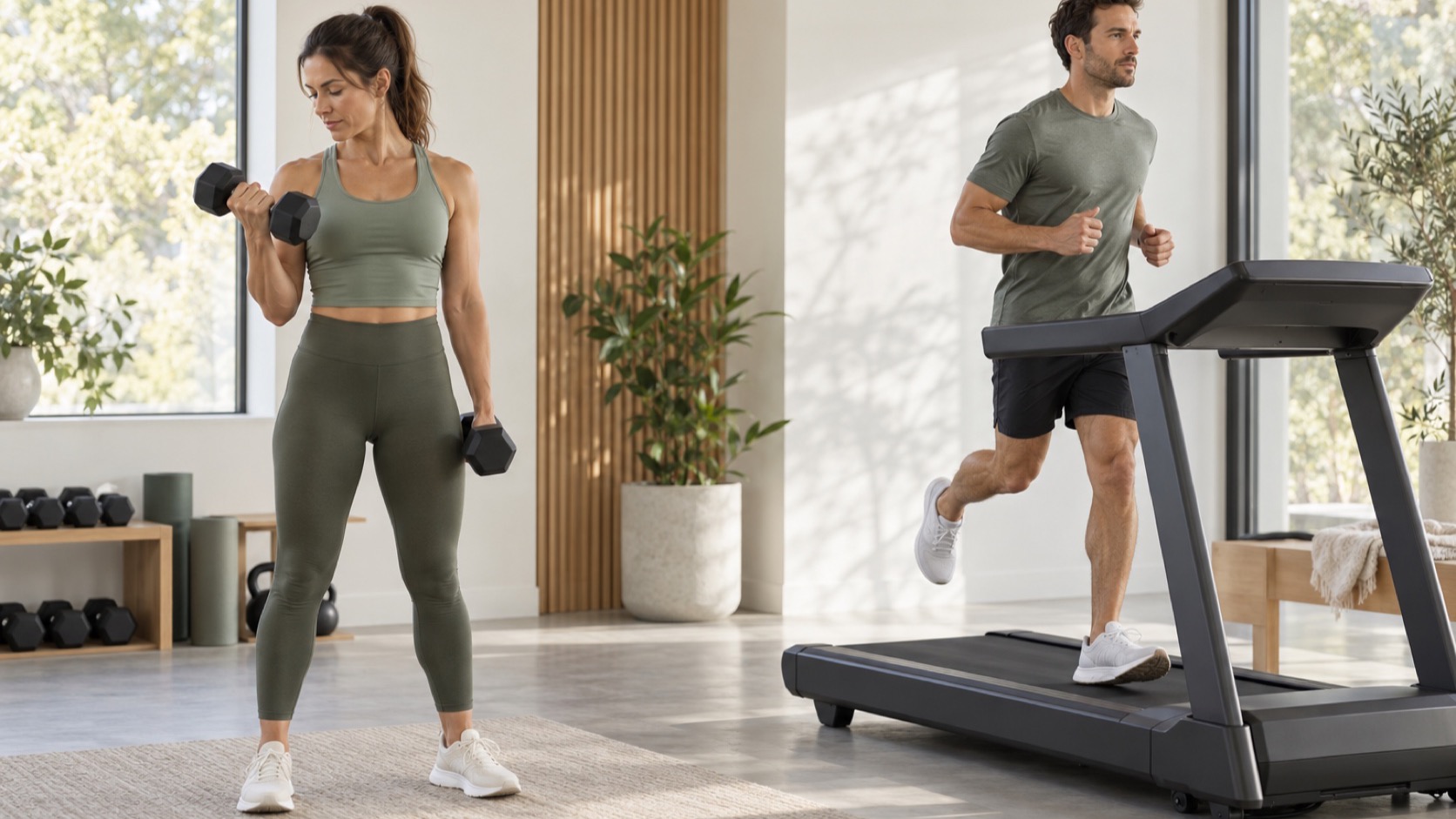
Where the Question Comes From
Guidelines ask for both modes: 150–300 weekly minutes of moderate aerobic activity (or 75–150 vigorous) plus muscle-strengthening work on two or more days (WHO, 2020). They pointedly do not rank the two — which leaves a tiebreaker to be found, and an industry happy to supply it.
A second, subtler question folds in: if you do both, does the cardio cut into strength gains, or the strength into aerobic fitness? So "cardio versus strength" is really two questions — which mode protects you more, and does combining them blunt either one.
What Each Mode Buys
Aerobic training owns the deepest mortality dose-response. It raises cardiorespiratory fitness (see the VO2 max topic), lowers blood pressure, and improves insulin sensitivity — the longest track record of the modes.
Muscle-strengthening training covers the outcomes aerobic work cannot reach. Resistance loading is what preserves muscle mass and strength — the substrate of standing up, carrying groceries, and catching yourself — and it loads bone in a way cycling and swimming do not. Its mortality signal is younger: the pooled 10–17% lower risk survived adjustment for aerobic activity — lifting added something on top.
- 🫀 Overlap is larger than the rivalry suggests: both modes move blood pressure, insulin sensitivity, and body composition; the "two separate systems" story is oversold.
- 🦴 Strength's distinct claim is structural: muscle, bone, and balance outcomes ride on loading — the strength after 40 topic maps that territory.
- 🏃 Cardio's distinct claim is the fitness ceiling: the aerobic machinery sets how much capacity you carry into late life.
- 🗺️ The full map is a subtopic: What each mode buys goes outcome by outcome.
The Head-to-Head Evidence
No trial compares the modes directly, so the question gets answered by inference from two shapes of data. The first asks whether muscle-strengthening activity matters independently of aerobic activity: pooling 16 prospective cohorts, Momma and colleagues found 10–17% lower risk of death, cardiovascular disease, total cancer, diabetes, and lung cancer — after adjusting for aerobic activity (Momma et al., 2022, BJSM). The association was J-shaped.
The second shape asks what happens when you combine the modes: pooling 11 studies and 370,256 participants, Saeidifard and colleagues found resistance training alone tracking with 21% lower all-cause mortality, and combined aerobic-plus-resistance with 40% lower (Saeidifard et al., 2019).
Read those bars carefully. The lowest pooled estimate belongs to combined training — but it is not a randomized comparison, and it cannot tell you whether adding cardio to a lifting habit beats a second lifting day. Cancer mortality showed no clear association, and non-fatal events were too thin to pool. The dissection is the head-to-head subtopic's job.
The Dose Curves
Both modes have dose shapes worth knowing. For aerobic activity, the guideline band (150–300 moderate minutes weekly) sits on a curve whose steepest section is the first 150 minutes. For muscle-strengthening activity, the pooled curve peaks early: maximum risk reduction around 10–20% at roughly 30–60 minutes per week — a J-shape, not a straight line (Momma et al., 2022). Diabetes behaved differently, with large reductions up to about 60 minutes weekly.
- 📈 Strength fits in tiny slots: 30–60 minutes weekly — two or three short sessions.
- 🏃 Aerobic rewards the first 150 minutes most: a population floor, not a personal optimum; the curve keeps rising modestly past it.
- ⚠️ Curves describe groups: population-level associations, never promises about one person's risk — the dose-curves subtopic keeps the axes honest.
Does Cardio Blunt Strength Gains?
The interference effect is this question's practical core, and its reputation traces to one 1980 study: men who added running to a lifting program gained less leg strength than men who lifted alone (Hickson, 1980). That hardened into gym folklore the modern meta-analyses do not back. Schumann and colleagues pooled 43 studies and found essentially no deficit in maximal strength or muscle size when endurance work was added; only explosive power dipped, worst in same-session training (Schumann et al., 2022).
Petré and colleagues found where the signal lives: interference appeared in already trained individuals, driven almost entirely by same-session pairing — a clear negative effect within one workout, nothing when sessions were separated (Petré et al., 2021). Untrained participants showed none.
- ⏰ Separate by three or more hours: or use different days; same-session stacking is the pooled data's main villain.
- 🥇 Priority first: on a combined day, do the session whose goal matters more while you are fresh.
- 🏋️ Cap endurance volume if strength is the goal: the negative signal grew with endurance volume, not mere presence.
- 🔀 The audit continues here: The interference effect, audited walks study by study.
How to Decide: Decision Rules
No trial crowns a winner, so decisions come from what each mode protects and what you will sustain. The table is a reasoning aid, not a prescription: protect a little of each rather than perfecting one.
| If this is you | Lean toward | The honest reasoning | Evidence |
|---|---|---|---|
| 🫀 Protecting against death and heart disease is the priority | Aerobic base + 2 strength days | Aerobic leads the mortality curve; strength adds an independent 10–17% lower risk on top (Momma et al., 2022) | Strong |
| 💪 Muscle, bone, and daily function matter most to you | Strength first | Resistance loading preserves muscle and bone; cardio cannot cover those outcomes (see strength after 40) | Strong |
| ⏱️ About two hours a week, total, is realistic | 1–2 full-body strength sessions + aerobic on the rest | Two sessions capture much of the strength signal; aerobic takes the leftover minutes | Moderate |
| 🏋️ Already a devoted lifter | Add aerobic work — separated from heavy days where possible | Lifting does not offset the aerobic mortality association; interference mainly appears with same-day stacking (Petré et al., 2021) | Moderate |
| 🏃 Already a devoted runner or cyclist | Add 2 short strength days | Muscle, bone, and function ride on loading; interference for non-maximal goals looks small (Schumann et al., 2022) | Moderate |
⏱️ The prioritization takeaway
The evidence does not support the idea that one mode makes the other unnecessary — the lowest pooled mortality estimates belong to those who did both. If hours are scarce: some strength every week (it is hardest to get back), aerobic minutes as the week allows, and session separation when strength matters to you. If you have a cardiovascular condition or are returning after a break, clinician clearance comes before any schedule. Where it all lands in a calendar is the 3-2-1 formula's territory; If you only had time ranks the trade-offs.
Questions, Answered Briefly
- Can cardio replace lifting? Not for muscle, bone, and function — the strength–mortality association also survived adjustment for aerobic activity (Momma et al., 2022).
- Can lifting replace cardio? Not established, and it looks unlikely: the aerobic dose-response is the deeper curve, and combined patterns show the lowest pooled estimates.
- Which mode is better for the heart? Both associate with lower cardiovascular risk; the pooled combined figure (40% lower) is the largest, but observational.
- What is the true minimum? Something in both slots most weeks — two short full-body strength sessions plus aerobic minutes your schedule will defend.
- Does the order within a week matter? Less than within-day separation — see the weekend warrior topic.
The Bottom Line
- It is not a prizefight: no trial has put cardio and strength head-to-head for mortality; the defensible answer is "both, sized to your goals and your week."
- Strength earns its slot independently: 10–17% lower risk across major outcomes after aerobic adjustment (Momma et al., 2022); the lowest pooled mortality estimates belong to combined training (Saeidifard et al., 2019).
- The interference worry is mostly conditional: strength and muscle size survive concurrent training in the pooled data; trained lifters should keep hard endurance out of the same session as heavy lifting (Schumann et al., 2022; Petré et al., 2021).
- Treat the guideline as a floor: 150–300 aerobic minutes plus 2+ strength days (WHO, 2020), with strength's association peaking around 30–60 minutes weekly — small doses, large returns.
Go Deeper: Subtopics
- 📊 The Head-to-Head Evidence — the cohort showdown dissected: the adjustments, and what the hazard ratios do and do not license. Read it →
- 🗺️ What Each Mode Buys — outcome by outcome: CVD, cancer, diabetes, cognition, bone, mood, falls. Read it →
- 📈 The Dose Curves — the shape of the response for each mode, and what the guidelines are really for. Read it →
- 🔀 The Interference Effect, Audited — does cardio blunt strength? The full audit and the separation rules. Read it →
- ⏳ If You Only Had Time — a prioritization framework for tight weeks: by goal, age, and constraint. Read it →
Related Topics
- Momma H, Kawakami R, Honda T, Sawada SS, "Muscle-strengthening activities are associated with lower risk and mortality in major non-communicable diseases: a systematic review and meta-analysis of cohort studies," British Journal of Sports Medicine (2022)
- Saeidifard F, Medina-Inojosa JR, West CP, et al., "The association of resistance training with mortality: A systematic review and meta-analysis," European Journal of Preventive Cardiology (2019)
- Schumann M, Feuerbacher JF, Sünkeler M, et al., "Compatibility of Concurrent Aerobic and Strength Training for Skeletal Muscle Size and Function: An Updated Systematic Review and Meta-Analysis," Sports Medicine (2022)
- Petré H, Hemmingsson E, Rosdahl H, Psilander N, "Development of Maximal Dynamic Strength During Concurrent Resistance and Endurance Training in Untrained, Moderately Trained, and Trained Individuals: A Systematic Review and Meta-analysis," Sports Medicine (2021)
- Bull FC, Al-Ansari SS, Biddle S, et al., "World Health Organization 2020 guidelines on physical activity and sedentary behaviour," British Journal of Sports Medicine (2020)
- Hickson RC, "Interference of strength development by simultaneously training for strength and endurance," European Journal of Applied Physiology and Occupational Physiology (1980)